
Home buying emotional stress management is the practice of using targeted financial, psychological, and behavioral strategies to reduce anxiety throughout the purchase process. Surveys show home buying ranks as more stressful than dating, starting a new job, or beginning college, with 65% of buyers losing sleep and 42% reporting family conflicts during the process. That stress is predictable, and it is manageable. This guide gives you specific techniques, grounded in expert research, to stay clear-headed from pre-approval through closing day.
What triggers emotional stress in first-time homebuyers?

Anxiety during home buying is a rational response to a complex, high-stakes process. It is not a sign of weakness or inexperience. Understanding the specific triggers helps you address each one directly instead of feeling overwhelmed by a vague sense of dread.
The most common stress triggers for first-time buyers include:
- Financial uncertainty. A home purchase is likely the largest financial commitment of your life. Down payments typically range from 3% to 20% of the purchase price, and hidden costs like property taxes, HOA fees, and maintenance add up fast. Not knowing your true ceiling creates constant low-grade anxiety.
- Unfamiliar terminology. Terms like earnest money, title insurance, contingencies, and escrow are not part of everyday vocabulary. Unanswered questions about jargon are a primary source of anxiety for first-time buyers. Confusion breeds hesitation, and hesitation costs you offers.
- Decision fatigue. Viewing dozens of listings without a clear filter system drains your mental energy fast. Excessive listing views overwhelm buyers and make every choice feel harder than it needs to be.
- Emotional attachment to outcomes. Home carries deep psychological meaning. When a bid falls through, it does not just feel like a lost transaction. It feels personal.
- Timeline uncertainty. Escrow periods, inspection delays, and lender processing times are hard to predict. Not knowing when the process ends keeps your nervous system in a state of low-level alert.
- Relationship pressure. Money worries drive the majority of relational conflicts during home buying. Couples and families often disagree on priorities, price, or neighborhoods, adding interpersonal stress on top of an already demanding process.
Recognizing these triggers is the first step. Each one has a direct countermeasure, covered in the sections below.
How can financial planning reduce home buying stress?
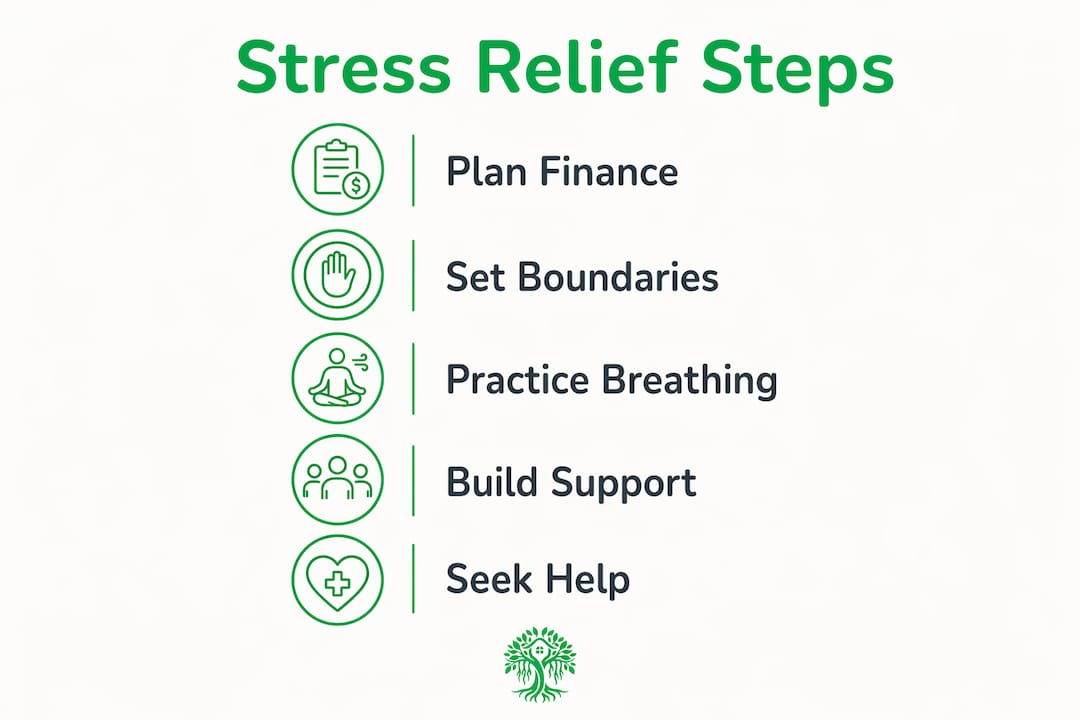
Financial clarity is the single most effective stress-reduction tool available to a first-time buyer. When you know your exact budget, your anxiety has less room to grow.
-
Get full mortgage pre-approval, not just pre-qualification. Pre-qualification is a rough estimate based on self-reported numbers. Full pre-approval verifies your income, assets, credit, and debt with actual documentation. It locks in your budget, speeds up underwriting, and makes your offers significantly stronger. Pre-approval removes the single biggest unknown before you ever walk into an open house.
-
Build a budget that includes reserves. Your budget is not just the purchase price. Calculate your full PITI (principal, interest, taxes, and insurance), add HOA fees if applicable, and factor in a maintenance reserve. Build a 3–6 month reserve fund on top of your down payment. Knowing you have a financial cushion changes how you feel about every decision.
-
Set a maximum offer price before you start searching. Decide your ceiling in advance and commit to it in writing. Emotional attachment to a specific property will push you past your limit if you have not already drawn the line. A pre-set maximum protects you from yourself in the heat of a bidding situation.
-
Define your non-negotiables before viewing listings. Decide in advance which features are required and which are preferences. Filtering listings by clear priorities reduces decision fatigue and buyer’s remorse compared to viewing every available property.
Pro Tip: Ask your lender to walk you through the full loan estimate line by line before you sign anything. Every number should make sense to you in plain English. If it does not, ask again.
What emotional self-care techniques ease acute anxiety during homebuying?
Financial preparation handles the logical side of stress. Your nervous system also needs direct support. These techniques work in real time, during open houses, after a lost bid, or on a sleepless night before closing.
- 4-4-4 breathing. Inhale for four counts, hold for four counts, exhale for four counts. Grounding techniques like 4-4-4 breathing lower sympathetic nervous system arousal within minutes. Use it before entering a competitive open house or after receiving bad news from your agent.
- 5-4-3-2-1 sensory grounding. Name five things you can see, four you can hear, three you can touch, two you can smell, and one you can taste. This technique pulls your attention out of anxious future-thinking and anchors it in the present moment.
- Daily movement anchor. Twenty minutes of physical activity resets your emotional baseline. It does not need to be a gym session. A brisk walk around the block after a stressful call with your lender is enough to shift your state.
- Regular meals and scheduled breaks. Skipping meals while rushing between showings compounds stress. Daily anchors like regular meals and 10 minutes of pleasure maintain emotional stability across a process that can last months.
- Sleep hygiene as a non-negotiable. Maintaining sleep hygiene reduces decision fatigue and supports clearer thinking throughout the buying process. A consistent bedtime, a dark room, and no screens for 30 minutes before sleep are the minimum. Poor sleep turns manageable stress into a crisis.
Pro Tip: Schedule one “no real estate” evening per week. No listings, no lender emails, no neighborhood research. Your brain needs recovery time to make good decisions the rest of the week.
Emotional wellness during home buying is not a luxury. It is a performance requirement. Buyers who are rested and regulated make better offers, negotiate more clearly, and recover faster from setbacks.
How to build a supportive network and get professional help
No first-time buyer should navigate this process alone. The right people around you reduce both the practical and emotional load.
- Work with a buyer’s agent who communicates proactively. Real estate professionals confirm that first-time buyer anxiety is a natural reaction. The goal is not to eliminate anxiety but to prevent it from paralyzing your decisions. An agent who explains each step before it happens gives you a map instead of a maze. Check out the home buying timeline to understand what to expect at each stage.
- Ask for plain-language explanations every time. Asking for plain-language translations of real estate jargon directly reduces stress levels. You are paying for professional guidance. Use it fully.
- Talk openly with your partner or family. Use time-limited discussions anchored on shared values rather than open-ended arguments about price or location. Agree to a 20-minute conversation with a clear agenda, then stop. This structure prevents money conversations from spiraling.
- Know when to bring in a counselor or financial advisor. If anxiety is affecting your sleep, your relationships, or your ability to make decisions for more than two weeks, a licensed counselor or financial planner is a worthwhile investment. Emotional validation from a professional is not a sign that the process is too hard. It is a sign you are taking it seriously.
The first-time buyer emotional pitfalls guide covers specific mistakes that compound stress, including the ones most buyers do not see coming.
What are common pitfalls and how to avoid them?
Most home buying anxiety spikes are predictable. These are the mistakes that cause the worst of it, and how to sidestep each one.
-
Confusing pre-qualification with pre-approval. Pre-qualification gives you a ballpark. Pre-approval gives you a verified number. Buyers who start searching with only a pre-qualification often discover their real budget is different mid-process, which is a significant emotional shock.
-
Letting emotion override your price ceiling. Falling in love with a property that is $30,000 over your maximum is one of the most common home buying emotional challenges. Set your ceiling before you start viewing, and treat it as fixed.
-
Avoiding questions out of embarrassment. First-time buyers often hesitate to ask about loan terms, inspection findings, or contract language because they do not want to appear inexperienced. Every unanswered question becomes a source of anxiety. Ask everything.
-
Refusing to take breaks. Taking breaks and accepting imperfection lowers stress during home buying. Flexibility and stepping away briefly reset your perspective. Buyers who treat every weekend as a mandatory search session burn out within weeks.
-
Ignoring sleep and self-care during the final stretch. The period between accepted offer and closing is the most administratively intense. It is also when buyers most often abandon their routines. Skipping sleep and exercise during escrow leads to poor decisions on inspection negotiations and loan terms.
| Pitfall | Smarter approach |
|---|---|
| Pre-qualification only | Get full pre-approval before searching |
| No price ceiling set | Commit to a maximum offer price in writing |
| Skipping questions | Ask for plain-language explanations at every step |
| No scheduled breaks | Block one “no real estate” evening per week |
| Ignoring self-care in escrow | Protect sleep and movement routines through closing |
Key takeaways
Effective home buying emotional stress management combines financial preparation, grounding techniques, and a trusted support network to keep anxiety from derailing your decisions.
| Point | Details |
|---|---|
| Pre-approval first | Full mortgage pre-approval removes the biggest financial unknown before you search. |
| Set a price ceiling early | Commit to your maximum offer price in writing before viewing any property. |
| Use grounding techniques | 4-4-4 breathing and sensory naming lower acute anxiety within minutes. |
| Protect sleep and routine | Sleep hygiene and daily movement reduce decision fatigue across the full process. |
| Ask every question | Plain-language explanations of jargon directly reduce stress for first-time buyers. |
What I have learned about stress and the home buying process
Anxiety during home buying is not a malfunction. It is your brain correctly identifying that this decision is large, complex, and consequential. The problem is not the anxiety itself. The problem is when buyers treat it as a signal to freeze rather than a signal to prepare.
The buyers I have seen navigate this process most confidently share one trait: they do their homework early and they ask questions without apology. They get pre-approved before they fall in love with a neighborhood. They set their price ceiling before they walk into an open house. They build a support team that includes their agent, their lender, and at least one trusted person who has no financial stake in the outcome.
What surprises most first-time buyers is how much the emotional load lightens once the financial picture is clear. Uncertainty is the fuel for anxiety. Clarity is the antidote. When you know your exact budget, your non-negotiables, and what happens at each stage of the process, the fear of the unknown shrinks to a manageable size.
One more thing: do not skip the self-care basics because you feel like you do not have time. The buyers who push through exhausted and skipping meals make worse decisions. They overbid, they miss red flags in inspections, and they agree to terms they later regret. Protecting your sleep and your routine is not indulgent. It is part of buying well.
— Anand
How Ficustree helps you buy with less stress

Ficustree is built specifically for first-time buyers in California and Texas who are tired of sorting through noise. The AI-powered platform filters listings to match your actual priorities, so you spend less time scrolling and more time evaluating real options. That alone cuts decision fatigue significantly. Ficustree also represents you directly: you pay $1,000 at closing plus 1% commission and keep a rebate of roughly 2% where permitted. Clear timelines, transparent costs, and on-demand showing agents give you the structure that makes anxiety manageable. Start with your buyer profile on Ficustree and see how much clarity two months of focused searching can create. Or visit ficustree.ai to learn how the platform works.
FAQ
Is anxiety during home buying normal?
Yes. Anxiety is a rational response to a high-stakes, complex process, not a sign of weakness. The goal is to prevent it from paralyzing your decisions, not to eliminate it entirely.
What is the fastest way to reduce acute stress during a showing or bidding situation?
4-4-4 breathing (inhale four counts, hold four counts, exhale four counts) lowers sympathetic nervous system arousal within minutes and requires no tools or preparation.
What is the difference between pre-qualification and pre-approval?
Pre-qualification is a rough estimate based on self-reported information. Pre-approval verifies your income, assets, credit, and debt with documentation, giving you a confirmed budget and stronger offers.
How do I avoid decision fatigue when searching for a home?
Define your non-negotiables before you start viewing listings, then filter strictly by those criteria. Viewing fewer, better-matched properties reduces mental exhaustion and buyer’s remorse.
When should a first-time buyer seek professional mental health support?
If anxiety is disrupting your sleep, relationships, or decision-making for more than two weeks, a licensed counselor is a worthwhile resource. Stress relief for home buyers sometimes requires professional support, and asking for it is a practical choice, not a last resort.