
Finding a home buyer representation platform that truly delivers transparent savings and local support is tougher than it should be. Too many platforms restrict cashback to certain states, rely heavily on opaque commission structures, or limit human-guided service tiers by location. This comparison details pricing, support transparency, and coverage for three alternatives so you can match a platform to your region and budget.
Table of contents
Ficustree

At a glance
According to the company, ficustree matches homes using AI in 30 seconds. That claim signals a fast first pass at narrowing search results for buyers who do not have time to wade through listings. The platform also advertises up to 2% cashback at closing, which the product frames as a direct savings feature for buyers.
Core features
Ficustree bundles several buyer focused tools into a single platform. It provides AI guided home matching, AI disclosure and risk analysis, and guided tours supported by AI assistance. The platform includes mortgage calculators, neighborhood and market insights, lender and service provider matching, and a direct buy pathway that reduces traditional commission friction.
- AI guided home matching in 30 seconds (vendor claim).
- AI disclosure analysis for risk spotting and plain language summaries.
- Neighborhood and ownership cost tools combining market data with affordability models.
- Lender and service provider matching plus hourly showing agents on demand.
Key differentiator
Ficustree’s defining feature is its focus on emotional intelligence in AI driven guidance. The product pairs data signals with prompts and explanations designed to reduce anxiety and cut decision time for first time buyers. That human centered approach aims to convert confusing advice into clear next steps for people unfamiliar with real estate.
Pros
- Human centered approach: The platform surfaces explanations and plain language around offers, disclosures, and affordability so you do not guess what matters next.
- Direct savings at closing: The vendor advertises up to 2% cashback for buyers where allowed, which reduces net purchase cost for eligible transactions.
- Disclosure and risk focus: AI disclosure analysis flags potential concerns in seller documents, helping you prepare inspection and negotiation priorities.
- All in one for buyers and agents: Buyers get mortgage and affordability tools while independent realtors can replace multiple point tools with one platform.
- Hourly showing agents on demand: The platform supports booking shorter showing sessions rather than committing to full agent retainers.
Cons
- Availability is initially limited to California, which restricts the platform for buyers outside that region.
Who it’s for
Ficustree fits first time buyers in California who want a guided, data backed experience and some cashback at closing. It also suits independent realtors who prefer one platform to replace multiple apps and spreadsheets. Investors and homeowners who want neighborhood level data will find its market tools useful.
Unique value proposition
Buyers pay $1,000 at closing plus 1% commission while keeping a rebate of roughly 2% where legally permitted. That structure, combined with a premium platform that buyers can use without an additional subscription fee, changes the economic trade offs of representation. For buyers weighing traditional agent commissions versus a tech first representative, ficustree makes the math explicit and shifts dollars back to the buyer in many cases.
Real world use case
A first time buyer in San Francisco uses ficustree to generate matches, book an hourly showing agent, and run AI disclosure checks on a chosen house. The buyer compares mortgage scenarios inside the same account and negotiates with clarity about inspection priorities. Closing happens with the platform tracking costs and applying a cashback rebate where allowed.
Pricing
The core premium platform is free for buyers to use. Buyers who accept representation pay $1,000 at closing plus 1% commission, with buyers keeping a rebate of roughly 2% where legally permitted. Agents and realtors select from tiered subscription plans that add agent facing features and transaction management.
Website: https://ficustree.ai
Homa
At a glance
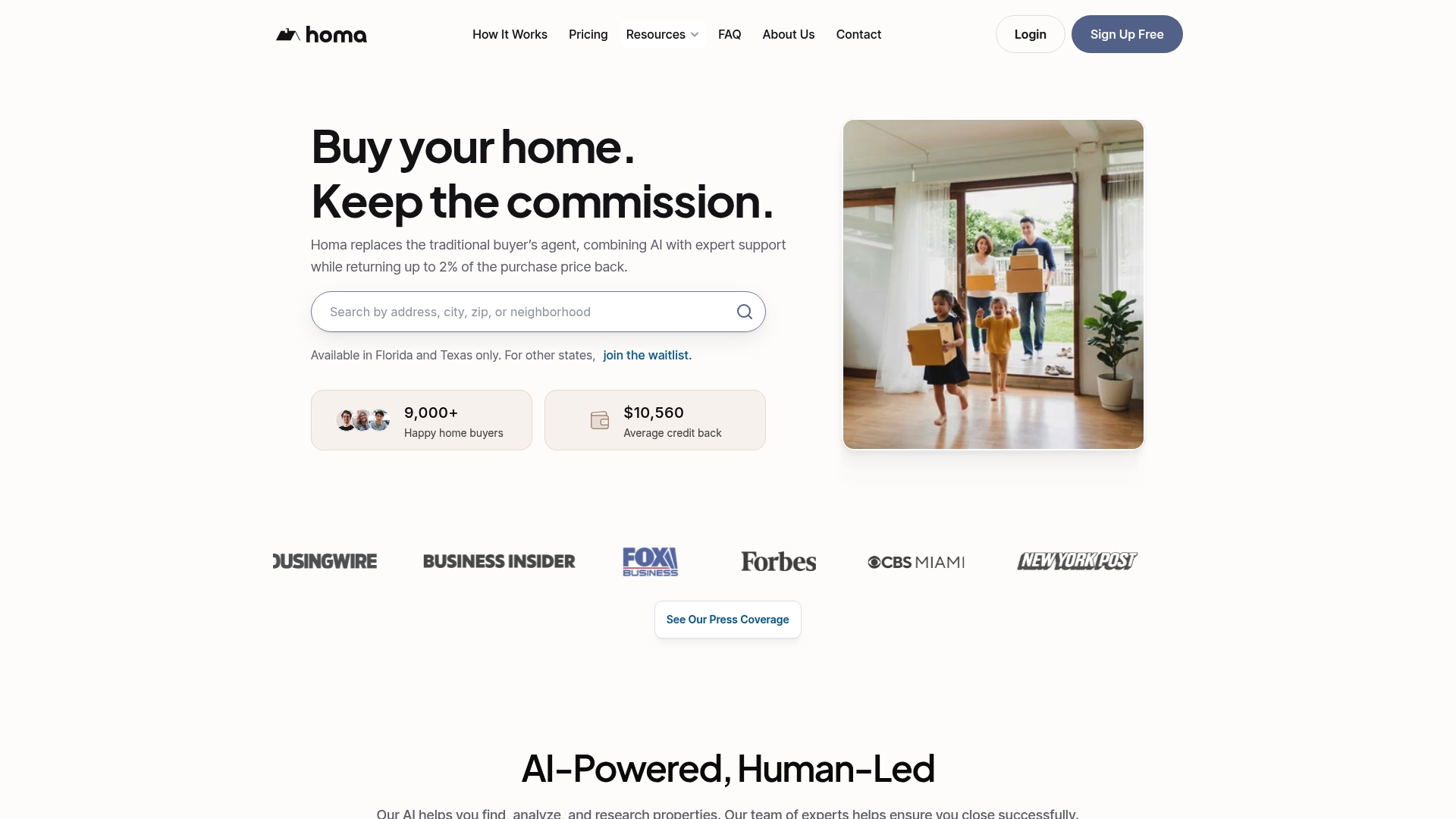
Homa claims up to 2% credited back of the home purchase price at closing. That claim pairs an AI-led property research toolkit with licensed broker review and local showing guides. The platform focuses on lowering buyer costs while keeping human support available depending on the service tier and location.
Core features
- AI-powered property analysis and research tools that help you compare schools, recent sales, and basic price drivers.
- Expert human support for showings, negotiations, and closing coordination so you still talk to licensed professionals when needed.
- Credit of up to 2% at closing that returns a portion of the buyer commission to you, subject to local rules and availability.
- On-demand home tours with local guides who handle in-person viewings when you cannot attend.
- Data-backed offer strategies reviewed by licensed brokers before submission.
Key differentiator
The model pairs algorithmic property research with licensed broker oversight and on-demand local guides. That hybrid approach aims to replace a traditional buyer agent while keeping broker review for offers. The clear financial signal is the credit at closing, which makes cost savings central to Homas pitch.
Pros
-
Significant direct savings. The platforms credited buyer commission reduces out-of-pocket closing costs for buyers who qualify for the credit.
-
Clear, flat fee structure. Homa advertises straightforward fees instead of opaque percentage commissions, which simplifies budgeting for first-time buyers.
-
Tools that speed analysis. The AI tools help you narrow choices and compare comparable sales faster than manual searches.
-
Local showing support. On-demand tours with local guides let you see properties without relying on a full-service agents schedule.
-
Licensed broker oversight. Brokers review and refine offer strategy before submission, which reduces simple offer mistakes.
Cons
-
Limited to Florida and Texas. Buyers outside those states cannot use Homas buyer credits and local services.
-
Sparse third-party reviews. There is limited public sentiment or extensive customer reviews to verify consistent service quality.
-
Relies on third-party data. The platform depends on external feeds that may include errors or out-of-date information.
-
Service quality may vary by market. Local guides and broker responsiveness can differ across cities.
When it may not fit
If you are buying outside Florida or Texas, Homa will not deliver local guides or the buyer credit. If you want a full-service agent who sources off-market listings and runs a traditional local network, this model may feel lean. If you need extensive independent user reviews before you commit, Homa currently offers limited third-party evidence.
Who it’s for
This fits buyers in Florida and Texas who want to reduce transaction costs and use data to make stronger choices. First-time buyers who still want licensed support but do not want full traditional commissions will find the model appealing. Buyers comfortable with some self-directed work plus on-demand human help will get the most value.
Real world use case
According to Homa, DJ, a Tampa first-time homebuyer, saved over $10,500 by using the platform. He used the AI research tools to shortlist properties, booked local guided tours, and had a broker review his offer before submission. The combination delivered professional oversight while returning a portion of the buyer commission at closing.
Website: https://tryhoma.com
Kaboodle
At a glance
Kaboodle’s workflow uses a layered decision process called Kaboodle Golden to pick how deep the system should reason for each query. The platform coordinates multiple specialized models to reduce blind spots in answers. That design targets complex questions that involve tradeoffs, ambiguity, or hidden assumptions.
Core features
Kaboodle runs coordinated reasoning across several specialist models to produce more balanced answers. The system adapts its reasoning depth per query with the Kaboodle Golden controller. It runs on AWS for scalable compute and storage. The platform emphasizes flexible architecture so teams can add or swap component models over time.
Key differentiator
Kaboodle uses explicit multi model coordination to surface varied perspectives before returning an answer. That coordination reduces single model bias by letting specialist models challenge and refine each other. The result is answers that aim to weigh tradeoffs and hidden assumptions rather than present a single confident view.
Pros
- Highly professional support reported by users. The support team often helps with technical onboarding and use questions.
- Efficient query handling for complex scenarios. Users say the platform manages multifaceted prompts without manual orchestration.
- Resilient answer generation through model collaboration. The coordinated approach usually produces more balanced recommendations than a single model.
- Adaptive reasoning depth improves output quality on hard problems. The controller increases effort on ambiguous or high stakes queries.
- Flexible architecture for model upgrades and swaps. Teams can evolve internal models without rebuilding the whole stack.
Cons
- Some users report inconsistent login and account access issues. That problem can block work while support intervenes.
- Ticket release and response times have been slow for certain customers. Delays affect fast moving decision processes.
- A minority of support responses were unhelpful. That experience varies by account and issue complexity.
- Account management and ticketing systems show occasional technical glitches. Those glitches create extra administrative steps for teams.
When it may not fit
Kaboodle does not suit buyers who need a simple single model API for basic tasks. It may be excessive for low complexity applications that only need one reliable model. Organizations with strict uptime or fast support SLAs should test account access and ticket workflows before committing.
Who it’s for
Kaboodle fits enterprises that need nuanced decision support rather than simple answers. It matches teams evaluating tradeoffs, legal risk, or strategic scenarios. If your use requires cross model scrutiny and explainable deliberation, Kaboodle aligns with that need.
Real world use case
A financial services firm uses Kaboodle to evaluate risk scenarios. The firm runs several analytic models in parallel and asks Kaboodle to synthesize their assessments. That synthesis reveals conflicting assumptions and produces a more complete view for senior decision makers.
Pricing
The vendor describes the offering as informational only and does not list commercial pricing in public materials. Prospective buyers should contact the company for deployment, support, and licensing options. Pilot arrangements and enterprise contracts are likely handled case by case.
Website: https://kaboodleai.com
Comparison of alternatives
Selecting the most suitable home-buying representation platform involves assessing individual preferences and the unique advantages each option provides. Each of the following options offers notable strengths; however, identifying the best fit is essential for an experience.
Strengths in local expertise and support
Homa distinguishes itself by combining advanced AI property analysis with professional oversight from licensed brokers. This unique mix allows for a streamlined experience for buyers needing human assurance while navigating complex real estate processes. Moreover, Homa’s availability for professional in-person property tours in Florida and Texas creates convenience for buyers within these regions.
Technical configurations
Kaboodle focuses on delivering detailed and multi-tier AI modeling to manage complex decision-making scenarios. This architecture is beneficial for professionals in strategic fields requiring AI outputs with cross-model validation. The platform’s robustness is best suited for intricate transaction requirements.
Best fit
- Ficustree.ai: An excellent choice for Californian buyers desires an AI-centered platform due to its highly integrated offerings and cashback.
- Homa: Perfect for Florida and Texas residents leveraging professional guidance coupled with customer-friendly financial initiatives.
- Kaboodle: Designed for organizations needing advanced configurational AI setups performing validation and analysis comprehensively.
Our pick
FicusTree.ai emerges as a market leader for Californian first-time buyers seeking an AI-enhanced, user-centric experience married to a strong emphasis on economic benefits. Buyers outside California should evaluate alternatives closely, but for those within the state, its offerings solidify its status as a go-to solution.
Ficustree and its competitors offer distinct advantages and serve different needs within home buyer representation. This comparison helps highlight key differences:
| Product | Key Feature | Best For | Pricing | Notable Limitation |
|---|---|---|---|---|
| Ficustree | AI-guided home matching | First-time buyers in California | Buyers pay $1,000 and 1% commission | Limited to availability in California |
| Homa | AI property analysis | Buyers in Florida and Texas | Flat fee structure; up to 2% credit | Limited to Florida and Texas markets |
| Kaboodle | Multi-model reasoning | Enterprises needing complex analysis | Not disclosed | Complexity might exceed basic needs |
Discover why Ficustree is a leading choice among Kaaboai.com alternatives
If you find yourself overwhelmed by the complex home buying process, especially as a first-time buyer in California or Texas, Ficustree offers a clear path forward. Unlike other platforms, Ficustree combines AI-powered home matching with direct buyer representation, helping you understand affordability, reduce closing costs with up to 2% cashback, and access hourly showing agents on demand. This approach compresses months of confusion into just two months of clarity.

Start turning your uncertainty into confidence with Ficustree’s data-driven guidance tailored just for first-time buyers. Explore how AI and human-centered support simplify every step at ficustree.ai. Take charge of your home purchase and learn the Ficustree way today.
FAQ
What benefits does Ficustree provide for home buyers?
Ficustree offers AI-guided home matching, allowing you to find homes quickly in just 30 seconds. This feature is designed to narrow down your search efficiently, making it easy for first-time buyers to interface with the home-buying process.
How does homa’s cashback compare with ficustree’s?
Homa provides a cashback of up to 2% at closing, which helps lower the overall transaction costs for buyers. While Homa’s model is beneficial, Ficustree also offers a similar cashback feature, providing competitive savings for home buyers who prefer a guided, technology-enhanced experience.
What unique feature does Ficustree provide that homa doesn’t?
Ficustree features AI disclosure analysis that identifies potential risks in seller documents and offers clear summaries. This capability helps you prepare for inspections and negotiations more effectively than Homa’s model, which focuses more on property analysis.
Who is the ideal target audience for homa compared to Ficustree?
Homa suits buyers in Florida and Texas seeking to reduce transaction costs while utilizing some licensed support. In contrast, Ficustree is tailored for first-time buyers in California who want a more comprehensive, data-informed approach with emotional intelligence in decision-making.
How does the service area of Ficustree limit its availability?
Ficustree is initially limited to California, which restricts its service for buyers located in other regions. While it’s ideal for California residents, those outside may want to explore alternatives like Homa, which serves Texas and Florida.