
Neighborhood research for first-time buyers is the structured process of evaluating schools, safety, commute, amenities, and community values before committing to a home purchase. In California, where coastal metro prices and intense competition leave little room for costly mistakes, getting this process right matters more than in almost any other U.S. market. The difference between a neighborhood that fits your life and one that frustrates you daily comes down to how thoroughly you research before you sign. This guide gives you a practical, California-focused framework to do exactly that.
What tools should first-time buyers use to research neighborhoods?
The best neighborhood research combines government data, real estate platforms, and on-the-ground observation. No single tool gives you the full picture, but the right combination gets you close.
Online data sources worth bookmarking
Start with California-specific public resources. The California Department of Education’s School Finder tool lets you look up exact school assignments by street address, which matters because school boundaries rarely align with neighborhood names on a map. For safety data, local police department open-data portals, such as the Los Angeles Police Department’s crime mapping tool or the San Francisco Police Department’s public incident reports, show crime patterns by type and location. These are more granular than third-party aggregators and reflect actual reported incidents in your target area.
For real estate market context, platforms like Ficustree layer neighborhood-level data directly onto property searches, so you can evaluate listings and community attributes at the same time rather than toggling between a dozen tabs. For region-specific context, resources like the San Diego neighborhoods guide from local specialists add qualitative color that raw data cannot.
| Research Category | Recommended Tool | What It Tells You |
|---|---|---|
| School boundaries | CA Dept. of Education School Finder | Exact school assignment by address |
| Crime patterns | Local PD open-data portals | Incident type, frequency, and location |
| Commute times | Google Maps “Depart at” feature | Rush-hour travel time by mode |
| Community vibe | Nextdoor, local Facebook groups | Resident concerns, events, and culture |
| Zoning and land use | County assessor or planning portal | Future development risk near your address |
Pro Tip: Set Google Maps to “Depart at” with a Monday morning timestamp to simulate your actual commute. A route that takes 22 minutes at noon can take 55 minutes at 8 a.m. in the Bay Area or Los Angeles.
Commute testing during rush hour consistently produces more accurate estimates than single casual checks, and that accuracy directly shapes whether a neighborhood actually fits your daily life.
For community values, check HOA websites if applicable, browse local event calendars on city government pages, and spend time in neighborhood-specific Facebook groups or Nextdoor. Residents discuss everything from parking frustrations to school fundraiser culture, and those conversations tell you more about a neighborhood’s character than any data set.
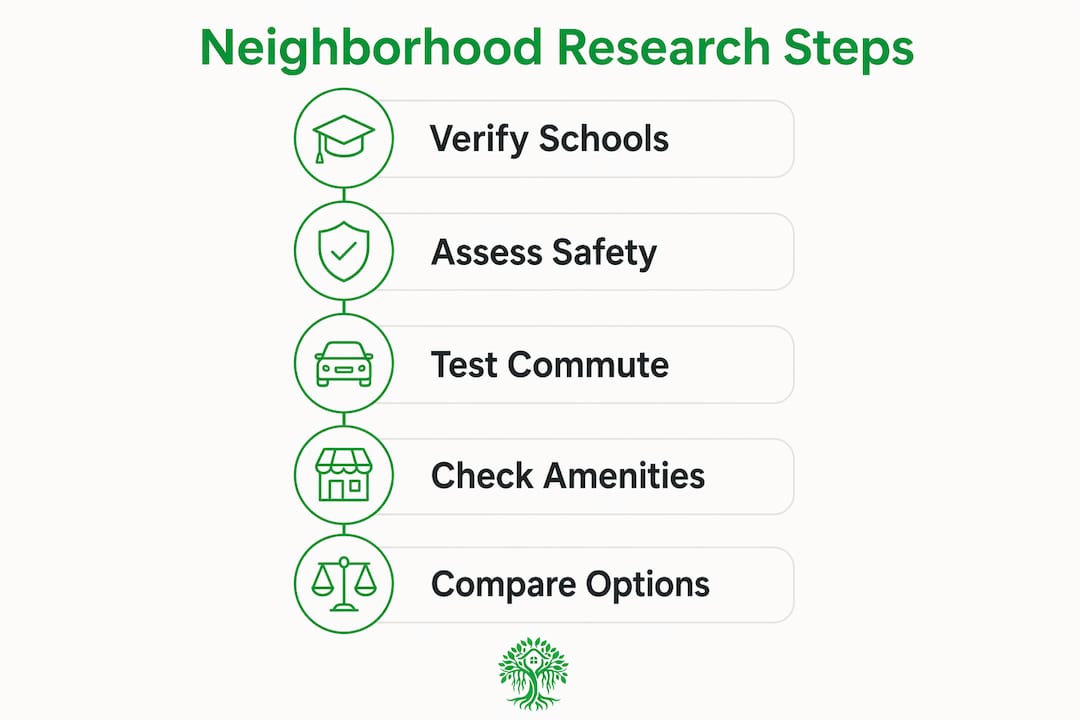

How to evaluate key neighborhood factors step by step
A structured approach prevents you from missing factors that only surface after you move in. Work through these six steps for every neighborhood you seriously consider.
-
Confirm school boundaries at the address level. Do not rely on neighborhood-level school ratings. School rating aggregators are useful for initial screening, but boundaries shift and catchment zones are specific. Enter the exact property address into the California Department of Education’s School Finder to confirm which schools serve that home. A house one block outside a sought-after boundary is a fundamentally different purchase than one inside it.
-
Review crime data across multiple time frames. Pull at least 12 months of incident data from the local police department’s open portal. Look for trends rather than snapshots. Crime maps show patterns and hotspots, but reported incidents also reflect local reporting practices, so cross-reference with community-police meeting notes and neighborhood watch group activity for a balanced read.
-
Visit the neighborhood at different times and days. A Saturday afternoon visit tells you almost nothing about Tuesday morning traffic or Friday night noise levels. Multiple visits at varied times reveal the real rhythm of a neighborhood. Walk the streets at 7 a.m. on a weekday, return on a weekend evening, and note parking availability, foot traffic, and ambient noise each time.
-
Assess local amenities with maps and in-person checks. Use Google Maps to identify grocery stores, parks, urgent care clinics, and transit stops within a mile of the property. Then visit them. A park that looks green on a satellite image may be poorly maintained. A transit stop may have a 45-minute headway that makes it impractical for daily use.
-
Test your commute personally during peak hours. Drive or take transit on a typical workday morning. Apps give estimates; your body gives you the real answer about whether 45 minutes in stop-and-go traffic is something you can sustain five days a week. For California buyers considering the Bay Area housing market, this step is non-negotiable given the region’s notorious congestion.
-
Talk to current residents. Neighbors share specific insights that no data source captures. Ask about noise, parking, HOA management, and how the neighborhood has changed over the past three years. Most people are willing to talk, especially if you approach them during a weekend visit when they are outside.
Pro Tip: Bring a printed checklist for each neighborhood visit. Rate each factor on a 1 to 5 scale so you can compare three neighborhoods objectively when you sit down to decide.
Common mistakes buyers make during neighborhood research
Most first-time buyer regrets trace back to a handful of avoidable errors. Knowing them in advance puts you ahead of the majority of buyers entering the California market.
-
Trusting headline school ratings without boundary verification. Buyers frequently lack clarity on which schools actually serve a specific address, leading to surprises after closing. A neighborhood may be associated with a top-rated school, but the property you are buying could fall in a different catchment zone entirely.
-
Ignoring zoning changes and nearby land use. Zoning shifts from residential to commercial or multi-family can fundamentally alter a neighborhood’s character within a few years. Check the county planning portal for any pending “Change of Use” permits or rezoning applications near your target address before you make an offer.
-
Running a single commute test at the wrong time. One midday drive does not represent your actual commute. California traffic is notoriously variable, and a route that feels manageable on a Tuesday at noon can add 30 to 40 minutes during peak hours.
-
Skipping nighttime and weekend visits. A neighborhood that feels calm at 2 p.m. on a Wednesday may have a very different character on a Friday night. Noise from nearby bars, weekend market traffic, or late-night parking congestion are factors you will only discover by showing up at those times.
-
Not engaging with HOA members or neighbors. First-time buyers often under-collect contextual information about community dynamics before touring homes. HOA meeting minutes, available on request, reveal recurring disputes, deferred maintenance, and financial health of the association.
“Digital neighborhood data is a starting point. The best homebuyers combine it with on-the-ground visits and conversations to gain a complete view.” — homeonyourown.com
How to interpret your research and make a confident decision
Gathering data is only half the work. Synthesizing it into a clear decision is where most buyers struggle.
Balancing numbers with what you actually observed
Quantitative data, including school scores, crime statistics, and walkability indexes, gives you a foundation. Qualitative observations, including what residents told you and what you felt during your visits, fill in what the numbers miss. A neighborhood with a moderate crime index but an active neighborhood watch program and strong community cohesion may feel safer in practice than one with a lower index but no social infrastructure.
Weight your priorities before you start scoring neighborhoods. If you have school-age children, school boundary confirmation carries more weight than proximity to a farmers market. If you work remotely, commute time matters less than walkability and access to parks. Write your top three priorities down before you begin comparing, and use them as your filter.
Pro Tip: Build a simple comparison table in Google Sheets with your top three to five neighborhoods as columns and your priority factors as rows. Score each factor from 1 to 5 and total the columns. The numbers will not make the decision for you, but they will clarify which tradeoffs you are actually making.
Recognizing address-level nuances
California neighborhoods are rarely uniform. A single zip code in Los Angeles or San Jose can span multiple school districts, noise zones, and flood risk areas. Always research the specific address, not the neighborhood name. Tools that let you search California homes by precise location rather than broad area boundaries give you a much more accurate picture of what you are actually buying into.
| Factor | Data Source | What to Look For |
|---|---|---|
| School quality | CA Dept. of Education School Finder | Confirmed assignment for exact address |
| Safety | Local PD open-data portal | 12-month trend, not single-month snapshot |
| Commute | Google Maps “Depart at” | Peak-hour travel time, multiple days |
| Community values | Nextdoor, HOA minutes | Recurring issues, resident engagement level |
| Future character | County planning portal | Pending rezoning or commercial permits |
The goal is not to find a perfect neighborhood. The goal is to find the neighborhood where the tradeoffs match your priorities and your lifestyle. That clarity only comes from combining spatial crime data with qualitative sources and your own direct observation.
Key takeaways
Effective neighborhood research for first-time buyers in California requires verifying school boundaries at the address level, testing commute routes during peak hours, and combining data with direct resident conversations to make a confident, well-informed purchase decision.
| Point | Details |
|---|---|
| Verify school boundaries precisely | Use the CA Dept. of Education School Finder for the exact address, not neighborhood averages. |
| Test commute during rush hour | Drive or transit your route on a real workday morning to get an accurate time estimate. |
| Visit at multiple times | Return on weekday mornings, weekend evenings, and nights to observe the full neighborhood rhythm. |
| Cross-reference safety data | Combine police open-data maps with community-police meeting notes for a balanced safety picture. |
| Check zoning before you offer | Review county planning portals for pending rezoning or commercial permits near your target address. |
What I’ve learned from watching California buyers get this wrong
By Anand
After working with hundreds of first-time buyers across California, the pattern I see most often is this: buyers spend weeks comparing listing photos and square footage, then spend about 90 minutes total researching the neighborhood. That imbalance is where regret comes from.
The buyers who feel best about their purchases a year later are the ones who treated neighborhood research as a separate project from home shopping. They built a shortlist of three to five neighborhoods first, researched each one methodically over two to three weeks, and only then started touring homes within their preferred areas. That sequence matters. When you fall in love with a specific house before you have vetted its neighborhood, your objectivity is compromised.
The other thing I have noticed is that California buyers often over-index on school ratings from aggregate platforms and under-invest in actually calling the school district to confirm enrollment eligibility for a specific address. I have seen buyers close on a home assuming their child would attend a particular school, only to discover the property sits in a different catchment zone. That is a painful and entirely preventable surprise.
My honest advice: spend at least as much time researching neighborhoods as you spend touring homes. Visit each finalist neighborhood three times at different hours. Talk to at least two residents. Pull the zoning records. The upfront investment in research protects every dollar you put into the purchase.
— Anand
How Ficustree helps you research California neighborhoods faster
Ficustree is an AI-powered platform built specifically for first-time buyers, and neighborhood research is central to how it works. Instead of bouncing between a school lookup tool, a crime map, a commute app, and a listings site, you get neighborhood-level context layered directly onto your property search.

You can explore California neighborhoods by the factors that matter most to you, whether that is school quality, commute distance, or community character, and see matching listings in the same view. Ficustree’s AI matches your priorities to neighborhoods and homes, so your search starts focused rather than overwhelming. If you are ready to move from research to action, start your search on Ficustree and see how a hyper-personalized approach changes the experience.
FAQ
What does neighborhood research for first-time buyers include?
Neighborhood research covers school boundary verification, safety data review, commute testing, amenity assessment, and community value evaluation. The goal is to confirm that a specific address fits your lifestyle before you commit to a purchase.
How do I verify school zones in California?
Use the California Department of Education’s School Finder tool and enter the exact property address. School rating aggregators are useful for screening but should never replace address-level district confirmation.
How many times should I visit a neighborhood before buying?
Visit at least three times: once on a weekday morning, once on a weekend afternoon, and once in the evening. Multiple visits at varied times reveal traffic, noise, and community patterns that a single visit will miss.
What is the biggest mistake first-time buyers make in neighborhood research?
The most common mistake is relying on neighborhood-level school ratings without confirming the exact school assignment for the specific address. Buyers frequently discover this mismatch only after closing.
How do I find affordable neighborhoods as a first-time buyer in California?
Start with the Ficustree California neighborhood search to filter by price range and community factors simultaneously. California’s inland markets, including parts of the Central Valley and Inland Empire, consistently offer more inventory and lower entry prices than coastal metros.