Why Buyers Love San Francisco, California
San Francisco is a global financial hub defined by iconic landmarks, cutting-edge culture, and uncompromising walkability.
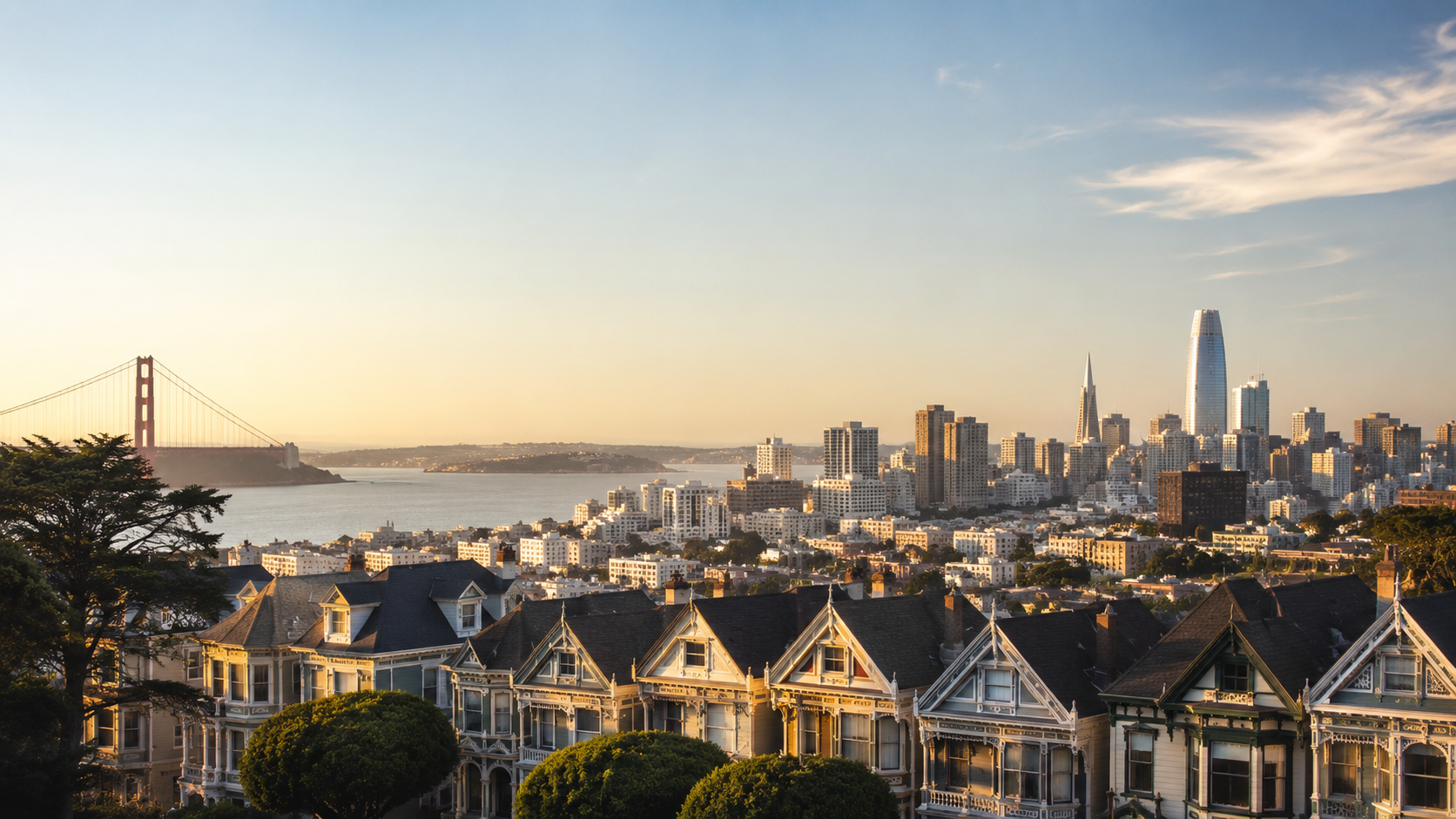
Living and buying in San Francisco, CA
San Francisco stands as one of California's most dynamic real estate markets, attracting homebuyers from across the globe. With a median home price of $1,348,700 and a population of 851,036, the city offers unmatched transit access (100 transit score), pedestrian walkability (99 walk score), and a highly educated workforce, with 59.8% of residents holding a bachelor's degree or higher. Whether you're a first-time buyer exploring dense urban living, an investor seeking long-term appreciation, or a remote worker valuing cultural amenities, San Francisco delivers a lifestyle unlike anywhere else in California, though at a premium price point that demands serious financial planning.
Who should buy in San Francisco
San Francisco appeals to a diverse range of buyers, from tech professionals to established families, provided they can navigate the city's premium pricing and urban density.
Young professionals and tech workers with strong incomes find condos and small townhomes in neighborhoods like the Tenderloin or SoMa more accessible than suburban sprawl, though median prices remain steep.
Families value the city's excellent public transportation, proximity to museums and cultural venues, and walkable commercial districts, though high density and 9.4% child population means school choice competition is fierce.
San Francisco's strong rental demand, educated tenant base, and historical appreciation make it attractive for long-term rental or fix-and-flip strategies despite high entry costs and 22.4% ownership rates in nearby areas.
Tech and knowledge workers relocating to the Bay Area or working hybrid schedules benefit from a thriving co-working scene, reliable fiber internet, and access to in-person networking events across the city.
Affluent retirees drawn to cultural amenities, world-class healthcare institutions like CPMC Van Ness Campus, and the median age of 40.9 find established neighborhoods like Pacific Heights or the Marina appealing, though cost of living is high.
Who should think twice
San Francisco's extreme cost, density, and social challenges make it unsuitable for budget-conscious buyers, car-dependent households, or those seeking suburban tranquility.
Best neighborhoods in San Francisco
San Francisco's neighborhoods are dramatically distinct, each with its own character, price range, and appeal. From bohemian Mission District to upscale Pacific Heights, choosing the right neighborhood is crucial to long-term satisfaction and financial success.
Each neighborhood reflects San Francisco's broader character: high density, walkability, and cultural diversity. Pacific Heights and the Marina command premium prices for established infrastructure and safety, while the Mission and Hayes Valley attract younger, more adventurous buyers seeking authenticity and nightlife. SoMa and South Beach offer the best entry points for first-time buyers and investors, though construction activity and shifting demographics mean these areas are in perpetual flux. Noe Valley delivers a village atmosphere within the city, perfect for families but at a price that reflects its desirability. Neighborhoods like the Tenderloin and Bayview remain more affordable but grapple with homelessness and property crime. Ultimately, your neighborhood choice defines your San Francisco experience as much as the city itself.
All neighborhoods in San Francisco
Browse detailed buyer guides for every San Francisco neighborhood we cover, including local market data, walkability, schools, and lifestyle.
- Anza Vista
- Bayview District
- Bernal Heights
- Castro District
- Chinatown
- Civic Center
- Cole Valley
- Cow Hollow
- Diamond Heights
- Dogpatch
- Duboce Triangle
- Fillmore District
- Financial District
- Fisherman's Wharf
- Forest Hill
- Forest Knolls
- Glen Park
- Golden Gate Heights
- Haight-Ashbury
- Hayes Valley
- Inner Richmond
- Inner Sunset
- Japantown
- Jordan Park
- Laurel Heights
- Little Saigon
- Lower Nob Hill
- Lower Pacific Heights
- Marina District
- Midtown Terrace
- Mission
- Mission Bay
- Nob Hill
- Noe Valley
- North Beach
- North of Panhandle
- Outer Richmond
- Outer Sunset
- Pacific Heights
- Parkside
- Pier 70
- Polk Gulch
- Potrero Hill
- Potrero Terrace
- Presidio Heights
- Presidio Terrace
- Richmond District
- Rincon Hill
- Russian Hill
- Seacliff
- Silver Terrace
- South Beach
- South of Market
- St. Mary's Park
- Sunset District
- Telegraph Hill
- Tenderloin
- Transbay
- Union Square
- West SoMa
- Western Addition
San Francisco home prices and market data
San Francisco's real estate market remains constrained by limited supply, strong investor demand, and Bay Area wealth concentration. Prices have stabilized after pandemic-era volatility, but affordability pressures persist.
vs CA Median: 281% above California median of $425,000 | Inventory: 1.8 months
Real estate trends and forecast in San Francisco
San Francisco's market has cooled from pandemic highs but remains seller-favorable, with strong underlying demand from remote-work-enabled buyers and institutional investors. Year-over-year appreciation sits around 3.2%, reflecting a stabilized seller's market.
GROWTH DRIVERS
- Tech industry concentration and high salaries in Bay Area
- Limited housing supply and restrictive zoning
- Institutional investor activity and portfolio consolidation
- Remote work flexibility attracting high-income relocations
RISK FACTORS
- Recession fears and tech sector layoffs impacting buyer confidence
- Rising mortgage rates reducing buying power for non-all-cash buyers
- Homelessness, street crime, and public safety concerns deterring families
- Regulatory uncertainty around short-term rentals limiting investor exits
San Francisco's long-term appreciation is supported by its unmatched economic moat: tech wealth, world-class universities, and geographic constraints on new supply. However, macro headwinds including recession risk and tech sector contraction create near-term uncertainty. Neighborhoods like SoMa and the Tenderloin offer the best entry points for value-oriented buyers and investors, while established areas like Pacific Heights and the Marina remain flight-to-quality destinations for ultra-high-net-worth individuals. The rental market remains robust, with yield-focused investors targeting properties under $1.2 million in mixed-use neighborhoods where tenant demand outpaces supply. In the next 24 months, expect modest price adjustments in lower-priced segments (under $1 million) but resilience in trophy neighborhoods above $2 million.
True cost of owning a home in San Francisco
Owning a home in San Francisco demands annual spending well beyond the mortgage, with property taxes, insurance, and maintenance pushing total ownership costs significantly higher than most California markets.
Mortgage, taxes, insurance, HOA, utilities, and maintenance add up fast. Use Ficustree’s True Cost of Ownership calculator to model the full monthly carrying cost for your specific price point, county, and loan terms before you commit.
For a quick anchor, a $500K home in San Francisco typically runs around $3,445/month all-in. Income to qualify is roughly $185,000/year with a 20% down payment of $269,740. Use the calculator above for your exact numbers.
Quality of life in San Francisco
San Francisco delivers elite walkability, cultural richness, and professional opportunity, but quality of life is diminished by cost of living stress, street-level homelessness, and congestion. The experience varies dramatically by neighborhood.
Climate: Mediterranean with cool, foggy summers (average 65F June-August) and mild winters. September through November offers the warmest, most pleasant weather.
Schools in San Francisco
San Francisco's public schools have improved but remain highly variable by neighborhood and competitive for desirable seats. Private schools offer strong alternatives for families prioritizing academics and stability.
Top Schools: Lowell High School (selective enrollment, 9.2/10), Lincoln High School (STEM focus, 8.4/10), Raoul Wallenberg Traditional High School (8.1/10), De Marillac Academy (private, 8.8/10), Cathedral School for Boys (private, 8.5/10)
Private Options: De Marillac Academy, Cathedral School for Boys, Chinese American International School, San Francisco City Academy
Is San Francisco safe?
San Francisco's crime rates exceed California and national averages, particularly for property crime and street-level theft. Safety varies sharply by neighborhood, making location selection critical for families and risk-averse buyers.
Safest areas: Pacific Heights, Marina District, Noe Valley, Presidio Heights, Forest Hill
Trend: stable | Watch: The Tenderloin, SoMa, and parts of the Bayview experience elevated property crime, car break-ins, and visible street disorder. Buyers seeking these neighborhoods for affordability should factor in security measures and insurance costs.
Property taxes in San Francisco
California's Proposition 19 allows reassessment on parent-to-child transfers over $1 million, potentially increasing your tax burden in inheritance scenarios.
Honest buyer reality check
The honest take: San Francisco is a premium market for premium reasons: culture, opportunity, and stability. However, buyers often underestimate lifestyle stress from cost-of-living anxiety, street-level disorder, and the gap between neighborhood appeal and actual safety. The city's regulatory complexity makes renovations expensive and time-consuming. Most critically, San Francisco's affordability crisis means many buyers are stretching financially, leaving little margin for recession, job loss, or personal emergency. Neighborhood quality varies so dramatically that a $1.2 million condo in SoMa and a $1.2 million Victorian in Noe Valley are entirely different lifestyle purchases.
Hidden costs buyers miss: Homeowners consistently underestimate earthquake insurance (often 25 to 40% of standard insurance costs), parking solutions (rent or monthly permits), tech-related repairs (plumbing and HVAC labor rates are 30 to 50% above statewide averages), and transaction costs including city transfer taxes (2.5% in SF) on top of realtor commissions.
Natural risks: Seismic activity: San Francisco sits near the San Andreas Fault, creating ongoing earthquake risk and higher insurance costs., Flooding: Parts of the Mission District, SoMa, and coastal neighborhoods are in FEMA flood zones, particularly during heavy rain events., Liquefaction: Bay-adjacent neighborhoods built on landfill may experience soil liquefaction during earthquakes.
Zoning watch: San Francisco's strict zoning limits new housing supply, keeping prices artificially elevated. Zoning changes around the Mission and Hayes Valley are shifting toward transit-oriented development, but political opposition slows approval. Short-term rental restrictions mean Airbnb arbitrage is now illegal, reducing investor exit flexibility.
Unexpected cost factor: 18 to 24%
Nature and outdoor life
San Francisco offers exceptional urban park access and nearby wilderness, from the beloved Golden Gate Park to dramatic coastal trails at Ocean Beach and the Marin Headlands just across the bridge. The city's compact size means nature is never far away.
Seasonal highlights: Fall (September to November) offers the warmest weather and clearest skies. Summer fog is famous but can feel monotonous for sun-seekers.
Daily Life and Amenities in San Francisco
Real named places within San Francisco from Proximitii’s POI database.
- Saigon Sandwich · 1 min walk
- Hai's Restaurant · 1 min walk
- Mộng Thu · 1 min walk
- Emperor Norton's Boozeland · 1 min walk
- Lapats · 1 min walk
- Larkin Restaurant · 2 min walk
- Sing Sing · 1 min walk
- Lafayette Coffee Shop · 2 min walk
- Mom's Soul Groove · 2 min walk
- DeliShack · 2 min walk
- Quickly · 3 min walk
- Sweet Glory · 3 min walk
- Turk-Hyde Mini Park · 1 min walk
- Turk-Hyde Mini Park Playground · 1 min walk
- Urban Alchemy Oasis · 2 min walk
- Tenderloin Children's Playground · 3 min walk
- Tenderloin Children's Playground · 3 min walk
- Sergeant John Macaulay Park · 4 min walk
- Sam's Bakery · 4 min walk
- Downtown Grocery · 6 min walk
- Arsicault Bakery · 6 min walk
- Salama Halal Meat · 8 min walk
- The French Spot · 8 min walk
- Sutter Fine Foods · 9 min walk
- Tenderloin Recreation Center · 3 min walk
- Community Youth Center · 8 min walk
- The Mix · 8 min walk
- 24 Hour Fitness · 9 min walk
- Hit Fit SF · 9 min walk
- California Martial Arts · 10 min walk
- Modernism · 3 min walk
- Tenderloin Museum · 4 min walk
- Great American Music Hall · 4 min walk
- Book & Job Gallery · 5 min walk
- Asian Art Museum of San Francisco · 6 min walk
- Moth Belly Gallery · 6 min walk
Frequently asked questions about San Francisco real estate
Is San Francisco a good place to buy a home?
San Francisco is an excellent long-term real estate investment if you have stable income, can manage the $1.3+ million median price, and value urban walkability, cultural amenities, and professional opportunity over affordability. The city delivers world-class transit, top-tier healthcare, and strong historical appreciation. However, it's not suitable for budget-conscious buyers, families seeking suburban space, or those sensitive to homelessness and street crime. Success in San Francisco's market requires realistic expectations about cost, lifestyle stress, and neighborhood research.
What is the average home price in San Francisco?
The median home price in San Francisco is $1,348,700 as of the latest market data. Condos average $950,000, while single-family homes and townhouses range from $1.2 million in emerging neighborhoods like SoMa to $3+ million in established areas like Pacific Heights and the Marina. Rental prices average $2,400 for a one-bedroom and $3,850 for a three-bedroom.
What are the best neighborhoods in San Francisco for families?
Family-friendly neighborhoods include Noe Valley (village feel, excellent schools, tree-lined streets), Hayes Valley (vibrant dining and culture with nearby parks), and the Marina District (waterfront access, established families, strong schools). Pacific Heights is the traditional family stronghold but comes at a premium price. Areas like the Mission District and SoMa are popular with younger families seeking walkability and urban energy, though schools are more variable and street conditions less stable than established neighborhoods.
Is San Francisco safe for families and homeowners?
Safety in San Francisco is neighborhood-dependent. Pacific Heights, Marina District, and Noe Valley are considered safe with low crime rates and active community presence. The Tenderloin, parts of SoMa, and the Bayview struggle with property crime, vehicle break-ins, and visible homelessness. The city's violent crime index exceeds California averages, and property crime remains elevated. Families should thoroughly research specific blocks before buying and factor security concerns into their decision-making process.
What is the cost of living in San Francisco?
San Francisco ranks among the most expensive cities in the U.S. The median household income is $136,689, but this is required just to keep pace with living costs. Groceries are 15 to 20% above national average, restaurant meals are premium-priced, and transportation (parking, car insurance, repairs) is substantially higher than regional averages. Renters spend 45 to 55% of income on housing alone. Homebuyers must budget $3,400+ monthly for ownership costs on a $500k home, including mortgage, taxes, insurance, and maintenance.
How are the schools in San Francisco?
San Francisco Unified School District averages 7.8/10 on GreatSchools and is highly variable by neighborhood. Top performers include Lowell High School (selective enrollment, ranked 9.2/10) and Lincoln High School (STEM focus, 8.4/10). Private schools like De Marillac Academy and Cathedral School for Boys offer consistent quality but cost $15,000 to $25,000+ annually. The best public schools concentrate in Pacific Heights, Presidio Heights, and Noe Valley neighborhoods. School choice is competitive, and families should plan ahead during the enrollment process.
What are the property taxes in San Francisco?
California's Proposition 13 caps property tax at 1% of assessed value, but San Francisco adds local assessments and bonds, bringing the effective rate to approximately 0.76% of market value. On a $1.35 million home, expect annual property taxes around $10,260. Additionally, San Francisco charges a 2.5% real estate transfer tax on sales, one of the highest in California. HOA fees are common in condos and townhouses, averaging $250 to $450 monthly. These cumulative costs significantly impact total ownership expense.
Is San Francisco good for real estate investors?
San Francisco offers strong long-term appreciation (72% over 10 years) and consistent rental demand, making it attractive for buy-and-hold investors with high equity. Rental yields average 2.1 to 3.4%, which is modest but supported by high rents and tenant demand. However, San Francisco's regulatory complexity (strict eviction controls, short-term rental bans, tenant protections) makes active management challenging. Entry costs are prohibitive for most investors, and leverage through mortgages is risky given the premium valuation. Value-focused investors should target neighborhoods like SoMa and the Tenderloin where entry points are lower and renovation upside exists. Institutional investors and all-cash buyers dominate the market.
Where this San Francisco data comes from
All numbers come from public, authoritative sources you can verify yourself. We pull median home values and demographic profiles from the U.S. Census Bureau, walk and transit ratings from Walk Score, school information from GreatSchools, and geographic boundaries from OpenStreetMap.
Find Your Perfect Home in San Francisco
Use our AI-powered search to discover homes in San Francisco neighborhoods that match your lifestyle, budget, and long-term goals.
Search San Francisco Homes →