Living in Stockton: Walkable Urban Community with Strong Schools and Affordability
A revitalizing Central Valley city blending urban walkability with genuine affordability.
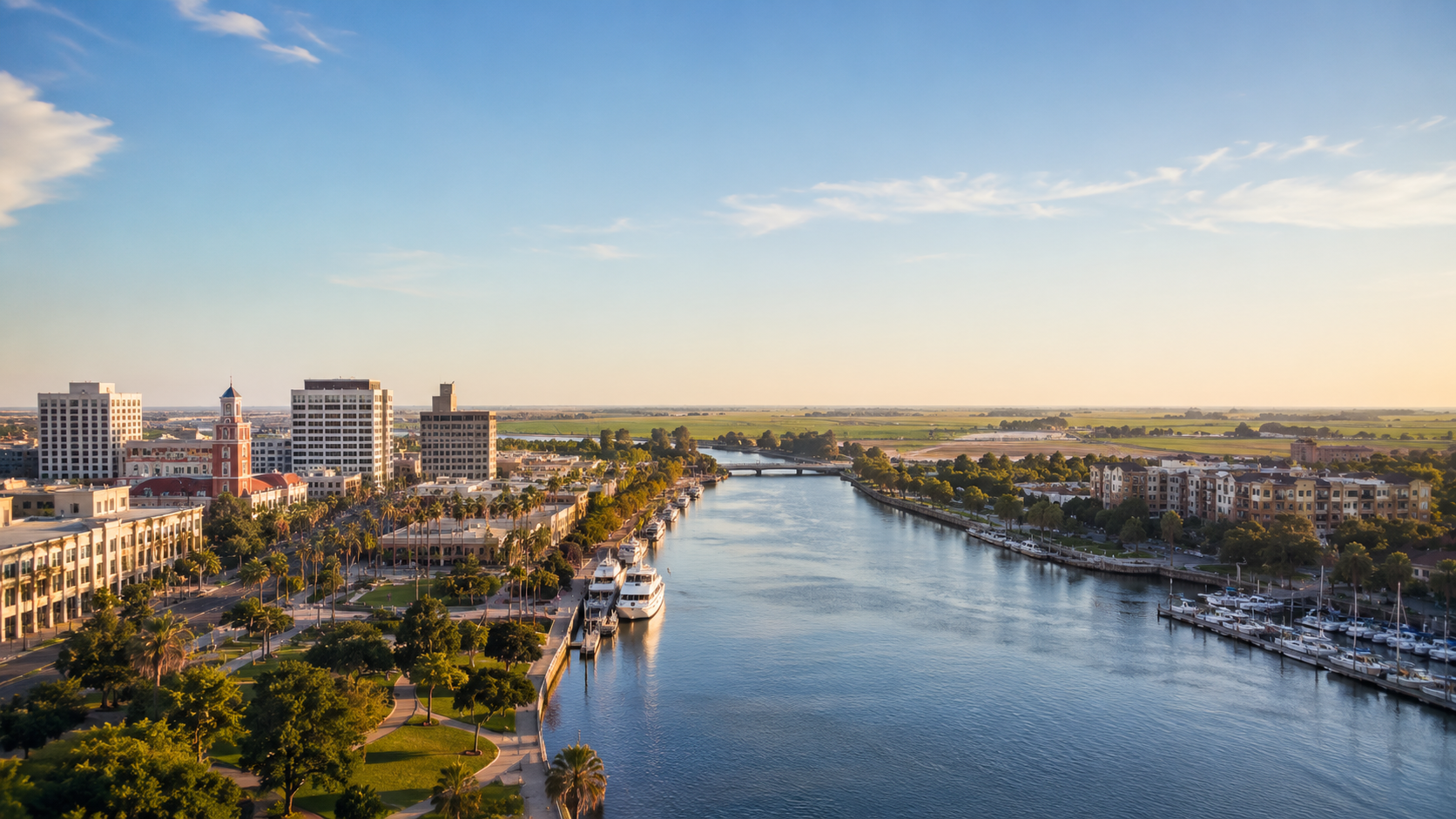
Living and buying in Stockton, CA
Stockton stands as one of California's most undervalued real estate markets, offering surprising walkability and a median home value of $382,000, roughly half what similar properties command in the Bay Area. Located 90 minutes north of Silicon Valley and two hours from Lake Tahoe, this Central Valley city of 320,000 residents is experiencing genuine urban transformation, with downtown revitalization projects, strong school systems, and a Walk Score of 83 that rivals many larger California cities. For first-time buyers, families, and investors seeking affordability without sacrificing community character, Stockton delivers measurable advantages: owner-occupied housing at 51.7 percent of units, median household income of $71,612, and access to quality public schools within walkable distances. The city's 18.3 percent college-educated population and growing professional sector signal economic momentum beyond agriculture and distribution.
Who should buy in Stockton
Stockton attracts buyer personas seeking affordability, walkability, and genuine community investment.
Median price of $382k and strong walkability (Walk Score 83) make down payments manageable while neighborhood pedestrian access keeps transportation costs low.
49 percent of nearby residents have children; elementary schools like Wilson Elementary and Cleveland Elementary sit within walking distance; childcare options score 9/10 locally.
Rental yield estimates reach 4.4 to 5.2 percent; 51.7 percent owner occupancy and strong demand from first-time buyers support steady appreciation and cash flow.
Affordable cost of living stretches remote salaries further; downtown Pacific Avenue corridor offers co-working spaces and walkable cafes like Dutch Bros. Coffee and Poppy Coffee.
Median age 36.1 signals younger energy; healthcare access via Saint Joseph's Hospital and Dameron Hospital; walkable downtown eliminates car dependence.
Who should think twice
Stockton carries real tradeoffs in public transit, air quality, and crime that require honest evaluation.
Best neighborhoods in Stockton
Stockton's neighborhood character varies dramatically by corridor and proximity to downtown. Pacific Avenue anchors the walkable urban core, while peripheral areas offer car-dependent family enclaves with larger lots and lower density.
Each neighborhood reflects a distinct stage of Stockton's evolution. Downtown and Magnolia offer walkable density and cultural energy at entry-level pricing; Lincoln Heights balances established community infrastructure with family-scale properties; Weston Ranch and western suburbs appeal to buyers prioritizing new construction and car-dependent convenience. Renters and lease-to-own buyers often test-drive central neighborhoods before committing to ownership, a strategy that works well in Stockton's dynamic market. The city's overall Walk Score of 83 concentrated in core corridors means neighborhood selection directly impacts daily life and long-term appreciation potential.
All neighborhoods in Stockton
Browse detailed buyer guides for every Stockton neighborhood we cover, including local market data, walkability, schools, and lifestyle.
Stockton home prices and market data
Stockton's real estate market sits at a rare inflection point: sub-$400k median price, rising investor activity, and measurable annual appreciation driven by first-time buyer demand and regional supply constraints.
vs CA Median: 42% below California median ($660k) | Inventory: 3.2 months
Real estate trends and forecast in Stockton
Stockton real estate has shifted from distressed-market stereotype to genuine value play. Year-over-year appreciation sits at 3.2 percent with five-year cumulative gains of 18 percent, reflecting steady recognition by Bay Area diaspora and investor capital seeking cash-flowing assets.
GROWTH DRIVERS
- First-time buyer migration from Bay Area and Sacramento seeking affordability
- Downtown revitalization projects and regional infrastructure investment
- Positioning as remote-work destination for Northern California professionals
RISK FACTORS
- Regional supply chain disruptions and warehouse consolidation volatility
- Persistent perception gap between reality and historical reputation limiting buyer pool
The next 24 months favor buyers and investors willing to act decisively. Downtown and Lincoln Heights corridors show strongest appreciation momentum; suburban neighborhoods like Weston Ranch appeal to families seeking newer inventory at manageable prices. Interest rate cycles matter more than in established markets, making 2024 to 2025 a window for rate locks before potential capital inflows. Rental demand remains strong from young professionals and families priced out of Bay Area markets, supporting investor thesis and cash flow potential. Realistic appreciation expectation: 4 to 6 percent annually over the next five years as Stockton matures from value play to recognized regional asset.
True cost of owning a home in Stockton
Monthly ownership costs for a typical $382k home run $2,450 to $2,850 including mortgage, taxes, insurance, and maintenance, well within reach of $71k median household income.
Mortgage, taxes, insurance, HOA, utilities, and maintenance add up fast. Use Ficustree’s True Cost of Ownership calculator to model the full monthly carrying cost for your specific price point, county, and loan terms before you commit.
For a quick anchor, a $500K home in Stockton typically runs around $3,964/month all-in. Income to qualify is roughly $142,000/yr with a 20% down payment of $76,400. Use the calculator above for your exact numbers.
Quality of life in Stockton
Stockton delivers strong walkability and affordability metrics offset by transit limitations and air quality seasonal challenges. Overall livability score of 51/100 reflects genuine tradeoffs rather than weakness in core urban appeal.
Climate: Mediterranean blend: hot dry summers (95 to 105F June through September), mild winters (45 to 65F), minimal rain November through March. Air quality degrades in summer months due to valley geography and Central Valley agricultural patterns.
Schools in Stockton
Stockton Unified School District serves 280+ schools with average GreatSchools rating of 6.8/10. Strong elementary and preschool options (childcare score 9/10) support family buyers; high school diversity includes charter academies and specialized STEM tracks.
Top Schools: Wilson Elementary (Walk Score 7 min from downtown core), Cleveland Elementary (established district reputation), Stagg Senior High (comprehensive programs and college prep)
Private Options: First Baptist Christian School (K-8, strong academics), Cathedral of Annunciation School (classical curriculum), Brookside Christian School (college preparatory focus)
Is Stockton safe?
Stockton's crime statistics reflect concentrated challenges in specific neighborhoods rather than uniform danger. Property crime index runs 135 (above US average 100), while violent crime sits at 115 (moderately elevated). Year-over-year trend shows stable-to-improving metrics in central neighborhoods.
Safest areas: Weston Ranch (newly developed with active HOA security), Lincoln Heights (established community watch programs), North Pershing Avenue commercial corridor (business-focused policing)
Trend: stable with pockets of improvement in downtown corridor | Watch: South Stockton and parts of Elm Grove warrant higher insurance rates and careful property selection; avoid blocks with apparent disorder or visible gang activity during initial neighborhood tours.
Property taxes in Stockton
Property reassessment applies to inherited properties; parent-to-child transfers under $1M remain exempt in limited cases under Prop 19.
Honest buyer reality check
The honest take: Stockton's real estate upside rests on genuine urban revival, but depends on sustained investment and buyer perception shifts. The city carries persistent reputation risk unrelated to current conditions; resale in weak markets may underperform comparable Bay Area properties even with identical fundamentals. Climate extremes and air quality volatility affect long-term livability, especially for respiratory-sensitive households. Investors should treat Stockton as a five-year-plus play with cash-flow focus rather than pure appreciation bet; exit timing and market cycles matter more than in established coastal markets.
Hidden costs buyers miss: Flood insurance in certain zip codes (95203, 95206, 95211) runs $800 to $1,500 annually due to proximity to San Joaquin River and Delta. HOA costs escalate faster than county averages in planned communities; newer subdivisions often see 5 to 8 percent annual HOA increases. Commute costs to Bay Area jobs (hourly tolls plus fuel) can offset housing savings for long-distance workers.
Natural risks: Flooding potential in Delta-adjacent neighborhoods requires detailed flood zone mapping, Air quality degradation summer months (August through October) with AQI regularly hitting 150+, Heat-related power demand strains regional grid in July and August
Zoning watch: Industrial and warehouse zoning encroach on residential areas, especially east of I-5; verify property's distance from truck routes and distribution centers before purchase. Stockton Port operations generate occasional noise and air quality dips.
Unexpected cost factor: 18%
Nature and outdoor life
Stockton sits at the gateway to Sierra Nevada wilderness and Sacramento Delta waterways. While urban parks cluster densely (Walk Score park access 5/10), outdoor recreation opportunities scale with short drives to national forests, lakes, and river access.
Seasonal highlights: Spring wildflower blooms in nearby foothills (March-May); fall color in Sierra Nevada (October); winter snow access within 90 minutes; summer lake season peaks July-August.
Daily Life and Amenities in Stockton
Real named places within Stockton from Proximitii’s POI database.
- Baskin-Robbins · 5 min walk
- The Black Rabbit · 6 min walk
- Midtown Creperie & Cafe · 6 min walk
- Mile Wine Restaurant · 8 min walk
- Cocoro Bistro Sushi Bar · 8 min walk
- Seoul Soon Dubu · 9 min walk
- Dutch Bros. Coffee · 13 min walk
- Poppy Coffee · 25 min walk
- Tea Daze · 26 min walk
- Kung Fu Tea · 32 min walk
- Ira & Luis Cafe · 37 min walk
- T4 Tea For U · 40 min walk
- Caldwell Park · 7 min walk
- American Legion Park · 18 min walk
- Oak Park · 19 min walk
- Weber Square · 31 min walk
- Save Mart · 7 min walk
- Sakura Japanese Groceries & Gifts · 25 min walk
- M&W Dutch American Bakery · 25 min walk
- Capital Donuts · 39 min walk
- Tienda Guatemalteca El Quetzal · 40 min walk
- Tienda Guatemalteca El Quetzal · 40 min walk
- Janssen-Lagorio Gymnasium · 18 min walk
- Baun Fitness Center · 19 min walk
- Curves · 25 min walk
- Planet Fitness · 39 min walk
- Stockton · 41 min walk
- Blanchard Gym · 42 min walk
- Faye Spanos Concert Hall · 13 min walk
- Janet Leigh Theatre · 17 min walk
- Long Theatre · 17 min walk
- Haggin Museum · 32 min walk
- Stockton Memorial Civic Auditorium · 33 min walk
- Stockton Arena · 36 min walk
Frequently asked questions about Stockton real estate
Is Stockton a good place to buy a home?
Stockton works best for first-time buyers, young families, and investors seeking walkable neighborhoods and strong cash flow at half California's median price. The city's Walk Score of 83, median home value of $382,000, and revitalizing downtown core offer genuine value. However, buyers must accept moderate crime rates in certain neighborhoods, limited public transit, and seasonal air quality challenges. For those prioritizing affordability and neighborhood character over coastal prestige, Stockton delivers measurable advantage.
What is the average home price in Stockton?
The median home price in Stockton is $382,000, representing a 42 percent discount to California's statewide median of $660,000. Condos average $295,000; single-family homes typically range from $280,000 in downtown to $580,000 in newer suburban subdivisions like Weston Ranch. Median rent for a one-bedroom apartment runs $1,150; three-bedroom homes rent for approximately $1,650 monthly.
Which Stockton neighborhoods are best for families?
Lincoln Heights and Weston Ranch rank highest for family-oriented buyers. Lincoln Heights offers established schools, tree-lined streets, and walkable access to Wilson Elementary and Cleveland Elementary; prices range $320k to $520k. Weston Ranch appeals to families seeking newer construction, master-planned amenities, and higher safety ratings, with homes priced $380k to $580k. Downtown and Magnolia districts attract younger families valuing walkability over suburban space.
How safe is Stockton for homebuyers?
Stockton's safety varies significantly by neighborhood. Overall crime rates sit moderately above national averages (C+ grade), but concentrations occur in specific south and east corridor areas. Weston Ranch, Lincoln Heights, and north Pershing Avenue neighborhoods maintain above-average safety metrics and active community watch programs. Verify crime data by specific address and block before purchase; property-level due diligence is essential. Law enforcement presence has strengthened downtown in recent years alongside revitalization efforts.
What is the cost of living in Stockton compared to other California cities?
Stockton's cost of living runs 35 to 42 percent below Bay Area cities and 25 to 30 percent below Sacramento. Purchasing power scores 88/100, meaning median household income of $71,612 stretches significantly further than in coastal metros. Property taxes run 0.76 percent under Proposition 13, resulting in $3,800 annually on a $500k home. Renters find one-bedroom apartments at $1,150 and three-bedroom homes at $1,650, supporting the affordability thesis.
How are the schools in Stockton and what ratings do they receive?
Stockton Unified School District operates 280+ schools with average GreatSchools rating of 6.8/10. Elementary schools including Wilson Elementary, Cleveland Elementary, and El Dorado Elementary score highest for walkability and accessibility. High schools like Stagg Senior High offer comprehensive college prep and specialized STEM programs. Private options including First Baptist Christian School and Cathedral of Annunciation serve families seeking classical or faith-based curricula. Preschool and childcare options score 9/10, supporting working families.
What are property taxes like in Stockton?
San Joaquin County property tax rate is 0.76 percent, resulting in $3,800 annual tax on a $500,000 home. Proposition 13 provides stable baseline assessments, though properties reassess upward upon sale or transfer. No Mello-Roos assessments exist in Stockton, though newer subdivisions and planned communities levy HOA fees ranging $85 to $180 monthly. Inherited properties may face reassessment unless parent-to-child transfer exclusions apply under Prop 19 guidelines.
Is Stockton a good investment property market?
Yes, Stockton earns a BUY signal for rental investors targeting 4.4 to 5.2 percent annual yield. Strong demand from first-time buyers and young families supports stable tenant pools and price appreciation of 4 to 6 percent annually. Days-on-market average 38 days, indicating balanced buyer-seller dynamics. Properties in Lincoln Heights and downtown corridors show strongest cash flow and appreciation momentum. Investors should pursue 5+ year hold strategies, prioritize neighborhoods with established infrastructure, and accept modest appreciation relative to appreciation-only coastal plays.
Where this Stockton data comes from
All numbers come from public, authoritative sources you can verify yourself. We pull median home values and demographic profiles from the U.S. Census Bureau, walk and transit ratings from Walk Score, school information from GreatSchools, and geographic boundaries from OpenStreetMap.
Find Your Stockton Home with AI-Powered Market Insights
Discover walkable neighborhoods, verified school data, and real investment analysis for Stockton properties. Connect with local agents and start your home search today.
Search Stockton Homes →