
Most buyers can afford a home priced at several times their gross annual income, but the real answer depends on four things: your income, your existing debts, your credit score, and how much you put down. Lenders use the debt-to-income ratio as the primary gatekeeper, with conventional loans capping your front-end DTI at 36% of gross income and your back-end DTI at 45–50%. FHA loans are more flexible, allowing a front-end DTI up to 31% and a back-end DTI up to 56.9% with strong compensating factors.
The 28/36 rule is the baseline most financial planners recommend: keep your monthly housing costs below 28% of gross income, and keep all debt payments below 36%. Lenders may approve you for more, but that ceiling is not your budget.
Key factors that shape your home affordability:
- Gross monthly income: The starting point for every DTI calculation
- Monthly debt payments: Car loans, student loans, credit cards (minimum payments only)
- Credit score: Affects your rate, loan type eligibility, and DTI flexibility
- Down payment: Larger down payments lower your loan amount and eliminate PMI above 20%
- Loan type: Conventional, FHA, or VA each carry different DTI limits
- Property taxes and homeowners insurance: Both are included in your monthly PITI payment
- HOA fees: Counted as part of your front-end housing cost by lenders
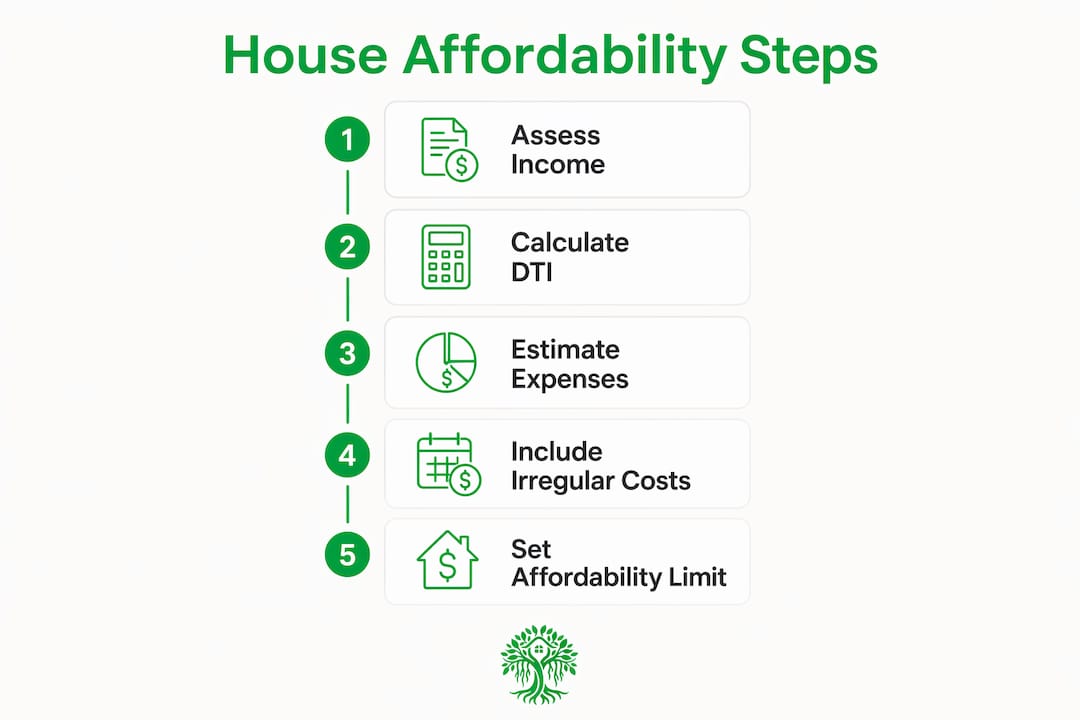
How to calculate how much house you can afford
Getting to a real number takes about 15 minutes if you have your pay stubs and a recent credit card statement handy. Here is the process lenders actually use.
- Find your gross monthly income. Use pre-tax income. If you are salaried, divide your annual salary by 12. Self-employed buyers should average the last two years of net income from tax returns.
- List all monthly debt payments. Pull minimum payments from your credit report: car loans, student loans, personal loans, and credit card minimums. Do not include utilities or subscriptions.
- Estimate your monthly housing costs (PITI). Add principal and interest (from a mortgage calculator), property taxes (typically 1–2% of home value annually, divided by 12), homeowners insurance (roughly $100–$200/month for most markets), and any HOA fees.
- Calculate your front-end DTI. Divide estimated monthly housing costs by gross monthly income. Stay at or below the commonly recommended thresholds for conservative targets and loan limits.
- Calculate your back-end DTI. Add your estimated housing costs to all existing monthly debt payments, then divide by gross monthly income. Conventional loans generally want this below 45–50%.
- Factor in your down payment. A larger down payment reduces your loan size, lowers your monthly payment, and eliminates private mortgage insurance (PMI) once you reach 20% of the purchase price.
- Compare 15-year vs. 30-year loan terms. A 15-year mortgage carries a higher monthly payment but a lower interest rate and far less total interest paid. A 30-year loan stretches payments out, which lowers the monthly cost but increases total borrowing expense.
- Run the numbers through a home affordability calculator. Online tools let you plug in income, debts, rate, and down payment to see a realistic price range in seconds.
- Get a lender pre-approval. Pre-approval gives you a verified borrowing limit based on your actual credit file, not estimates.
Pro Tip: Build a separate line item for irregular homeownership costs before you commit to a price. HVAC repairs, roof maintenance, and appliance replacements are real expenses. A dedicated emergency fund covering several months of housing payments protects your budget when something breaks.

Understanding DTI ratios and the 28/36 rule
Your DTI ratio is the single number lenders care most about. It tells them what share of your income is already committed to debt, and how much room is left for a mortgage.

Front-end DTI covers housing costs only: principal, interest, taxes, insurance, and HOA fees. Back-end DTI covers everything: housing plus car payments, student loans, credit cards, and any other recurring debt. Lenders calculate both using your gross (pre-tax) income and the minimum monthly payments listed on your credit report, not your actual balances.
DTI thresholds by loan type:
- Conventional loans: Front-end up to 36%, back-end up to 45–50%
- FHA loans: Front-end up to 31%, back-end up to 56.9% with compensating factors
- VA loans: No strict DTI ceiling; lenders evaluate residual income instead, giving veterans more flexibility
The 28/36 rule is a budgeting guideline, not a lender requirement. It predates modern expenses like childcare and rising utility costs, so treat it as a floor for your thinking rather than a final answer. A buyer with $8,000 in gross monthly income who follows the 28% front-end target keeps housing costs at $2,240 per month or below. That is a useful anchor, even if your lender would approve you for more.
Other factors that shape what you can actually buy
Credit scores, loan products, interest rates, and your down payment all move the affordability number in ways that can add up to tens of thousands of dollars.
Credit score impact:
- Scores above 740 typically unlock the lowest available mortgage rates
- Scores between 620 and 739 qualify for conventional loans but at higher rates
- Scores below 620 generally require FHA financing, which carries mortgage insurance premiums regardless of down payment size
- VA loans have no minimum credit score set by the VA, though individual lenders often require 620 or above
Loan type differences:
- Conventional loans suit buyers with strong credit and at least 5% down; PMI drops off once you reach 20% equity
- FHA loans accept lower credit scores and down payments as low as 3.5%, but require mortgage insurance for the life of the loan in most cases
- VA loans require no down payment and no PMI for eligible veterans, making them the most affordable entry point available
Mortgage rate effect: Even a 1-percentage-point rate change significantly shifts your monthly payment and total purchasing power. At a given income and debt level, a higher rate shrinks the loan amount you can qualify for, which directly reduces the home price you can target.
Down payment and PMI:
- Putting down less than 20% on a conventional loan triggers PMI, typically 0.5–1.5% of the loan amount annually
- A larger down payment also improves your loan-to-value ratio, which can unlock better rates
- Some buyers use lodger income or co-borrower income to strengthen their application when their own income falls short
What experts say about setting your own affordability limit
Pre-approval is a lender’s assessment of their risk, not a recommendation for how much you should spend. That distinction matters in practice.
“Mortgage pre-approval reflects the maximum a lender is willing to risk, not the maximum a buyer should borrow. Buyers who self-regulate their budget below the approved ceiling tend to maintain stronger long-term financial health.” — Mortgage Affordability Calculator, Chase
Lenders can and do approve loans above standard DTI limits when compensating factors are present. A credit score above 720, a down payment above 20%, and cash reserves covering 6–12 months of payments can all push approval thresholds higher. That flexibility exists to serve buyers with strong overall profiles, not as an invitation to stretch your budget to the edge.
Smart affordability practices beyond the lender checklist:
- Account for true ownership costs. Property taxes, insurance, HOA fees, maintenance, and utilities all belong in your monthly budget, not just principal and interest
- Keep an emergency fund separate from your down payment. Depleting savings to close leaves no buffer for the first repair bill
- Model rate scenarios. Run your affordability calculation at your quoted rate and at a rate 1 point higher to understand your exposure if rates move before closing
- Revisit your budget after pre-approval. The true cost of homeownership often runs higher than the mortgage payment alone once maintenance and utilities are added
Ficustree helps you buy with a clear number, not a guess
Knowing your affordability ceiling is one thing. Buying confidently within it is another, and that gap is exactly where first-time buyers lose months of time and money.

Ficustree is an AI-powered buyer platform built for first-time buyers in California and Texas who want clarity before they commit. You pay $1,000 at closing plus 1% commission, keep a rebate of roughly 2% where legally permitted, and get access to the full platform free. There is no traditional agent retainer, no pressure to stretch your budget, and no listings-site noise. Ficustree’s tools connect your real DTI, credit profile, and down payment to homes that actually fit your numbers. When you are ready to move from calculation to search, start with Ficustree and see what your budget unlocks.
Key takeaways
Most buyers can afford a home priced at several times their gross annual income, provided their back-end DTI stays within lender limits and their credit, down payment, and reserves support the loan.
| Point | Details |
|---|---|
| DTI is the primary lender filter | Conventional loans cap back-end DTI at 45–50%; FHA allows up to 56.9% with compensating factors. |
| The 28/36 rule is a floor, not a ceiling | Keep housing costs below 28% of gross income as a baseline, but personalize for your actual expenses. |
| Credit and down payment move the number | Scores above 740 and down payments above 20% unlock better rates and eliminate PMI. |
| Pre-approval is not your budget | Lenders assess their risk tolerance; buyers must set their own comfortable payment limit. |
| Ficustree connects your numbers to real homes | The platform matches your verified DTI and budget to listings in California and Texas, free to use. |
FAQ
What is the 28/36 rule for buying a house?
The 28/36 rule says your monthly housing costs should not exceed 28% of gross income, and total monthly debts should not exceed 36%. It is a budgeting guideline, not a lender requirement.
How much mortgage can I get on a $100,000 salary?
Keeping housing costs at the 28% front-end target supports a monthly payment aligned with your income, which in turn influences the loan amount you can afford depending on your rate, down payment, and existing debts.
Does my credit score affect how much house I can afford?
Yes, directly. Higher credit scores qualify you for lower mortgage rates, which reduces your monthly payment and increases the home price you can reach at the same income. Scores above 740 typically access the best available rates.
What DTI ratio do lenders require for a mortgage?
Conventional lenders generally want a back-end DTI below 45–50%. FHA loans allow up to 56.9% with strong compensating factors. VA loans use a residual income standard rather than a strict DTI cap.
Should I borrow the maximum my lender approves?
No. Pre-approval reflects the lender’s risk limit, not your comfortable budget. Buying below your approval ceiling leaves room for maintenance costs, emergencies, and life changes without putting your finances under pressure.