
A competitive home offer is a bid that combines financial credibility, strategic pricing, and seller-friendly terms to stand out in a crowded field. For first-time buyers in California and Texas, knowing how to make a competitive home offer is the difference between getting the keys and getting outbid. The good news: price alone rarely wins in 2026. Clean terms, strong pre-approval, and the right assistance programs now carry as much weight as the number at the top of the page.
What financial preparation does your offer actually need?
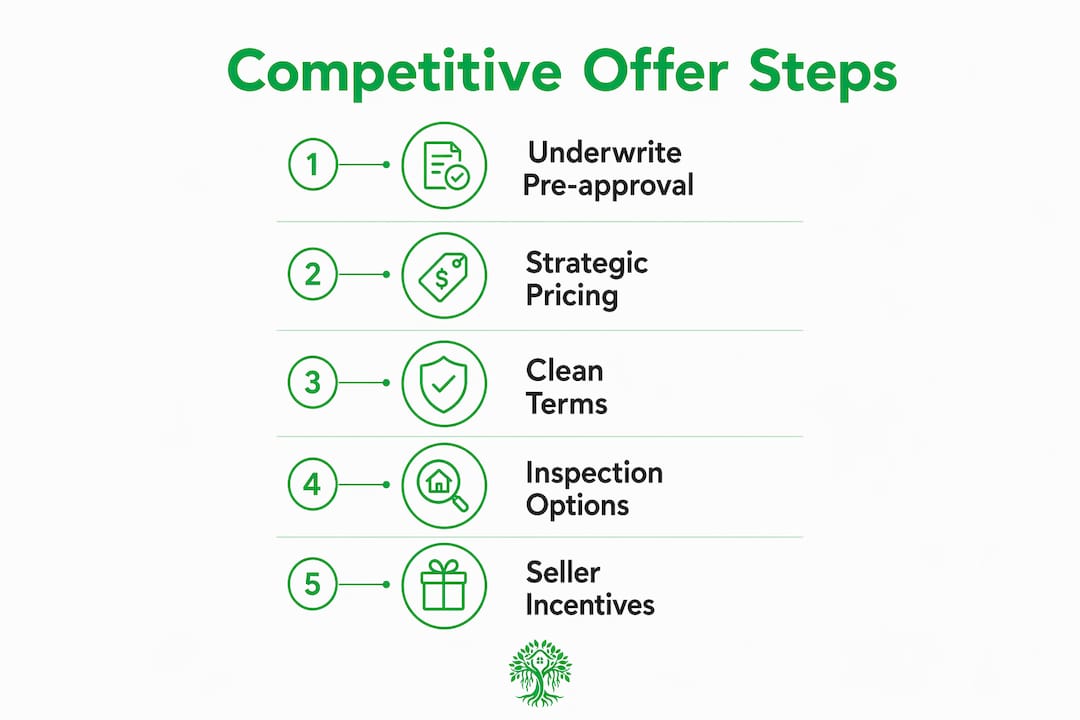
Financial strength is the foundation of every winning bid. Sellers want certainty, and the clearest signal you can send is a fully underwritten pre-approval letter, not just a standard one.

The difference matters. A standard pre-approval is a lender’s estimate based on self-reported income and a credit check. An underwritten pre-approval means a mortgage underwriter has reviewed your full financial file before you ever tour a home. That distinction tells a seller your financing is near-guaranteed, not just probable. In a multiple-offer situation, that letter alone can move you to the top of the stack.
Earnest money also signals seriousness. A deposit of 1%–3% of the purchase price is standard in most California and Texas markets. Going higher, say 3%–5%, tells the seller you are committed and financially prepared to follow through.
Here is what your financial package should include before you submit any offer:
- A fully underwritten pre-approval letter from your lender
- Proof of funds for your down payment and earnest money
- A pre-approval amount that matches or exceeds the listing price range you are targeting
- A lender who can close on a compressed timeline (21–25 days is competitive in California)
- Documentation of any gift funds, if applicable, already sourced and seasoned
Pro Tip: Ask your lender specifically for a “credit-approved” or “DU approved” pre-approval. This is the underwritten version. Many lenders offer it but do not advertise it unless you ask.
How do you price your offer in California and Texas markets?
Pricing your offer correctly requires reading the local market, not just the listing price. California and Texas are not one market. They are dozens of micro-markets with very different conditions right now.
In Texas, buyers have real leverage in several cities. Austin homes average 96 days on market as of march 2026. That extended time on market means sellers are more open to negotiation than they were two years ago. In Dallas, 29% of listings have cut prices recently. Those price reductions are an invitation to negotiate, not a warning sign. In California, the picture is more mixed. Los Angeles builders have dropped prices by about 6% to attract buyers, but resale inventory in coastal cities remains tight.
Use this four-step process to set your offer price:
- Pull recent comparable sales (comps). Look at homes that closed within the last 60–90 days, within a half-mile radius, with similar square footage and condition. This is your pricing anchor.
- Check days on market. If a home has been listed for more than 30 days, you have room to negotiate. If it listed within the last week, expect competition.
- Assess price reductions. A home that has dropped its price once or twice is a seller who is motivated. Factor that into your opening number.
- Decide on an escalation clause. If you expect multiple offers, an escalation clause automatically raises your bid above competing offers. Use increments of $5,000–$10,000 and set a firm maximum ceiling you are genuinely comfortable paying.
| Market condition | Suggested pricing approach |
|---|---|
| Home listed under 7 days, no reductions | At or above asking price |
| Home listed 15–30 days, no reductions | At asking price or slight premium |
| Home listed 30+ days with price cuts | 2%–5% below current asking price |
| New construction with builder incentives | Negotiate on upgrades and closing costs, not just price |
Pro Tip: An escalation clause reveals your maximum to the seller. Only use one when you are confident there are competing offers and when your ceiling is a number you can genuinely afford.
What offer terms actually appeal to sellers?
Competitive offers in 2026 are won through clean terms more than price alone. Sellers care about certainty, speed, and convenience. Your terms can deliver all three.
The inspection contingency is the most negotiated term in California and Texas offers right now. Waiving it entirely carries real risk. A smarter approach is converting it to an “informational only” inspection, where you complete the inspection but agree not to request repairs. This protects you from buying a structurally compromised home while signaling to the seller that you will not renegotiate after the fact.
Appraisal gaps are another lever. If you offer above the appraised value, your lender will only finance up to the appraised amount. You cover the difference in cash. Offering to cover a gap of $10,000–$20,000 can make your offer stand out without raising the headline price. Full appraisal waivers are aggressive and generally only appropriate when you have significant cash reserves.
Flexible closing dates and rent-back options can tip a seller’s preference when price is equal. A seller who needs 60 days to find their next home will favor a buyer who offers a rent-back period over one who demands a 30-day close.
- Informational-only inspection: You inspect but do not request repairs. Reduces seller anxiety about renegotiation.
- Appraisal gap coverage: You commit to covering a defined dollar amount above appraised value in cash.
- Flexible close date: Match the seller’s preferred timeline, even if it means a longer escrow.
- Rent-back agreement: Let the seller stay in the home after closing for a defined period, often 30–60 days.
- Seller closing cost coverage: Covering the seller’s closing costs adds real value without raising your offer price.
Pro Tip: Before you offer a rent-back, confirm with your lender that it is allowed under your loan type. FHA and VA loans have specific rules about occupancy that can conflict with rent-back agreements.
What assistance programs help first-time buyers in California and Texas?
Down payment assistance programs do not just help you afford a home. They free up cash reserves that make your overall offer stronger. Both California and Texas offer programs specifically designed for first-time buyers.
In California, the CalHFA MyHome Assistance Program provides a deferred-payment junior loan covering up to 3.5% of the purchase price for down payment or closing costs. It is available year-round, which matters because it does not require you to wait for a lottery or a funding cycle. First-time buyers in California should pursue MyHome proactively rather than waiting on lottery-based alternatives. The CalHFA ZIP loan can also cover closing costs as a silent second mortgage.
In Texas, the Texas State Affordable Housing Corporation (TSAHC) offers grants or forgivable loans up to 5% of the loan amount through its Home Sweet Texas program. Forgivable loans require no repayment if you stay in the home for a defined period. Grants require no repayment at all.
| Program | State | Benefit | Repayment |
|---|---|---|---|
| CalHFA MyHome | California | Up to 3.5% down payment assistance | Deferred, due at sale or refi |
| CalHFA ZIP | California | Closing cost assistance | Deferred, silent second |
| TSAHC Home Sweet Texas | Texas | Up to 5% grant or forgivable loan | None (grant) or forgiven after term |
Both programs require you to work with an approved lender. Confirm your lender is on the program’s approved list before you start the application. Stacking a state program with an FHA loan is a common and effective combination for buyers with limited cash reserves. For a full breakdown of California options, the California buyer programs guide at Ficustree covers eligibility and application steps in detail.
What mistakes cost first-time buyers the most in competitive markets?
The most expensive mistakes in competitive markets are not about price. They are about timing, preparation, and misreading local conditions.
- Waiting on assistance lotteries instead of acting. Some buyers stall their search waiting for a specific program’s funding window. The better approach is to qualify for a year-round program like CalHFA MyHome and keep your search active in parallel.
- Ignoring local comps and relying on list price. List price is a starting point, not a market value. Buyers who skip the comp analysis routinely overbid in slow markets and underbid in hot ones.
- Submitting offers slowly. In competitive California markets, a 24-hour delay can cost you the home. Have your pre-approval, proof of funds, and offer template ready before you tour.
- Underestimating the agent relationship. Listing agents talk to buyer’s agents before they talk to buyers. An agent with a strong local reputation can get you information, access, and goodwill that no offer letter can buy. Learn more about how agent relationships affect offers and what to expect from representation.
- Ignoring your true maximum. Escalation clauses and bidding wars create pressure to go higher. Know your PITI (principal, interest, taxes, and insurance) ceiling before you enter any negotiation, and do not cross it.
Pro Tip: Review common negotiation mistakes before you submit your first offer. Most first-time buyers repeat the same five errors. Knowing them in advance costs nothing.
Key Takeaways
A competitive home offer wins on financial credibility, strategic pricing, and seller-friendly terms, not price alone.
| Point | Details |
|---|---|
| Get underwritten pre-approval | A fully underwritten letter signals near-guaranteed financing and outranks standard pre-approvals. |
| Price from comps, not list price | Use recent sales, days on market, and price reductions to set a number grounded in actual market value. |
| Use terms to stand out | Informational-only inspections, appraisal gap coverage, and flexible closing dates often matter more than price. |
| Stack assistance programs | CalHFA MyHome and TSAHC Home Sweet Texas free up cash reserves and strengthen your overall financial position. |
| Move fast and stay within budget | Speed and preparation win in competitive markets. Know your PITI ceiling and never exceed it under pressure. |
What I have learned about winning offers in California and Texas
After working with first-time buyers across both states, the pattern I see most often is this: buyers spend months getting ready financially, then lose homes because they hesitate on terms.
The buyers who win are not always the ones with the most money. They are the ones who show up prepared, move quickly, and make the seller’s life easier. A clean offer with a flexible close date and an informational-only inspection can beat a higher offer that comes loaded with contingencies and demands. I have seen it happen in Sacramento, in Austin, and in the Inland Empire.
The other thing I want to be direct about: do not let the fear of overpaying push you into a lowball strategy in a market that does not support it. In Dallas right now, with 29% of listings showing price cuts, you have real room to negotiate. In San Jose or coastal Orange County, you do not. Treating every market the same is how buyers lose months of time and miss homes they could have had.
Local nuance is everything. The offer strategy that works in Houston is not the same one that works in the Bay Area. Spend time understanding your specific submarket, not just the state-level headlines. And if you are stacking an assistance program with your offer, make sure your lender has closed that program before. A lender who has never used CalHFA MyHome will slow you down at exactly the wrong moment.
Preparedness is not just about documents. It is about knowing your number, trusting your comps, and being ready to move the day the right home appears.
— Anand
How Ficustree helps you submit stronger offers, faster
First-time buyers in California and Texas face a real problem: the information they need to make a confident offer is scattered across lenders, agents, county records, and state program websites.

Ficustree pulls that together in one place. The AI-powered buyer platform matches you to homes based on your actual criteria, tracks market conditions in your target neighborhoods, and helps you understand what a competitive offer looks like before you write one. Buyers pay $1,000 at closing plus 1% commission and keep a rebate of roughly 2% where legally permitted. You get hourly showing agents on demand and the full platform free. For buyers who want to manage the offer process with less confusion and more clarity, ficustree.ai is built for exactly that.
FAQ
What makes a home offer competitive in 2026?
A competitive offer combines a fully underwritten pre-approval, strategic pricing based on recent comps, and clean terms like informational-only inspections and flexible closing dates. Price matters, but clean terms often decide close calls between similar bids.
Should first-time buyers waive the inspection contingency?
Waiving it entirely is risky. Converting it to an informational-only inspection is a safer middle ground. You complete the inspection but agree not to request repairs, which reduces seller anxiety without eliminating your ability to walk away from a seriously defective property.
How does an escalation clause work when bidding on a house?
An escalation clause automatically raises your offer above competing bids by a set increment, up to a maximum you define. Use increments of $5,000–$10,000 and set a ceiling you can genuinely afford, because the seller will see your maximum.
What assistance programs are available for first-time buyers in California?
CalHFA MyHome offers a deferred-payment junior loan covering up to 3.5% of the purchase price for down payment or closing costs. It is available year-round and does not require a lottery application.
What assistance programs are available for first-time buyers in Texas?
TSAHC’s Home Sweet Texas program offers grants or forgivable loans up to 5% of the loan amount. Grants require no repayment. Forgivable loans are forgiven after you meet the program’s occupancy requirement.