
California first-time buyer programs are state-supported assistance options administered primarily by the California Housing Finance Agency (CalHFA) that reduce upfront homeownership costs through down payment loans, closing cost grants, and federal tax credits. With the median California home price exceeding $800,000 in most coastal counties, these programs exist because the gap between what buyers can save and what lenders require is simply too wide for most first-time buyers to close alone. Understanding how each program works, who qualifies, and how to combine them is the difference between waiting another five years and closing this year.
What are the main California first-time homebuyer assistance programs?
California homebuyer assistance comes in three structural forms: deferred loans, shared appreciation loans, and non-repayable grants. Each works differently, and choosing the wrong one can cost you tens of thousands of dollars in equity over time.
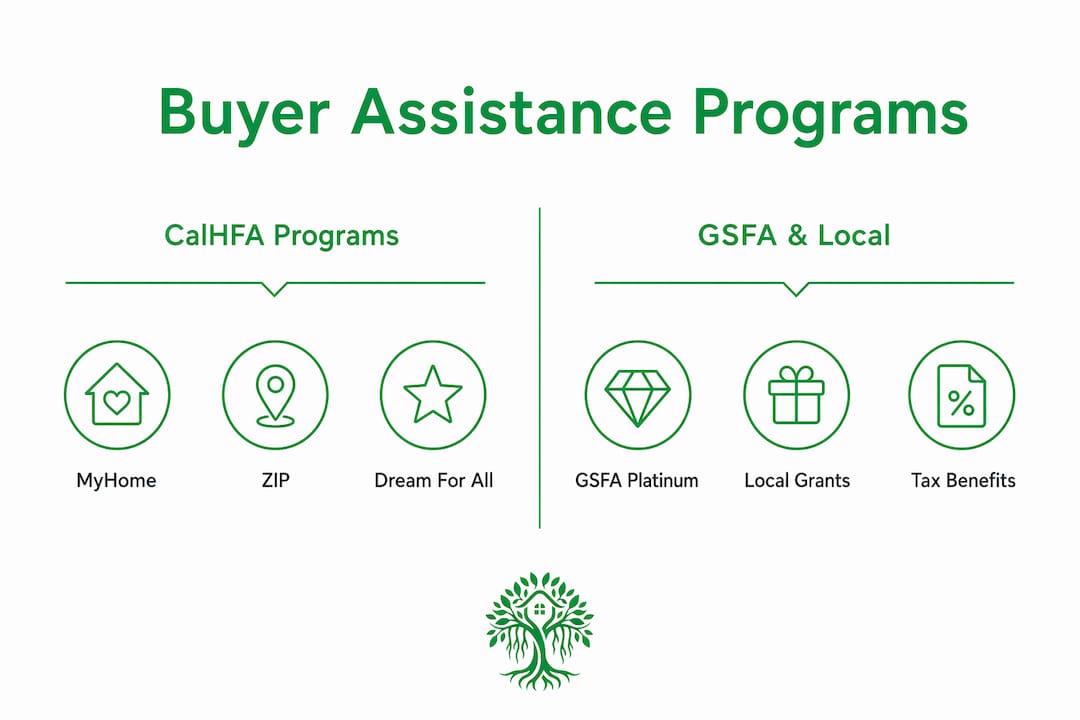
CalHFA MyHome Assistance Program is the most widely used option. It provides a deferred junior loan of up to 3.5% of the purchase price for FHA loans or 3% for conventional loans. You make no monthly payments. Repayment is triggered only when you sell, refinance, or pay off your first mortgage. On a $700,000 home, that translates to up to $24,500 in upfront help with zero monthly obligation.

CalHFA ZIP (Zero Interest Program) covers closing costs only, not the down payment. It is a zero-interest, deferred-payment second loan. The real power of ZIP is in combination: MyHome and ZIP stacked together can deliver approximately 6.5% of the loan amount in total assistance, roughly $32,500 on a $500,000 home, with no monthly payments on either loan.
Dream For All is CalHFA’s most aggressive program. It provides a shared appreciation second loan of up to 20% of the purchase price, capped at $150,000. There are no monthly payments, but when you sell or refinance, you repay the original loan amount plus a proportional share of your home’s appreciation. Access is lottery-based and requires first-generation buyer status, meaning neither of your parents owned a home during your childhood.
GSFA Platinum Program operates differently from CalHFA products. It offers a non-repayable grant of up to 5.5% of the loan amount and is available to both first-time and repeat buyers who meet income limits. Because it is a true grant, there is no repayment obligation at all.
| Program | Assistance type | Amount | Repayment |
|---|---|---|---|
| CalHFA MyHome | Deferred junior loan | Up to 3.5% (FHA) / 3% (conventional) | On sale or refinance |
| CalHFA ZIP | Zero-interest deferred loan | Closing costs only | On sale or refinance |
| Dream For All | Shared appreciation loan | Up to 20%, max $150,000 | Loan + appreciation share |
| GSFA Platinum | Non-repayable grant | Up to 5.5% | Never |
Pro Tip: Stack MyHome with ZIP from day one. Most buyers focus only on the down payment and forget that closing costs on a California home routinely run $8,000 to $15,000. ZIP covers that gap with zero interest.
How to qualify and apply for California first-time buyer programs
Qualifying for California housing programs for beginners requires meeting criteria across four categories: buyer history, income, credit, and education.
-
First-time buyer definition. You qualify as a first-time buyer if you have not owned and occupied a primary residence in the past three years. This rule applies to all CalHFA programs. A prior homeowner who sold three or more years ago is eligible again.
-
First-generation buyer definition. Dream For All adds a stricter layer. First-generation status requires that no parent or guardian owned residential property during your childhood. If either parent currently owns property anywhere, you are disqualified. Documentation proving this is mandatory, and misunderstanding this rule is the most common reason applicants are rejected.
-
Credit score minimums. CalHFA programs generally require a minimum 660 credit score for most loan types, though FHA-backed options may allow scores as low as 640. GSFA Platinum has its own lender-specific thresholds. Check with your lender before assuming you qualify.
-
Income limits. Limits vary by county and household size. In high-cost counties like Santa Clara and San Francisco, income limits are higher than in inland counties. CalHFA publishes updated county-by-county income tables annually.
-
Homebuyer education. All CalHFA programs require completion of an approved homebuyer education course before closing. CalHFA accepts courses from HUD-approved counseling agencies and online providers like eHome America.
-
Apply through an approved lender. CalHFA does not lend directly. You access every program through one of over 200 CalHFA-approved lenders statewide. Your lender submits the application on your behalf. Not every approved lender participates in every program, so confirm program availability before committing to a lender.
-
Dream For All lottery timing. Dream For All opens a registration window, typically a few weeks, during which you must submit your application. Missing that window means waiting for the next cycle. Prepare your pre-approval and documentation well before the window opens.
Pro Tip: Get your pre-approval letter from a CalHFA-approved lender at least 60 days before you plan to make an offer. For Dream For All, treat the lottery deadline like a tax filing deadline. Late preparation is the single biggest reason qualified buyers miss out.
Comparing CalHFA MyHome and Dream For All: which fits your situation?
These two programs serve different buyer profiles, and picking the wrong one is a costly mistake.
MyHome is available year-round on a first-come, first-served basis. It works with both FHA and conventional loans. The assistance is a deferred loan with simple interest accruing, but no monthly payments. You repay the original amount plus accrued interest when you sell or refinance. MyHome and Dream For All differ significantly in both access method and long-term cost structure.
Dream For All is lottery-based and available only to first-generation buyers. It works exclusively with conventional loans. The upside is substantial: up to $150,000 in assistance. The trade-off is that you share your home’s appreciation with the state when you exit. If your home appreciates 40% over seven years, you owe the state 20% of that gain on top of the original loan.
- Choose MyHome if you do not meet first-generation requirements, need FHA financing, or want predictable repayment terms without an equity-sharing component.
- Choose Dream For All if you qualify as first-generation, are buying a higher-priced home where 20% assistance makes a material difference, and plan to hold the property long enough that the appreciation share is worth the upfront benefit.
- Stacking rules: MyHome can be combined with ZIP for closing cost coverage. Dream For All cannot be stacked with MyHome but can be paired with other programs depending on lender approval. Verify stacking eligibility with your lender before structuring your offer.
Shared appreciation loans balance large upfront assistance against a reduction in future equity gains. Buyers who expect to sell within five to seven years in a rising market should calculate the total cost of appreciation sharing before committing.
What local programs complement CalHFA assistance?
State programs are not the only source of help. County and city programs often fill gaps that CalHFA leaves open, and local programs like Los Angeles’s LIPA and Berkeley’s local assistance can be layered with CalHFA or GSFA for expanded total aid.
Key facts about local programs:
- Los Angeles LIPA (Low Income Purchase Assistance) provides deferred loans for down payment and closing costs to low-income buyers purchasing in the City of Los Angeles. Income and property location restrictions apply.
- Berkeley and other Bay Area cities offer first-generation and low-income buyer assistance programs with their own eligibility criteria, often targeting buyers below 80% of Area Median Income.
- Stacking potential is real but complex. Combining a local program with CalHFA MyHome and ZIP can push total assistance above 10% of the purchase price on qualifying properties. That is a material reduction in cash needed at closing.
- Geographic restrictions matter. Local programs apply only to properties within city or county boundaries. A buyer targeting a home in Pasadena cannot use a City of Los Angeles program.
The most reliable way to identify local programs available to you is to ask a CalHFA-approved lender who specializes in first-time buyer transactions. These lenders track local program availability as part of their practice. You can also search the California Association of Realtors’ housing assistance database or contact your county housing authority directly.
What tax benefits apply to California first-time buyers?
Beyond loans and grants, two tax-based incentives reduce the ongoing cost of homeownership for qualifying buyers.
CalHFA Mortgage Credit Certificate (MCC) converts a portion of your annual mortgage interest into a direct federal tax credit of up to $2,000 per year. This is not a deduction. It reduces your federal income tax bill dollar for dollar. The credit continues every year you live in the home and pay mortgage interest, making it one of the most durable financial benefits available to California first-time buyers.
AB 1714 is a proposed California law that would create a 40% tax credit on repair costs up to $25,000 for sellers who close sales to buyers using first-time homebuyer assistance programs. The credit would apply to taxable years 2028 through 2032. This matters to buyers because sellers currently have little financial incentive to make repairs when selling to assisted buyers. AB 1714 changes that calculus and could make more properties accessible to program users.
Key points on California first-time buyer tax benefits:
- The MCC is issued at closing and filed annually with your federal tax return.
- MCC income and purchase price limits apply and vary by county.
- AB 1714 benefits the seller, but the downstream effect is a more cooperative transaction for the buyer using assistance programs.
- Consult a tax professional to calculate your specific MCC benefit based on your loan amount and interest rate.
Key takeaways
California first-time buyer programs provide the most value when you combine a deferred loan like CalHFA MyHome with ZIP for closing costs, add the Mortgage Credit Certificate for ongoing tax savings, and verify local program availability before submitting your offer.
| Point | Details |
|---|---|
| MyHome is the most accessible program | Available year-round through 200+ CalHFA-approved lenders with no monthly payments. |
| Dream For All requires first-generation proof | Parents must not have owned residential property during your childhood; documentation is mandatory. |
| Stack MyHome and ZIP together | Combined assistance reaches approximately 6.5% of loan amount with zero monthly obligation on either loan. |
| MCC delivers annual tax savings | Up to $2,000 per year in federal tax credits for the life of your mortgage. |
| Local programs expand total assistance | City and county programs like LIPA can layer with state programs to increase total buying power. |
What I’ve learned about navigating these programs
By Anand
After working with hundreds of California first-time buyers, the pattern I see most often is this: buyers spend weeks researching programs online and then lose their spot because they picked a lender who is not set up to process CalHFA applications efficiently. Verifying your lender’s specific program eligibility is not a formality. It is the first real decision you make, and the wrong choice costs you months.
The Dream For All program is genuinely powerful, but the first-generation requirement trips up more applicants than any other rule. I have seen buyers who were certain they qualified get rejected because a parent owned a vacation property decades ago. Read the Dream For All guidelines carefully and gather your documentation before the lottery window opens, not during it.
On shared appreciation loans: the math looks great at closing and can look painful at sale. If you buy a $600,000 home with $120,000 from Dream For All and sell five years later at $800,000, you owe the state $40,000 of that $200,000 gain on top of the original $120,000. That is still a net positive in most scenarios, but buyers who do not model this out in advance feel blindsided. Run the numbers with your lender before you commit.
Finally, stacking multiple programs adds weeks to your closing timeline. Budget for it. Tell your agent. Set expectations with the seller. The paperwork coordination between a first mortgage, a CalHFA second, a ZIP loan, and a local program is real work, and it moves at government speed.
— Anand
How Ficustree helps you find and use the right programs
Ficustree is an AI-powered home buying platform built specifically for California first-time buyers, and it does the program matching work for you.

When you start your search on Ficustree, the platform identifies which CalHFA programs, GSFA options, and local assistance programs you qualify for based on your income, location, and loan type. It connects you with CalHFA-approved lenders who actively participate in the programs you need, not just lenders who are technically approved. Ficustree also tracks application deadlines, including Dream For All lottery windows, so you never miss a registration period. If you want to understand your FHA loan options alongside your assistance program choices, the platform guides you through both in one place. Start your search on Ficustree and know exactly what you qualify for before you make your first offer.
FAQ
What counts as a first-time buyer in California?
You qualify as a first-time buyer if you have not owned and occupied a primary residence in the past three years. Prior homeowners who sold more than three years ago are eligible for CalHFA programs.
Can I combine multiple California assistance programs?
Yes. CalHFA MyHome and ZIP can be stacked for combined assistance totaling approximately 6.5% of the loan amount. Local programs like LIPA can layer on top, but verify stacking rules with your lender before structuring your financing.
What is the Dream For All first-generation requirement?
Dream For All requires that neither of your parents owned residential property during your childhood. First-generation status must be documented, and applicants whose parents currently own property are disqualified.
What is the CalHFA Mortgage Credit Certificate?
The Mortgage Credit Certificate converts up to 20% of your annual mortgage interest into a federal tax credit of up to $2,000 per year. It reduces your tax bill dollar for dollar every year you live in the home.
How do I apply for CalHFA programs?
CalHFA does not accept direct applications. You apply through one of over 200 CalHFA-approved lenders statewide, and your lender submits the program paperwork on your behalf. Confirm that your specific lender participates in the program you want before starting the process.