
Buying a house with no money down means securing a mortgage that requires zero upfront down payment, and three real paths exist to do it in California and Texas right now. VA loans, USDA loans, and state-sponsored down payment assistance programs each offer 100% financing options for qualified buyers. None of these paths are free rides. Each carries credit score minimums, income limits, and financial requirements you need to meet before a lender will say yes. This guide breaks down every option, what it costs you in the long run, and how to put yourself in the best position to close.
What loan programs allow buying a house with no money down?
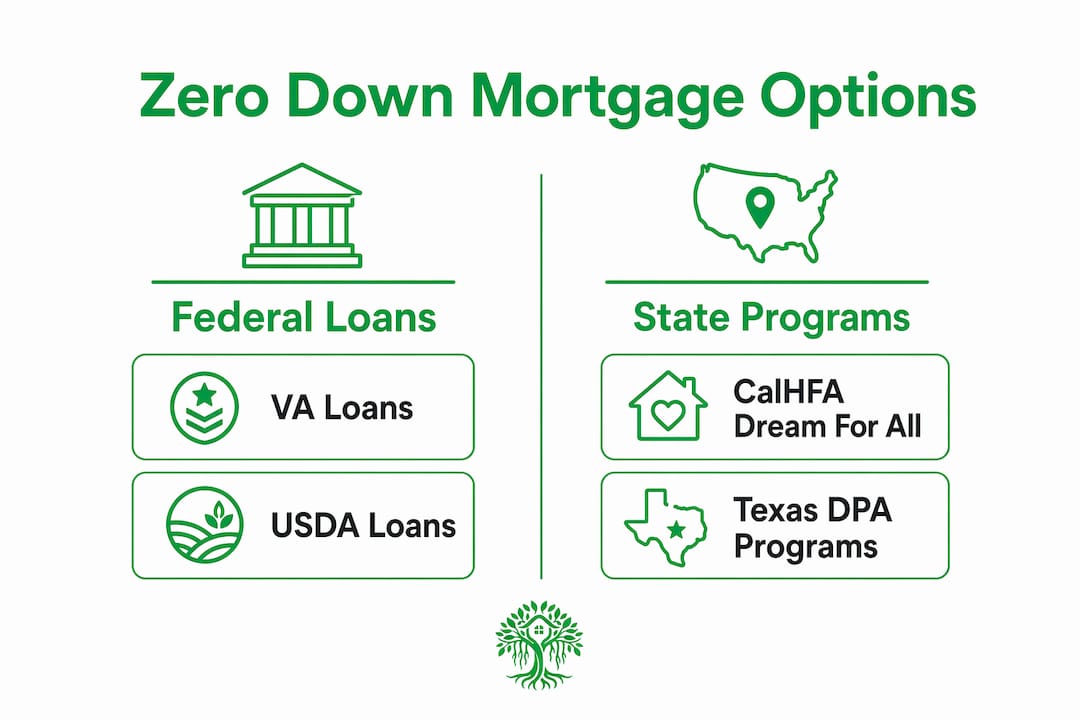
Three primary zero down payment mortgage programs serve California and Texas buyers in 2026. Each targets a different buyer profile, so knowing which one fits your situation saves you months of wasted effort.
VA loans
VA loans are the strongest no money down home loans available. They require zero down with no PMI, which immediately lowers your monthly payment compared to conventional loans with private mortgage insurance. Eligibility requires active duty service, veteran status, or qualifying surviving spouse status. The catch most buyers miss: you need a Certificate of Eligibility (COE) before any lender can process your loan. Many veterans assume their DD-214 discharge papers are enough, but lenders require the COE specifically. Request it online through the VA portal before you start shopping for homes.
VA loans do carry a funding fee. For first-time zero down use in 2026, that fee is typically 2.15% of the loan amount. On a $500,000 home, that adds $10,750 to your financed balance. It rolls into the loan, so you do not pay it upfront, but it does raise your monthly payment.
USDA loans
USDA loans offer 100% financing for properties in USDA-designated rural and some suburban areas. The program caps household income at 115% of the area median income. That limit is more generous than most buyers expect. A family of four in many Texas counties can earn well above $100,000 and still qualify. The property must be your primary residence and must sit within an eligible zone, which you verify on the official USDA eligibility map.
California and Texas down payment assistance
California’s Dream For All program, administered by CalHFA, provides up to 20% of the purchase price up to $150,000 as a shared appreciation loan. Texas takes a decentralized approach. The state hosts 77 local and state programs offering up to 5% assistance toward down payment and closing costs. Texas buyers who only use one program typically leave money on the table.
| Program | Who qualifies | Down payment | Key condition |
|---|---|---|---|
| VA loan | Veterans, active duty, surviving spouses | 0% | COE required; 2.15% funding fee |
| USDA loan | Buyers in eligible rural/suburban areas | 0% | Income at or below 115% AMI |
| CA Dream For All | California first-time buyers | Up to 20% covered | Shared appreciation repayment on sale |
| Texas DPA programs | Texas first-time buyers (varies by program) | Up to 5% covered | Program-specific income and purchase limits |
What financial qualifications do no down payment loans require in 2026?
Zero down does not mean zero scrutiny. Lenders apply strict financial standards to every no money down home loan application.
Credit score is the first filter. VA lenders typically require a FICO score of 620–670. USDA lenders prefer 640 or higher. Hitting 640 on a USDA application matters for a practical reason: scores at or above 640 qualify for streamlined underwriting, which speeds up approval. Scores below 640 trigger manual review, which adds time and uncertainty to your closing timeline.
Debt-to-income ratio (DTI) is the second major filter. Both VA and USDA programs target a DTI at or below 41%. DTI measures your total monthly debt payments divided by your gross monthly income. If you earn $7,000 per month before taxes, your total monthly debts including the new mortgage payment should stay at or below $2,870. Buyers who carry heavy car loans, student debt, or credit card balances often fail this test even with strong credit scores.
Income limits apply specifically to USDA and state DPA programs. USDA caps household income at 115% of the area median income for your county. California’s Dream For All and Texas DPA programs each carry their own income ceilings, which vary by county and household size.
Financial qualification checklist:
- Credit score of 620+ for VA loans; 640+ preferred for USDA
- DTI ratio at or below 41%
- Stable, verifiable income for at least two years
- Household income within program limits for USDA and DPA programs
- No recent bankruptcies or foreclosures within program-required waiting periods
- COE documentation ready for VA loan applications
One financial reality catches many first-time buyers off guard. Closing costs still apply even with a zero down payment mortgage. They typically run 2%–5% of the home price. On a $400,000 purchase, that is $8,000–$20,000 due at closing. Planning for closing costs is not optional.
Pro Tip: Ask your lender for a Loan Estimate within three business days of your application. It itemizes every closing cost line by line, so you know exactly what cash you need at the table.
How do you navigate down payment assistance programs in California and Texas?
Down payment assistance programs reward buyers who do their homework before they apply.
California’s Dream For All program opened its 2026 application window in february. CalHFA funded the program at $150–$200 million. The program provides a shared appreciation loan, which means CalHFA contributes up to 20% of your purchase price and receives 20% of the home’s appreciation when you sell or refinance. If you buy at $500,000 and sell at $700,000, CalHFA receives 20% of the $200,000 gain, which is $40,000 back to the program on top of the original loan amount. That is a meaningful reduction in your net proceeds. Buyers who plan to sell within five years should model this math carefully before committing.
Texas buyers face a different challenge. No single statewide program dominates. Instead, 77 local and state programs operate across Texas counties and cities. The most effective Texas strategy is layering multiple programs to cover both down payment and closing costs. A buyer in Houston, for example, might combine a state-level forgivable loan with a city-level grant and a lender credit to arrive at closing with minimal out-of-pocket costs. Buyers who rely on a single program often still face thousands in uncovered closing costs.
Pro Tip: Some California DPA programs use lottery or random selection when demand exceeds funding. Check CalHFA’s website for the exact application window and submit on day one. Waiting even a week can mean missing the funding round entirely.
For both states, seller concessions are an underused tool. Sellers can contribute toward your closing costs as part of the purchase agreement. In a slower market, asking for 2%–3% in concessions is reasonable and can eliminate most of your remaining out-of-pocket expense after DPA funds are applied.
What steps should first-time buyers take to buy a home with no money down?
A clear sequence separates buyers who close from buyers who stall.
The first step is confirming your eligibility for the program you want to use. VA loan applicants must obtain their COE before approaching lenders. USDA applicants must verify the property address on the official USDA eligibility map, which updates regularly. An address that qualified last year may not qualify today. Check the map for every property you seriously consider, not just once at the start of your search.
The second step is finding a lender who actively works with your target program. Not every lender processes VA or USDA loans efficiently. Ask specifically how many VA or USDA loans the lender closed in the past 12 months. A lender who closes two per year will move slower and make more errors than one who closes 50.
The third step is stacking your assistance. Confirm which DPA programs you qualify for, apply to all of them simultaneously where permitted, and communicate with your lender about how each layer interacts with your primary loan.
| Milestone | Action required | Timing |
|---|---|---|
| Eligibility check | Obtain COE (VA) or verify USDA map address | Before home search |
| Pre-approval | Submit income, credit, and DTI documentation | Week 1–2 |
| DPA application | Apply to all qualifying state and local programs | Concurrent with pre-approval |
| Offer and contract | Request seller concessions for closing costs | At offer stage |
| Closing | Confirm final cash-to-close figure with lender | One week before closing |
Understanding California closing costs in detail before you reach the closing table prevents last-minute surprises that can delay or kill a deal.
What common mistakes derail no money down home purchases?
Most failed applications share the same avoidable errors.
- Ignoring credit score minimums. Applying for a USDA loan with a 620 score triggers manual underwriting and often rejection. Hit 640 before you apply.
- Skipping the COE for VA loans. Lenders cannot process a VA loan without it. Delays here push back your entire closing timeline.
- Assuming USDA property eligibility. The USDA map updates. Verify the specific address, not just the general area.
- Using only one DPA program in Texas. Stacking local and state programs is the standard move for well-prepared buyers. Using one program alone leaves assistance unclaimed.
- Forgetting closing costs. Zero down does not mean zero cash at closing. Budget 2%–5% of the purchase price for closing costs, and plan to cover any gap not addressed by seller concessions or DPA funds.
- Underestimating the VA funding fee. At 2.15% of the loan amount, this fee adds real dollars to your financed balance. Factor it into your total loan cost calculation, not just your monthly payment.
Reviewing common first-time buyer mistakes before you start the process gives you a significant advantage over buyers who learn these lessons the hard way.
Key Takeaways
Buying a house with no money down is achievable in California and Texas through VA loans, USDA loans, or state DPA programs, but each path requires meeting specific credit, income, and documentation standards.
| Point | Details |
|---|---|
| Three real zero down paths | VA loans, USDA loans, and state DPA programs each serve different buyer profiles. |
| Credit score thresholds matter | VA requires 620–670 FICO; USDA prefers 640+ for streamlined approval. |
| Closing costs are not optional | Budget 2%–5% of the home price even with zero down payment financing. |
| Stack Texas DPA programs | Combining local and state programs covers more upfront costs than any single program alone. |
| Dream For All has long-term costs | CalHFA recaptures 20% of appreciation on sale, which reduces your net proceeds. |
The part most buyers skip until it’s too late
I have watched buyers spend four months chasing a VA loan only to discover at pre-approval that their COE had an error that took six weeks to resolve. The documentation step feels administrative and boring, so buyers put it off. That is the single most expensive mistake you can make with a zero down purchase.
The second thing I see buyers consistently underestimate is the long-term math on shared appreciation loans. California’s Dream For All is a genuinely useful program for buyers who plan to stay in a home for a decade or more. But if you are buying a starter home with a five-year horizon, you need to model what 20% of your appreciation looks like at sale. In a market where California homes appreciate at historical rates, that repayment can be substantial. The program is not bad. It is just not right for every buyer, and nobody in the transaction has a financial incentive to tell you that except you.
Texas buyers have the opposite problem. The assistance is there, spread across 77 programs, and most buyers never find most of it. The buyers who close with the least cash out of pocket are the ones who spent two weeks researching every county and city program before they ever talked to a lender. That research is unglamorous, but it is worth thousands of dollars.
Zero down does not mean zero cost. It means zero down payment. The buyers who succeed are the ones who understand that distinction before they sign anything.
— Anand
How Ficustree helps first-time buyers find the right no down payment path
Sorting through VA loans, USDA eligibility maps, and 77 Texas DPA programs while also managing offers and inspections is a lot to carry alone.

Ficustree is an AI-powered platform built specifically for first-time buyers in California and Texas. It functions as your decision intelligence layer, not a listings site. The platform helps you identify which no down payment programs you qualify for, tracks your documentation checklist, and connects you with showing agents on demand. Buyers pay $1,000 at closing plus 1% commission and keep a rebate of roughly 2% where permitted. You get the full platform free. Ficustree’s home buying workflow tools compress the typical six-month confusion cycle into two months of clear, guided steps.
FAQ
What is a zero down payment mortgage?
A zero down payment mortgage is a home loan that requires no upfront down payment from the buyer. VA loans and USDA loans are the two federally backed programs that offer this, and state DPA programs can cover the down payment on conventional loans.
Can I buy a house with no money down in California without being a veteran?
Yes. California’s Dream For All program through CalHFA provides up to 20% of the purchase price as a shared appreciation loan for qualifying first-time buyers who are not veterans. Income limits and application windows apply.
What credit score do I need for a no money down home loan?
VA loans typically require a FICO score of 620–670. USDA loans prefer 640 or higher, with scores below 640 triggering manual underwriting and slower approval timelines.
Do I still pay closing costs with a zero down mortgage?
Yes. Closing costs run 2%–5% of the purchase price regardless of your down payment amount. Texas and California DPA programs, combined with seller concessions, can offset most or all of these costs for well-prepared buyers.
How do I verify USDA loan eligibility for a specific property?
Check the official USDA eligibility map at the USDA website using the exact property address. The map updates regularly, so verify each property individually rather than assuming an area qualifies based on past searches.