
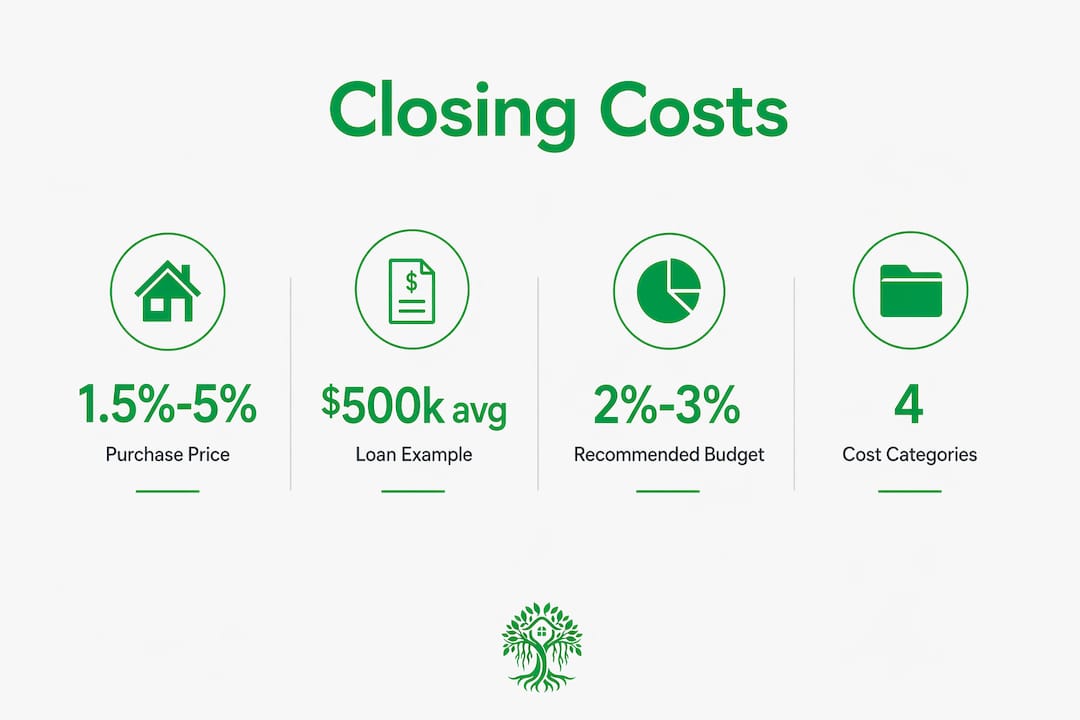
Closing costs in California are the fees and charges you pay at the end of a home purchase, separate from your down payment. California buyers should budget between 1.5% and 5% of the purchase price for these costs. On a median-priced $905,000 home, that translates to roughly $13,575 to $45,250 in additional cash you need at the table. For a $500,000 home, expect $7,500 to $25,000. Understanding this closing costs breakdown for California before you make an offer is the difference between a smooth closing and a last-minute scramble for cash.
What types of closing costs do California buyers pay?
The four main buckets of California closing costs are lender fees, title and escrow fees, prepaid expenses, and government fees. Knowing which bucket each charge falls into tells you immediately whether you can negotiate it or not. Fixed government fees are non-negotiable. Lender and service fees often are.
Lender fees
Lender fees cover the cost of processing and approving your mortgage. The median total loan cost in California reached $7,820 in 2025, which is 84.3% higher than the national median of $4,242. That gap reflects California’s high loan balances and the concentration of expensive markets. Common lender fees include origination fees (typically 0.5%–1% of the loan), underwriting fees, processing fees, and appraisal costs.

Title and escrow fees
Title insurance protects you and your lender if ownership disputes arise after closing. Escrow fees pay the neutral third party that manages the transaction funds and documents. Both fees scale with the purchase price, so they get expensive fast in California. These fees vary by provider, which means you have real room to shop around.
Prepaid expenses
Prepaid expenses are not junk fees. They are real costs you pay upfront to fund your escrow impound account and cover the gap between closing and your first mortgage payment. Expect to prepay homeowners insurance (typically 12 months), property taxes (2–6 months), and prepaid mortgage interest for the days remaining in the closing month.
Government fees and transfer taxes
Recording fees and transfer taxes are set by the county and city. California’s state transfer tax is $1.10 per $1,000 of the sale price. Several cities, including Los Angeles and San Francisco, add their own transfer taxes on top of that. These costs are fixed. No amount of negotiation changes them.
| Fee category | Typical range | Negotiable? |
|---|---|---|
| Lender origination fee | 0.5%–1% of loan | Yes |
| Title insurance | $1,000–$3,500+ | Sometimes |
| Escrow fee | $1,500–$3,000+ | Sometimes |
| Prepaid expenses | 1–3 months of costs | No |
| Government/transfer taxes | Fixed by county/city | No |
Pro Tip: Ask your lender for a Loan Estimate within three business days of your application. Federal law requires it. That document lists every fee by category so you can compare lenders line by line.
How can first-time California buyers budget for closing costs?
Closing costs do not exist in isolation. You need to plan for them alongside your down payment, moving costs, and the cash reserves your lender will require. Careful financial planning is critical in California because high home prices mean every percentage point translates into thousands of dollars. Running short on cash at closing is a real risk if you only budget for the down payment.
Here is a practical budgeting sequence to follow:
- Calculate your target purchase price. Use your pre-approval amount as a ceiling, not a goal. Your true budget includes the down payment plus closing costs plus reserves.
- Estimate closing costs at 2%–3% of the purchase price. This is a conservative midpoint that works for most California purchases. Adjust up if you are buying in San Francisco or Los Angeles, where city transfer taxes add to the total.
- Add your reserve requirement. Most lenders require 2 to 6 months of mortgage payments in cash reserves after closing. Jumbo loans typically require six months. Standard conforming loans require two. These reserves must sit in your account at closing. They are not spent, but they must be there.
- Build a cash buffer beyond reserves. Moving costs, immediate repairs, and utility deposits add up fast. Budget an extra $3,000–$5,000 as a cushion.
- Verify your numbers with a closing cost calculator. Many lenders and real estate platforms offer free calculators. Plug in your purchase price, loan type, and county to get a sharper estimate.
Pro Tip: Get your closing cost estimate before you fall in love with a specific home. Knowing your full cash requirement upfront keeps you from making an offer you cannot actually close.
You can also review the types of California homeownership costs beyond closing to build a complete picture of what owning a home in this state actually costs month to month.
What state programs help first-time buyers with closing costs in California?
California offers several programs specifically designed to reduce the out-of-pocket burden for first-time buyers. These programs do not eliminate closing costs, but they can cover a significant portion of them so you do not have to drain your savings.
- CalHFA MyHome Assistance Program. This program provides deferred-payment junior loans of up to 3.5% of the home’s purchase price for FHA loans, or 3% for conventional loans. The funds can cover both down payment and closing costs. You repay the loan when you sell, refinance, or pay off the first mortgage.
- California Dream For All. This shared-appreciation program can provide up to 20% of the purchase price to qualified first-time buyers. In exchange, the state receives a share of the home’s appreciation when you sell. It is a powerful tool for buyers who are cash-constrained but have stable income.
- Local city and county programs. Many California cities run their own assistance programs with grants or forgivable loans. Los Angeles, San Jose, and Oakland each have active programs. Eligibility typically depends on income limits and the property being your primary residence.
- Nonprofit and employer-assisted programs. Some nonprofits and large employers offer closing cost grants or matched savings programs. These are worth researching if you work in education, healthcare, or government.
Combining a CalHFA first mortgage with the MyHome junior loan is one of the most common strategies for first-time buyers in California. You can explore the full range of California buyer assistance programs to find what you qualify for based on income, county, and loan type.
How do you negotiate and reduce closing costs in California?
Negotiation is possible on more line items than most first-time buyers realize. The key is knowing which fees are fixed and which are flexible before you sit down with a lender or sign a purchase agreement.
- Shop lenders aggressively. The gap between the highest- and lowest-cost lenders on similar California loans exceeds $10,000. That is not a rounding error. Getting Loan Estimates from three or more lenders is the single highest-return action you can take before closing.
- Negotiate origination and processing fees. Lender fees like origination, underwriting, and processing are negotiable in many cases. Ask directly. The worst answer is no.
- Shop title and escrow providers. In California, buyers can choose their own title and escrow companies. Rates vary. Calling two or three providers and comparing quotes takes less than an hour and can save several hundred to over a thousand dollars.
- Request seller concessions. In a buyer-friendly market, sellers sometimes agree to cover a portion of your closing costs. This is called a seller concession or seller credit. Learn how to ask for seller concessions effectively so you do not leave money on the table.
- Evaluate discount points carefully. Discount points appear on 46% of California mortgage loans with a median cost of $3,208. Paying points buys a lower interest rate, but only makes financial sense if you stay in the home long enough to recoup the upfront cost. Calculate your break-even point before agreeing to any points.
Pro Tip: Never accept the first Loan Estimate as final. After you receive competing offers, go back to your preferred lender and ask them to match or beat the best quote. Lenders expect this.
Key takeaways
California closing costs range from 1.5% to 5% of the purchase price, and first-time buyers who plan for all four fee categories, reserve requirements, and available assistance programs close with far less stress and more money in their pocket.
| Point | Details |
|---|---|
| Budget 2%–3% as a baseline | Plan for 1.5%–5% of the purchase price; use 2%–3% as a conservative starting estimate. |
| Four fee buckets matter | Lender, title/escrow, prepaid, and government fees each behave differently for negotiation. |
| Reserves are required | Most lenders require 2–6 months of mortgage payments in cash beyond closing costs. |
| State programs reduce the burden | CalHFA MyHome and California Dream For All can cover down payment and closing costs for eligible buyers. |
| Shopping lenders saves thousands | The cost gap between lenders on similar California loans exceeds $10,000. |
What I have learned about closing costs the hard way
By Anand
Most first-time buyers I talk to have done the math on their down payment. Almost none of them have done the math on reserves. That is the number that catches people off guard. You can have your down payment and closing costs ready, then find out your lender requires six months of mortgage payments sitting in your account on top of that. On a $600,000 loan, six months of payments can easily be $20,000 or more. That is a real number that real buyers have to scramble to find.
The second mistake I see constantly is treating the Loan Estimate as a formality. It is not. It is a negotiating document. The buyers who read it line by line and push back on fees they do not recognize almost always close for less than buyers who sign and move on. The common mistakes first-time buyers make around closing costs are almost always about passivity, not ignorance.
My honest advice: start your closing cost planning the same week you start your home search. Not the week before closing. The buyers who do this show up to the table confident. The ones who do not show up stressed and sometimes unable to close.
— Anand
How Ficustree helps you plan for closing costs

Ficustree is built for exactly this moment. When you are trying to figure out what you can actually afford, the platform gives you a clear picture of your full cash requirement, not just the purchase price. That means down payment, estimated closing costs, and reserve requirements in one place.
Ficustree represents buyers directly, with a fee of $1,000 at closing plus 1% commission, and passes a rebate of roughly 2% back to you where legally permitted. That rebate can offset a meaningful portion of your closing costs. The Ficustree buyer platform walks you through each step of the purchase process so nothing catches you off guard at the table.
FAQ
What is the average closing cost for a buyer in California?
California buyers typically pay 1.5% to 5% of the home’s purchase price in closing costs. On a $500,000 home, that means budgeting $7,500 to $25,000 beyond the down payment.
Can closing costs be rolled into the mortgage in California?
Most conventional loans do not allow buyers to roll closing costs into the loan balance. However, seller concessions and lender credits can reduce the cash you need to bring to closing.
What are the biggest closing cost fees for California buyers?
Lender fees and title and escrow fees are typically the largest line items. The median total loan cost in California was $7,820 in 2025, well above the national median of $4,242.
Does California have programs to help with closing costs?
Yes. The CalHFA MyHome Assistance Program offers deferred junior loans of up to 3.5% of the purchase price. California Dream For All can provide up to 20% of the purchase price for eligible first-time buyers.
Are closing costs negotiable in California?
Lender origination, processing, and underwriting fees are negotiable. Title and escrow fees vary by provider and can be reduced by shopping around. Government transfer taxes and recording fees are fixed and cannot be negotiated.