
CalHFA income limits for 2026 are set by two program-specific tables published on the official CalHFA limits page: one for the Dream For All Shared Appreciation Loan and one for All CalHFA First Mortgages and Subordinate Mortgages. The California Department of Housing and Community Development (HCD) publishes the underlying 2026 State Income Limits PDF that feeds several CalHFA programs. Check the effective date printed on each PDF before you rely on any figure.
Three quick county examples from the 2024 Government and Conventional table (the most recent published PDF) give you a sense of variation across counties: higher-income counties have larger ceilings and lower-income counties smaller ones. The 2026 limits follow the same county-by-county structure; download the current PDF from CalHFA to confirm your county’s exact ceiling. Also check CalHFA Program Bulletins for any mid-year changes, since CalHFA can update limits outside the static page.

Table of Contents
- What are CalHFA income limits and why do they vary by program?
- Where to find your county’s income limit PDF and how to read it
- Which CalHFA program uses which income limit table?
- How does CalHFA calculate your household income?
- What should you do right now to check your eligibility?
- Key Takeaways
- The part most buyers miss about CalHFA income rules
- How Ficustree helps you confirm CalHFA eligibility
- Useful sources to verify current limits
- FAQ
What are CalHFA income limits and why do they vary by program?
CalHFA income limits are household gross-income ceilings. If your total annual household income exceeds the cap for your county and program, you cannot use that CalHFA-funded assistance, even if you qualify for the underlying mortgage. That is the key distinction: FHA loans carry no borrower income cap at all. FHA focuses on debt-to-income ratio and affordability, not a maximum income threshold. CalHFA assistance programs layer on top of FHA or conventional financing and add their own county-based income rules.

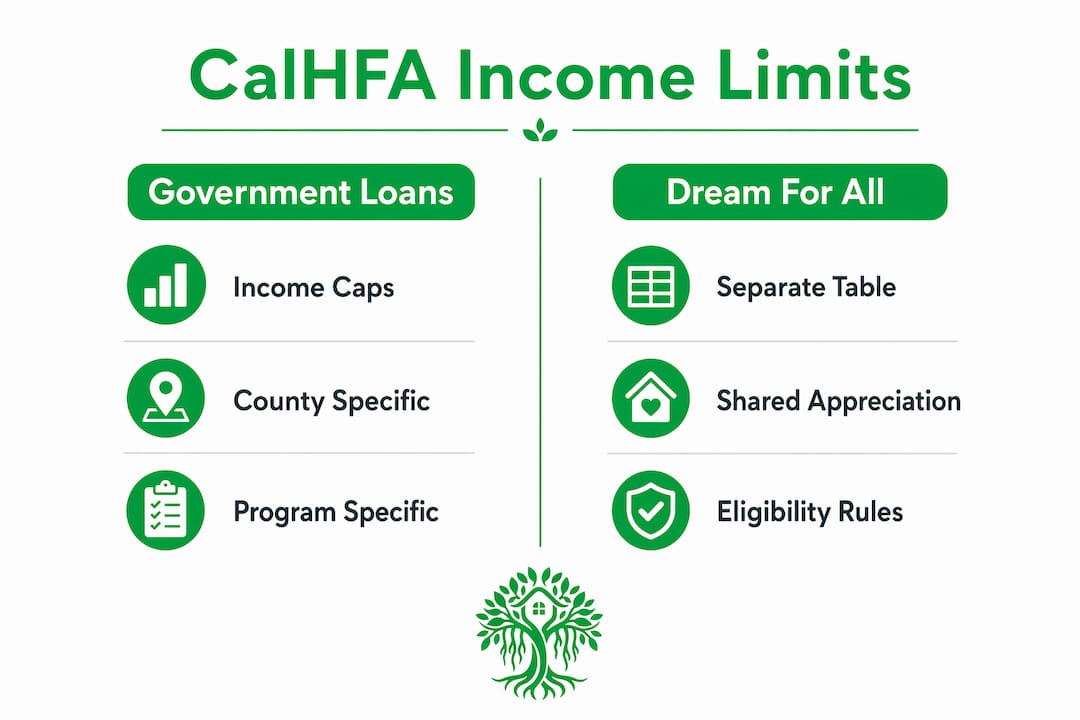
Multiple tables exist because each CalHFA product draws on different federal and state funding streams, each with its own eligibility rules. The Dream For All Shared Appreciation Loan, for example, typically carries lower income ceilings than the standard first-mortgage table. County variation reflects local Area Median Income (AMI), which HUD calculates annually and HCD translates into California-specific thresholds.
Here are the three main limit tables you will encounter:
- Dream For All Shared Appreciation Loan income limits — program-specific, often lower than the standard table; published separately on CalHFA’s limits page.
- All CalHFA First Mortgages and Subordinate Mortgages income limits — the broadest table, covering most CalHFA first and subordinate loan products.
- HCD State Income Limits (2026 PDF) — the statewide AMI-based table used for certain subordinate programs and Low Income (LI) eligibility determinations.
Understanding which table governs your program before you run the numbers saves you from a late-stage surprise. Many buyers learn this the hard way after a lender pre-qualifies them for an FHA loan, only to find their household income exceeds the CalHFA cap for the down payment assistance they planned to use.
Where to find your county’s income limit PDF and how to read it
The two authoritative downloads are the CalHFA program limits page and the HCD 2026 State Income Limits PDF. Download both and keep them in your mortgage file.
How to read a CalHFA county table row:
- Locate your county alphabetically in the PDF.
- The figure listed is the gross annual household income ceiling for that county under that program.
- Confirm the effective date printed at the bottom of the PDF (look for a date in MM.DD.YYYY format).
- If the effective date is older than the current program bulletin, download the updated version from the CalHFA limits page.
The table below shows example counties from the published Government and Conventional table for All CalHFA First Mortgages, alongside the Dream For All limits, illustrating how the two tables diverge for the same county. Always download the current PDFs from CalHFA for the most up-to-date limits.
The HCD statewide table differs structurally from the CalHFA program PDFs. HCD breaks limits into AMI categories (extremely low at 30%, very low at 50%, low at 80%, moderate at 120%) and lists figures for household sizes 1 through 8. CalHFA’s program PDFs typically show a single per-county ceiling rather than a full AMI breakdown, which is why you need both documents when checking eligibility for subordinate or LI-specific products.
Which CalHFA program uses which income limit table?
The mapping is straightforward once you know it, but it trips up a lot of buyers.
Dream For All Shared Appreciation Loan uses its own dedicated income limit table, published separately on the CalHFA limits page. These caps are lower than the standard first-mortgage table, and the program has historically been oversubscribed, so confirming eligibility early matters.
All CalHFA First Mortgages and Subordinate Mortgages (including MyHome Assistance and ZIP programs) use the Government and Conventional income limits table. This is the broader table with higher county ceilings.
Low Income (LI) subordinate products reference the HCD State Income Limits at the 80% AMI threshold. CalHFA’s Program Bulletin #2026-05 updated these 80% AMI figures specifically to determine LI eligibility, so check that bulletin if you are applying for an LI-designated subordinate loan.
One important caution: CalHFA publishes program-specific income limits and notes that limits may differ by program and cannot exceed certain federal maximum thresholds. Qualifying for one CalHFA product does not guarantee eligibility for another. Always verify the effective date on the PDF you are using and cross-check against the most recent program bulletin before submitting your loan file.
How does CalHFA calculate your household income?
Income eligibility is based on total gross annual household income — every dollar earned by all borrowers and co-borrowers before taxes and deductions. That definition is broader than most buyers expect.
Common income types CalHFA lenders will count and document:
- W-2 wages — base salary plus any guaranteed overtime.
- Bonuses and commissions — typically averaged over two years.
- Self-employment and 1099 income — net income from Schedule C, averaged over two years.
- Investment and rental income — documented via tax returns and bank statements.
- Social Security and disability payments — grossed up per lender guidelines.
Family-size adjustments matter significantly. HCD’s methodology applies percentage factors to the four-person AMI base to set limits for other household sizes. Smaller households face lower ceilings; larger households get higher ones. The HCD 2026 adjustment table uses factors such as 70% for a one-person household and 108% for a five-person household relative to the four-person base. A quick example: if a county’s four-person limit is $200,000, a two-person household’s limit would be set at 80% of that base, or $160,000.
Pro Tip: The single most overlooked income item is seasonal or irregular 1099 income. If you did contract work for six months last year, a lender will average that income across 24 months, not just the months you worked. Document it fully and early, or work with your lender to determine whether it qualifies as irregular income that can be excluded with proper documentation.
HCD’s Hold Harmless policy also means county AMI figures do not decrease below prior high-water marks, even when HUD’s national data would otherwise push them lower. That is why some inland counties hold limits that look high relative to current local wages.
What should you do right now to check your eligibility?
Getting this right before you are deep in escrow is the move. Here is a short, prioritized checklist:
- Download the right PDF. Go to the CalHFA limits page and download the table for your specific program. Confirm the effective date.
- Identify your program. Are you applying for Dream For All, a standard CalHFA first mortgage, or an LI subordinate product? Each uses a different table.
- Calculate your gross household income. Add up all income sources for every borrower, including bonuses and 1099 work. Use the home affordability calculator to stress-test the full picture.
- Apply the family-size adjustment. Find your household size in the HCD table and confirm you are comparing your income to the right row.
- Contact an approved CalHFA lender early. Lenders can run a soft eligibility check before you are under contract. Ask them to pull the current program bulletin, not just the static PDF.
Check CalHFA Program Bulletins and the Rates and Reservations portal for any mid-year limit changes. CalHFA has issued updates like Program Bulletin #2026-07 (updated income limits) and #2026-05 (updated 80% AMI LI limits) that changed eligibility after the static page was last refreshed. If you are in escrow, re-check.
Ficustree can help you map your county and program to the right table and run a quick eligibility check before you commit to a loan structure. It is a faster way to confirm you are looking at the right numbers.
Key Takeaways
CalHFA income limits vary by both county and program, and using the wrong table is the most common reason buyers discover a problem late in the process.
| Point | Details |
|---|---|
| Two program tables | Check the Dream For All table or the All CalHFA First Mortgages table depending on your program. |
| Always confirm the effective date printed on the PDF before relying on any figure — download the current version from CalHFA for updates. | |
| Gross household income counts | All income from all borrowers, including bonuses and 1099 work, counts toward the limit. |
| Family-size adjustments apply | HCD factors (e.g., 70% for one person, 108% for five) shift the ceiling up or down by household size. |
| Ficustree eligibility check | Ficustree maps your county and program to the correct table and runs a pre-check before you apply. |
The part most buyers miss about CalHFA income rules
Most articles on this topic stop at “check your county’s limit.” That is necessary but not sufficient. The real trap is the program-to-table mismatch. Buyers research the standard first-mortgage limit, see they qualify, and then apply for Dream For All without realizing it uses a separate, lower table. By the time the lender catches it, they have already paid for an appraisal and inspection.
The second trap is treating income as a static number. If you had a strong bonus year or picked up freelance work, your two-year average may push you over the cap even if your base salary sits comfortably below it. The fix is simple: run the numbers before you choose a program, not after you fall in love with a property.
California’s first-time buyer programs are genuinely valuable, but they reward buyers who do the homework upfront. The county table is the starting point, not the finish line.
How Ficustree helps you confirm CalHFA eligibility
Figuring out which table applies to your situation, calculating your gross household income correctly, and matching it to the right county row takes time most buyers do not have. Ficustree cuts that process down significantly.

With Ficustree, you get access to an affordability calculator built for real California budgets, direct connections to approved CalHFA lenders, and step-by-step guidance on which program table applies to your situation. Buyers pay $1,000 at closing plus 1% commission, keep a rebate of roughly 2% where legally permitted, and use the full platform free. No obligation to start. Check your eligibility at Ficustree and know where you stand before you make an offer.
Useful sources to verify current limits
- CalHFA Income Limits page — the primary source for all program-specific PDFs, including Dream For All and the Government and Conventional table. Check here first.
- HCD 2026 State Income Limits PDF — the AMI-based statewide table used for LI eligibility and subordinate program calculations.
- CalHFA Program Bulletins (Income Limits) — mid-year updates that can change eligibility between static PDF refreshes.
Verify the effective date shown at the bottom of every PDF before you use it. If the date predates the most recent program bulletin, download the updated version. Save or print the exact PDF version used during your loan application and keep it in your mortgage file. Lenders and underwriters may request it.
For San Diego County buyers, local first-time buyer guidance can also help you understand how county-specific programs layer on top of CalHFA assistance.
This article is general information, not legal or financial advice. Confirm current limits and program eligibility with an approved CalHFA lender or the official CalHFA program pages for your specific situation.
FAQ
What are the CalHFA income limits for 2026?
CalHFA publishes two program-specific tables; always check the date at the bottom of your county’s PDF and the CalHFA limits page for the current version. Limits vary by county, ranging from lower ceilings in lower-AMI counties to higher ceilings in high-cost counties like Alameda, San Francisco, and Santa Clara under the standard first-mortgage table.
Does FHA have an income limit for borrowers?
No. FHA loans have no maximum borrower income requirement; FHA qualification focuses on debt-to-income ratio and credit. CalHFA assistance programs, however, add county-based income caps on top of FHA underwriting, which is why you can qualify for an FHA mortgage but still be ineligible for CalHFA down payment help.
What income counts toward the CalHFA limit?
CalHFA uses total gross annual household income from all borrowers, including wages, overtime, bonuses, self-employment income, 1099 contract work, investment income, and rental income. Lenders typically average variable income over two years.
Is California offering $150,000 to first-time buyers?
The California Dream For All Shared Appreciation Loan has offered a shared appreciation loan for eligible first-time buyers, with specific terms and caps depending on the program round. Availability depends on program funding, which is limited; check the CalHFA limits page and current program bulletins for open enrollment periods and income eligibility.
How do family size adjustments affect my CalHFA income limit?
HCD applies percentage factors to the four-person AMI base to set limits for other household sizes. A one-person household is set at roughly 70% of the four-person base; a five-person household at roughly 108%. Download the HCD 2026 State Income Limits PDF and find your county row to confirm the exact figure for your household size.