
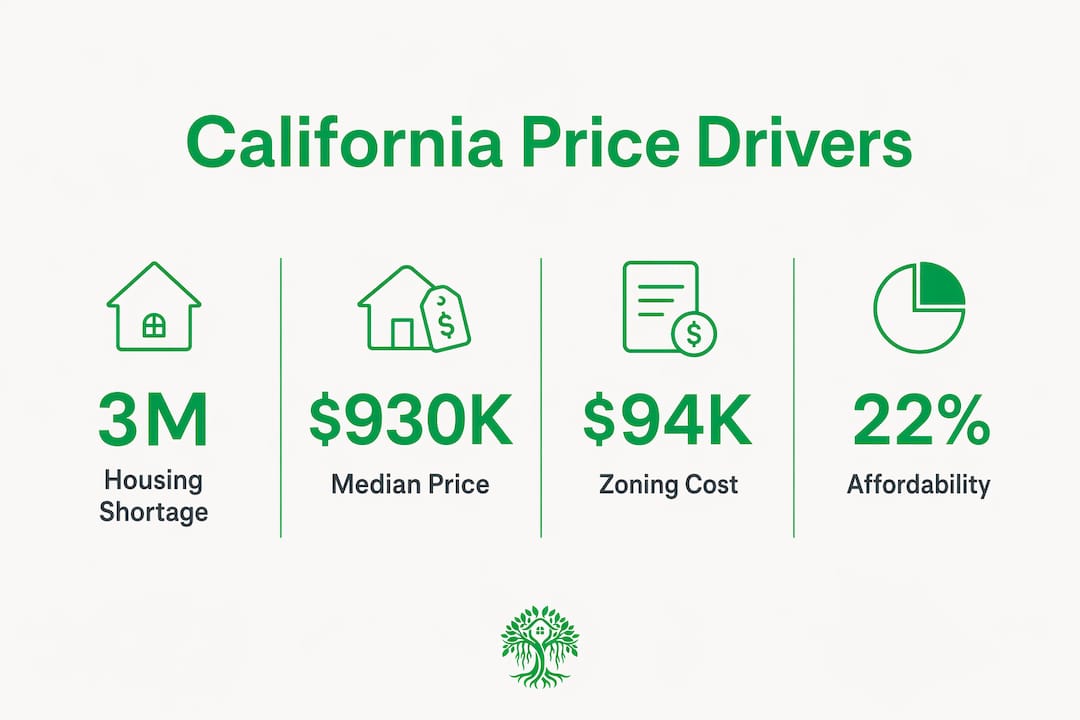
California home prices are defined by artificial scarcity, not just demand. The median home price hit $930,260 in may 2026, a 3.1% jump from the year before. Only 22% of California households could afford a median-priced home in Q1 2026. That means nearly 80% of residents are priced out of the typical home. Understanding why home prices are high in California starts with one core fact: the state has not built nearly enough homes for decades, and regulations make building harder every year.
Why home prices are high in California: the supply shortage
California’s housing crisis is, at its core, a supply problem. The state faces a shortage of 2.7 to 3.5 million housing units. That gap did not appear overnight. Since the 1970s, growth controls and exclusionary zoning have steadily choked off new construction.

Home prices in California doubled the national median by 2015, and the divergence traces directly to those early regulatory choices. Prices rise when supply cannot keep pace with demand. That is not a market failure. It is the market doing exactly what markets do when supply is constrained.
Here is what the supply gap looks like in practice:
- California adds roughly 100,000 to 120,000 new homes per year, well below the estimated 180,000 needed annually to close the gap.
- Coastal metros like San Francisco and Los Angeles face the most acute shortages, where land is scarce and regulations are strictest.
- The state’s population grew for decades while housing production stalled, compounding the deficit year after year.
- 38.5% of all California home sales in may 2026 were million-dollar-plus transactions, pulling the median price higher.
| Factor | Impact on prices |
|---|---|
| 2.7–3.5 million unit shortage | Drives prices up as buyers compete for limited stock |
| Below-target annual construction | Widens the gap between supply and demand each year |
| Coastal concentration of jobs | Concentrates demand in the least-buildable areas |
| Million-dollar sales share at 38.5% | Skews the median price upward statewide |
The supply gap is the foundation of every other pricing problem in California. Fix supply, and prices moderate. Leave it unaddressed, and every other policy lever produces only marginal relief.
How do zoning laws and land-use regulations drive up costs?
Regulation is the single biggest non-market force inflating California home prices. Local zoning and land-use rules add roughly $94,000 in regulatory costs to every new home built in the state. That figure includes height limits, parking minimums, setback requirements, impact fees, and litigation delays. Builders pass every dollar of that cost directly to buyers.
The regulatory burden works through several specific mechanisms:
- Height limits and density caps. Most California cities restrict buildings to two or three stories in residential zones. That forces builders to spread homes across more land, raising per-unit land costs.
- Parking minimums. Requirements for two or more parking spaces per unit add tens of thousands of dollars to construction costs, especially in urban areas where land is expensive.
- Setback and lot-coverage rules. These rules shrink the buildable footprint of each parcel, reducing the number of units a developer can place on a given lot.
- Impact fees. Cities charge developers fees for schools, parks, and infrastructure. In some California cities, these fees exceed $50,000 per unit before a single nail is driven.
- Permitting delays. A project that takes six months to permit in Texas can take two to three years in California. Every month of delay adds carrying costs that builders fold into sale prices.
Houston, Texas, offers a useful contrast. The city has no traditional zoning code. It builds homes at a fraction of California’s regulatory cost, and its median home price reflects that difference. California’s property values are not high because homes are inherently more expensive to build. They are high because regulations make building artificially expensive.
Pro Tip: If you are buying in California, ask your agent for the permit history on any new construction. Long permitting timelines often signal a market where supply will stay tight, which affects your resale value years down the road.
What economic forces keep California housing unaffordable?
Regulation explains the supply side. Economic dynamics explain why demand stays intense even at record prices. The most underappreciated force is the mortgage lock-in effect. Most California homeowners hold mortgages below 5%. Selling and rebuying at current rates would raise their monthly payment by roughly 11%. So they stay put.
That decision makes sense for individual homeowners. For the market, it is devastating. Resale inventory stays thin because existing owners will not sell. Buyers compete for a smaller pool of homes, which pushes prices higher. The lock-in effect turns a supply shortage into a double shortage: not enough new homes, and not enough existing homes coming to market.
Income inequality compounds the problem. California’s economy produces enormous wealth at the top and stagnant wages in the middle. High earners can absorb $930,000 median prices. Middle-income buyers cannot. The result is a market that functions well for high earners and shuts out everyone else. That is why only 22% of households can afford the median-priced home, even as the market technically “clears” at those prices.
- Buyers who locked in sub-3% rates in 2020 and 2021 face a painful trade-off: move and pay far more each month, or stay and reduce available inventory.
- Investor activity in high-demand metros adds another layer of competition, particularly for entry-level homes that first-time buyers target.
- True affordability includes property taxes, HOA fees, insurance, and maintenance. In California, those costs routinely add $1,500 to $2,500 per month on top of a mortgage payment.
Understanding your real monthly cost is the first step toward making a confident decision in this market. Use a full-cost calculator, not just a mortgage estimator, before you set your budget.
How do environmental laws and community opposition raise home prices?
California’s Environmental Quality Act, known as CEQA, was signed in 1970 to protect air, water, and wildlife. Over 54 years, it has become one of the most powerful tools for blocking new housing. CEQA litigation raises project costs and delays construction timelines, contributing directly to higher rents and sale prices. The law requires environmental review for nearly every new housing project, and any individual or group can file a lawsuit to challenge that review.
The practical effect is that CEQA functions as a veto for neighbors who oppose new housing. Homeowners use it to block apartments, condos, and infill projects near their properties. The litigation does not produce better environmental outcomes. It produces delays, cost overruns, and abandoned projects.
“CEQA’s centralized review process raises prices rather than deliver better outcomes. The law has become the nation’s most powerful anti-housing weapon, used primarily by current homeowners to protect property values at the expense of everyone who needs a place to live.”
Fragmented local control makes the problem worse. California has hundreds of cities and counties, each with its own planning department and political incentives. Local elected officials answer to existing homeowners, who vote in higher numbers and benefit from rising property values. Approving new housing rarely wins votes. Blocking it often does. The result is a system where the political incentives consistently favor less housing, not more.
What steps can actually lower California home prices?
No single policy fixes a shortage built over five decades. But several approaches have clear evidence behind them.
- Streamline permitting. California has passed laws like SB 9 and SB 10 to speed approvals for duplexes and small multifamily buildings. Consistent enforcement at the local level is the missing piece.
- Reform CEQA for housing. Exempting infill housing projects from CEQA review would remove the most common litigation tool used to block new supply. Several proposals have stalled in Sacramento, but the policy logic is sound.
- Eliminate parking minimums near transit. Cities like San Jose and Sacramento have already done this. Removing parking requirements near bus and rail lines cuts construction costs and allows more units per parcel.
- Increase density in job-rich areas. Allowing four to six story buildings within a half mile of major employment centers would add significant housing supply where demand is highest.
- Fund infrastructure for dense development. Dense urban construction carries higher infrastructure costs than greenfield development. State funding for water, sewer, and transit upgrades in infill zones makes dense projects financially viable for builders.
Pro Tip: First-time buyers in California should research state and local buyer programs before assuming they cannot afford to buy. CalHFA and several county programs offer down payment assistance that can meaningfully change your math.
The state has the tools. The barrier is political will at the local level, where homeowners with the most to lose from falling prices hold the most influence.
Key Takeaways
California home prices are high because decades of regulatory restrictions created a housing shortage of 2.7 to 3.5 million units, and that shortage will not resolve without sustained policy reform at both the state and local level.
| Point | Details |
|---|---|
| Supply shortage is the root cause | California is short 2.7 to 3.5 million homes, driving prices up through basic scarcity. |
| Zoning adds $94,000 per home | Regulatory costs from height limits, parking rules, and fees inflate every new home’s price. |
| Mortgage lock-in shrinks inventory | Homeowners with sub-5% rates stay put, reducing resale supply and intensifying competition. |
| CEQA enables housing opposition | Environmental review litigation blocks infill projects and raises costs without improving outcomes. |
| Reform requires local cooperation | State laws exist, but local political incentives consistently favor existing homeowners over new supply. |
California’s housing crisis is a policy choice, not a natural disaster
I have spent years watching people frame California’s housing affordability problem as a demand story. Too many people want to live here. Too much tech money. Too many investors. Those factors exist, but they are not the cause. The cause is supply. Prices rise to ration scarce housing when supply is constrained. That is not a controversial economic claim. It is how markets work.
What frustrates me is how clearly the evidence points to regulatory reform, and how little changes. CEQA reform has been debated for a decade. Zoning changes pass in Sacramento and get quietly ignored by cities. The political economy of housing is brutal: the people who benefit most from high prices vote in every election, and the people who are priced out often do not yet live in the jurisdiction making the decisions.
The path forward requires state government to override local obstruction more aggressively. California has done it before, with SB 9 and the builder’s remedy provision. But enforcement is inconsistent, and cities find workarounds. Until the state closes those loopholes and funds the infrastructure that makes density viable, the shortage will persist.
If you are a first-time buyer in California right now, understanding these dynamics matters for your decision. Prices are not going to collapse. The shortage is too deep and the political barriers to reform are too high for that. But knowing common first-time buyer mistakes and understanding true affordability can still put you in a position to buy well, even in this market.
— Anand
How Ficustree helps buyers navigate California’s high-price market
California’s housing market rewards buyers who come prepared. Ficustree is an AI-powered platform built specifically for first-time buyers in California who want clarity, not confusion.

Ficustree gives you decision intelligence at every step: real affordability analysis that includes PITI, HOA, insurance, and maintenance costs, not just a mortgage number. You pay $1,000 at closing plus 1% commission, and where legally permitted, you keep a rebate of roughly 2%. That rebate matters when prices sit near $930,000. Start your California home search with tools built to cut through the noise and get you to a confident decision faster. You can also browse homes across 467 California cities to find where your budget actually works.
FAQ
Why are California home prices so much higher than the national average?
California home prices diverged from the national average starting in the 1970s, when growth controls and exclusionary zoning began restricting new construction. The state now faces a shortage of 2.7 to 3.5 million housing units, which pushes prices up as buyers compete for limited supply.
What percentage of California households can afford a median-priced home?
Only 22% of California households could afford the median-priced home in Q1 2026, according to the California Association of Realtors. That figure represents a four-year high, meaning affordability has been even worse in recent years.
How much do zoning regulations add to the cost of a new home in California?
Local zoning and land-use regulations add roughly $94,000 in compliance costs to every new home built in California. That total includes height limits, parking requirements, setback rules, impact fees, and litigation-related delays.
Will California home prices drop anytime soon?
A significant price drop is unlikely without a major increase in housing supply. The shortage is structural, built over decades of restricted construction, and political barriers to reform remain strong at the local level. Prices may moderate, but a broad decline requires policy changes that have not yet materialized.
What is CEQA and how does it affect housing costs?
CEQA is California’s Environmental Quality Act, a 1970 law that requires environmental review for most new development. Neighbors and advocacy groups use CEQA litigation to delay or block housing projects, raising costs and reducing supply without producing measurable environmental benefits.