
You can buy a house with a low credit score. The path is narrower, the costs are higher, and the paperwork is thicker, but the door is open. Government-backed programs like FHA, VA, and USDA loans exist precisely for buyers who don’t fit the conventional mold, and lenders who specialize in manual underwriting can approve borrowers that automated systems reject outright.
Here’s what shapes your options when your credit is below 620:
- Loan type matters most. FHA, VA, and USDA loans each have lower credit thresholds than conventional mortgages.
- Lender overlays are the real gatekeepers. Federal programs set minimum floors, but individual lenders often require higher scores.
- Down payment can compensate. A larger down payment signals lower risk and can unlock approvals at lower credit scores.
- Your credit score directly affects your interest rate. Even a 20-point improvement can reduce your monthly payment meaningfully.
- Manual underwriting is your backup plan. When automated systems say no, a human underwriter reviewing your full financial picture can say yes.
Credit score is not a verdict. It’s a starting point.
What counts as a low credit score for mortgage eligibility?
Credit scores run from 300 to 850. In mortgage terms, anything below 620 is generally considered low, and below 580 is considered poor. These thresholds matter because most loan programs and lenders use them as cutoff points for automated approval.

| Credit Score Range | Rating | Loan Eligibility |
|---|---|---|
| 740 and above | Excellent | All programs; best rates |
| — | Good | All programs; competitive rates |
| 620–639 | Fair | Most conventional and government loans |
| 580–599 | Poor | FHA with 3.5% down; VA and USDA with lender approval |
| 500–579 | Very Poor | FHA with 10% down; manual underwriting required |
| Below 500 | Insufficient | Very limited options; hard money or co-borrower needed |
Federal programs set the floor, but lenders set the actual bar. A lender’s overlay, which is an internal policy that sits on top of federal guidelines, can raise the minimum score requirement by 40 to 120 points. That gap between what the government allows and what your lender actually approves is where most low-credit buyers get stuck.
Your debt-to-income ratio (DTI) and employment history carry serious weight alongside your score. Most lenders typically prefer your total monthly debt payments to stay within a reasonable portion of your gross monthly income, though government programs may allow some flexibility. Two years of steady employment in the same field is the standard benchmark lenders look for, and gaps or recent job changes require explanation letters.
Pro Tip: Shopping multiple lenders isn’t just smart, it’s necessary. Overlays vary so widely that a score of 600 might get you approved at one lender and rejected at three others. Pull your credit report first at AnnualCreditReport.com, then approach at least three to five lenders before drawing any conclusions about your eligibility.
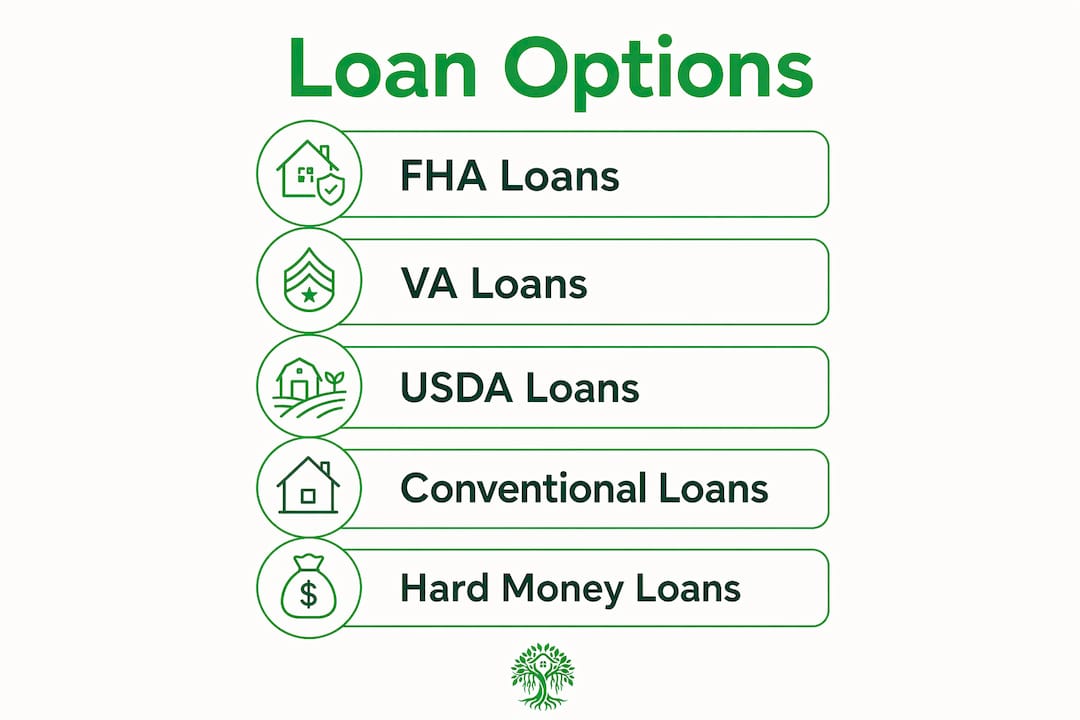
Loan options available if you’re financing a home with bad credit
1. FHA loans
FHA loans are the most accessible mortgage option for buyers with low credit. The Federal Housing Administration allows scores as low as 500, with 3.5% down for scores of 580 and above, and 10% down for scores between 500 and 579. Scores in the 500–579 range require manual underwriting, which means a human reviews your full file rather than an algorithm making the call.

The catch is lender overlays. Many lenders impose minimums of 620 or even 640 on FHA loans, regardless of the federal floor. You’ll need to find a lender willing to work at the lower end. FHA loan limits in 2026 range from $524,225 to $1,209,750 for single-family homes, depending on county, so high-cost markets like California are covered.
Advantages:
- Low down payment (3.5% at 580+)
- Manual underwriting available for scores below 580
- Available to first-time and repeat buyers
Drawbacks:
- Mortgage insurance premium (MIP) required for the life of the loan in most cases
- Lender overlays often raise the effective minimum above 580
- Loan limits cap what you can borrow
For a deeper look at how FHA loans work, Ficustree’s guide on FHA loans for first-time buyers covers the full picture.
2. VA loans
VA loans are the strongest mortgage product available, and credit score is not an official barrier. The VA sets no minimum credit score requirement, and the agency explicitly states that a lack of credit history is not viewed as a negative. Lenders, however, typically apply overlays requiring scores of 580 to 620. Scores of 740 and above get the best rates and terms, but approval is possible well below that threshold.
Advantages:
- No down payment required
- No private mortgage insurance
- Competitive interest rates even at lower scores
- Non-traditional credit tradelines accepted
Drawbacks:
- Requires military service eligibility and a Certificate of Eligibility
- Lender overlays still apply in practice
- VA funding fee applies unless exempt
Co-borrowers who are also VA-eligible can strengthen an application, but a non-veteran co-borrower does not extend VA benefits to the loan.
3. USDA loans
USDA Guaranteed Loans offer 100% financing with no down payment for eligible rural and suburban properties. The program sets no fixed minimum credit score, but the automated underwriting system (GUS) generally requires a score of 640 or above for a streamlined approval. Below 640, the loan moves to full manual underwriting, which is slower, more document-intensive, and accepted by fewer lenders.
Advantages:
- No down payment
- No set credit score floor from USDA
- Alternative credit documentation accepted for thin-file borrowers
Drawbacks:
- Property must be in an eligible rural area
- Income cannot exceed 115% of area median household income
- Manual underwriting below 640 limits lender options
Ficustree’s guide on buying with no money down covers USDA eligibility criteria in detail.
4. Conventional loans
Conventional loans are the hardest to access with low credit. Most lenders require a minimum score of 620, and rates climb sharply below 700. Private mortgage insurance (PMI) is required when the down payment is below 20%, and PMI premiums increase as credit scores fall. For buyers with scores below 620, conventional financing is rarely the right starting point.
5. Hard money loans
Hard money loans come from private investors rather than banks, and approval is based primarily on the property’s value rather than your credit profile. They’re a last resort: interest rates are high, loan terms are short (typically 12–36 months), and fees are steep. They work best for buyers who plan to renovate and refinance quickly, not for long-term homeownership.
The role of co-signers and co-borrowers
Adding a co-borrower with stronger credit can meaningfully improve your loan eligibility. Lenders typically use the lower of the two middle scores, so the benefit depends on how the specific program handles co-borrower credit. A co-borrower shares ownership and financial responsibility. A co-signer, by contrast, backs the loan without holding title, though not all programs allow co-signers without co-ownership.
How to check what mortgage you actually qualify for
Knowing your options on paper is one thing. Knowing where you actually stand takes a few concrete steps.
-
Pull your credit reports. Get free reports from all three bureaus at AnnualCreditReport.com. Review each one for errors, outdated accounts, and unfamiliar entries. Disputes on errors can raise your score within 30–45 days, and the Consumer Financial Protection Bureau outlines exactly how to file them.
-
Know your actual score, not just the range. Free score tools often show a VantageScore; lenders use FICO. Purchase your FICO scores directly from myFICO.com to see what lenders will see.
-
Calculate your DTI before approaching lenders. Add up all monthly debt payments (car, student loans, credit cards, minimum payments) and divide by your gross monthly income. Use Ficustree’s mortgage calculator to model what a new mortgage payment would do to that ratio.
-
Estimate your true affordability. Credit score affects your interest rate, which affects your monthly payment, which affects how much house you can realistically carry. Run the numbers through a home affordability calculator that accounts for taxes, insurance, and HOA fees, not just principal and interest.
-
Ask lenders directly about their overlays. Call or email and ask: “What is your minimum credit score for FHA loans?” and “Do you do manual underwriting?” Most lenders answer these questions upfront. If they don’t, move on.
-
Seek lenders who specialize in low-credit underwriting. Credit unions, community banks, and mortgage brokers who work with government-backed loans often have more flexibility than large retail banks. Brokers can shop your file across multiple wholesale lenders simultaneously.
-
Get pre-qualified before making offers. Pre-qualification gives you a realistic price range and signals to sellers that you’re serious. Pre-approval, which requires full documentation, carries more weight in competitive markets.
How to improve your credit score before buying
Credit scores respond to specific behaviors, and the most impactful ones are also the most straightforward.
-
Pay every bill on time, without exception. Payment history accounts for 35% of your FICO score. One 30-day late payment can drop a score by 60–100 points. Set up autopay for minimums on every account.
-
Reduce your credit card balances. Credit utilization, the ratio of your balance to your credit limit, makes up 30% of your score. Getting utilization below 30% helps; below 10% is better. Pay down the highest-utilization cards first.
-
Dispute errors on your credit report. Incorrect late payments, accounts that aren’t yours, and outdated derogatory marks can all be disputed. Removing a single erroneous collection account can lift a score by 20–50 points.
-
Avoid opening new credit accounts. Each hard inquiry drops your score by a few points and signals new risk to lenders. Hold off on new credit cards, car loans, or any financing until after closing.
-
Keep old accounts open. Length of credit history matters. Closing an old card shortens your average account age and can reduce your score even if the card has a zero balance.
-
Consider a secured credit card or credit-builder loan. If your file is thin, adding a secured card with a small limit and paying it in full each month builds positive history within six to twelve months.
-
Work with a nonprofit credit counselor. HUD-approved housing counselors offer free or low-cost guidance on credit repair and mortgage readiness. Find one at hud.gov/findacounselor.
Pro Tip: Even a 20-point score improvement can move you from one pricing tier to the next. Because credit score improvements lead to meaningful interest savings, spending three to six months on credit repair before applying often saves more money over the life of the loan than any negotiation tactic at closing.
Realistic timelines: disputing errors can show results in 30–60 days. Reducing utilization shows up in the next billing cycle. Building positive payment history takes six to twelve months of consistent behavior. Major derogatory marks like foreclosures and bankruptcies take years to fade, though their impact diminishes over time.
How manual underwriting and lender overlays affect your approval
Manual underwriting occurs when an automated system is unable to make a decision and a human loan officer reviews the application. For low-credit buyers, it can be an important path to approval.
Automated underwriting systems like Fannie Mae’s Desktop Underwriter and Freddie Mac’s Loan Product Advisor run your data through algorithms and return a recommendation in minutes. Below certain score thresholds, these systems return a “refer” or “refer with caution” result, which means a human must review the file. USDA’s GUS system follows the same logic: a score below 640 triggers full manual underwriting.
What lenders examine in manual underwriting:
- Rental history. Twelve to twenty-four months of on-time rent payments, verified by a landlord or bank statements, is one of the strongest compensating factors.
- Employment stability. Two or more years with the same employer, or in the same field, signals reliable income.
- Cash reserves. Having two to six months of mortgage payments in savings after closing reduces lender risk.
- Low DTI. A DTI below 31% for housing costs and 43% total is the standard benchmark, though some programs allow higher ratios with compensating factors.
- No recent derogatory marks. Lenders look for clean payment history in the twelve months before application, even if older negatives exist.
The challenge is finding lenders who actually do it. Many retail banks have eliminated manual underwriting from their operations because it requires specialized training and takes significantly more time. Many retail banks lack loan officers trained to handle manual underwriting effectively, which is why working with a mortgage broker or a lender who specifically advertises FHA, VA, or USDA expertise matters.
Lender overlays compound the challenge. A lender might technically offer FHA loans but impose a 640 minimum score overlay, effectively blocking the borrowers the FHA program was designed to help. Overlays vary by lender and change frequently, so asking directly is the only reliable way to know where a lender actually stands.
What are alternative documentation loans, and who do they help?
Alternative documentation loans, sometimes called alt-doc or non-QM loans, allow borrowers to qualify using income and credit evidence outside the standard W-2 and credit score framework. They serve two distinct groups: self-employed buyers whose tax returns understate their actual income, and thin-file buyers who have little to no traditional credit history.
For thin-file borrowers, the most practical form of alternative documentation is nontraditional credit. Under USDA and FHA guidelines, 12–24 months of verified rental, utility, or insurance payments can substitute for traditional tradelines when a borrower has no credit score or fewer than two scores. The payments must come from a third-party source, not relatives, and must be documented through billing statements, canceled checks, or landlord verification forms.
For self-employed buyers, bank statement loans are the most common alt-doc product. Instead of tax returns, lenders average 12–24 months of bank deposits to calculate income. These loans typically carry higher interest rates than conventional mortgages and require larger down payments, often 10–20%.
Alt-doc loans are not government-backed in most cases, which means they don’t carry FHA or VA protections. Rates and fees are higher, and qualifying criteria vary widely by lender. They’re a legitimate tool for the right borrower, but they require careful comparison shopping.
Pitfalls that catch low-credit homebuyers off guard
Buying with a lower credit score introduces risks that buyers with strong credit rarely encounter. Knowing them in advance keeps them from becoming expensive surprises.
Higher interest rates compound over time. A buyer with a 580 score might pay a full percentage point or more above what a 740-score buyer pays. On a $400,000 loan, that difference adds up to tens of thousands of dollars over a 30-year term. Use a mortgage calculator to see the actual dollar impact before committing to a rate.
Predatory lenders target low-credit buyers. Lenders who advertise “guaranteed approval” or charge excessive origination fees are exploiting buyers who feel they have no options. Compare loan estimates from multiple lenders and review the APR, not just the interest rate, to catch hidden fees.
Mortgage insurance adds to your monthly cost. FHA loans require an upfront mortgage insurance premium plus an annual premium for the life of the loan in most cases. On a $350,000 loan, this adds hundreds of dollars per month to your payment. Factor it into your affordability math from the start.
Seller reluctance is real in competitive markets. Some sellers and their agents view government-backed loans as more complicated to close. In hot markets like California, this can put you at a disadvantage against conventional buyers. A strong pre-approval letter and a knowledgeable buyer’s agent help offset this perception.
Overextending on price leaves no room for repairs. Low-credit buyers often stretch to qualify for the maximum loan amount, leaving nothing for maintenance, repairs, or an emergency fund. A house that costs everything you have to buy will cost more than you can afford to keep.
Skipping the inspection to win a bid. Waiving the inspection contingency to compete with stronger offers is a significant risk for any buyer, but especially for one with limited financial cushion. A major repair discovered after closing can derail your finances entirely.
Key Takeaways
Buying a house with a low credit score is achievable in 2026 through government-backed loan programs, manual underwriting, and targeted credit improvement, but lender overlays and higher interest costs require careful planning.
| Point | Details |
|---|---|
| FHA is the most accessible path | FHA allows scores as low as 500, with 3.5% down at 580 and 10% down below that. |
| VA and USDA set no official score floor | Both programs rely on lender overlays, making lender selection the critical variable. |
| Overlays raise the real minimum | Lenders routinely require 620–640 even on programs that allow lower scores. |
| Manual underwriting opens closed doors | Rental history, cash reserves, and low DTI can secure approval when automated systems decline. |
| Credit improvement pays off fast | Even a modest score increase moves you to a better rate tier and reduces total loan cost. |
FAQ
Can you buy a house with a 500 credit score?
Yes, but your options are limited. FHA loans allow scores as low as 500 with a 10% down payment and manual underwriting, but many lenders impose overlays that raise the effective minimum to 580 or higher. You’ll need to find a lender who works at the lower end of FHA guidelines.
How hard is it to buy a house with poor credit?
It’s harder, not impossible. Poor credit narrows your loan options, raises your interest rate, and requires more documentation. The biggest obstacle is usually lender overlays, not the federal program rules themselves, so shopping multiple lenders is the most important step.
What credit score do you need for a $250,000 house?
The loan program matters more than the price. FHA loans are available at 580 with 3.5% down; VA loans have no official minimum but lenders typically want 580–620; USDA loans generally require a credit score of 640 or higher for automated approval; borrowers with lower scores may qualify through manual underwriting, which depends on the lender’s willingness to process such loans. Conventional financing at that price generally requires 620 or above.
What credit score is needed to buy a $400,000 house?
At $400,000, FHA financing is available in most counties within the 2026 loan limits of $524,225 to $1,209,750. A score of 580 qualifies you for 3.5% down under FHA guidelines, though lender overlays may require 620 or 640. Conventional financing at that price point typically requires 620 minimum, with better rates at higher scores.
Does a co-borrower help when your credit score is low?
A co-borrower with stronger credit can improve your DTI and overall application strength, but most lenders use the lower of the two middle scores for qualification. The benefit depends on the loan program and lender policy, so ask your lender directly how they handle co-borrower credit before assuming it solves the score problem.