
Buying your first home in California is a structured process that requires financial preparation, knowledge of state-specific loan programs, and a clear understanding of the purchase timeline. This first home buying California guide covers every major step: from assessing your credit and debt-to-income ratio, to leveraging CalHFA programs like MyHome Assistance and ZIP, to navigating escrow, inspections, and contingency deadlines. California’s market moves fast, and buyers who prepare early close with confidence. The typical process runs 3 to 6 months from pre-approval to keys.
What financial preparations must you make before buying your first California home?
Financial readiness is the foundation of every successful home purchase in California. Three numbers matter most before you start: your credit score, your debt-to-income ratio, and your total cash available.
Your credit score determines which loan programs you qualify for and at what interest rate. Most conventional loans require a minimum score of 620, while FHA loans accept scores as low as 580 with a 3.5% down payment. A higher score directly reduces your monthly payment over the life of the loan.

Your debt-to-income ratio, or DTI, is the percentage of your gross monthly income that goes toward debt payments. Lenders prefer a DTI below 43%, and buyers who come in around 36% have stronger qualifying odds. This ratio matters more than most first-time buyers expect. Paying down a car loan or credit card balance before applying can shift your DTI enough to qualify for a better rate.
Budgeting for cash to close is where many buyers get caught off guard. Your down payment is only part of the picture. Closing costs in California typically run 3% to 6% of the loan amount, covering appraisal fees, title insurance, lender fees, prepaid property taxes, and homeowner’s insurance. On a $600,000 home, that adds $18,000 to $36,000 on top of your down payment.
- Credit score: Aim for 620 or higher for conventional loans; 580 minimum for FHA
- DTI ratio: Target 36% or below; 43% is the typical lender ceiling
- Down payment: Plan for 3.5% to 10% depending on loan type
- Closing costs: Budget an additional 3% to 6% of the loan amount
- Reserves: Keep 2 to 3 months of mortgage payments in savings after closing
Pro Tip: Get pre-approved before you start touring homes. Pre-approval tells you exactly what you can borrow, and sellers in California’s competitive market take pre-approved buyers far more seriously than pre-qualified ones.
For CalHFA assistance programs, eligibility also requires completing a homebuyer education course and working with a CalHFA-approved lender. Confirm those requirements early so they don’t delay your timeline.
Which California loan programs are available for first-time homebuyers?
California offers more loan assistance options than most states. Understanding the differences between loan types and state programs lets you choose the combination that saves the most money upfront.
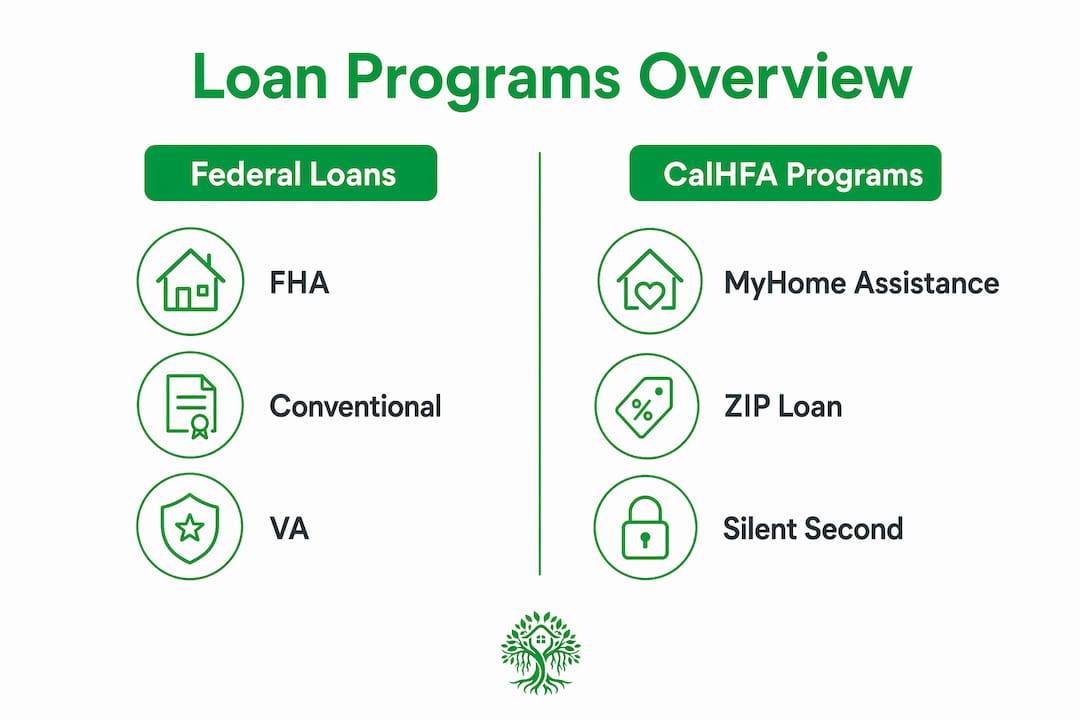
Federal loan options compared
| Loan Type | Minimum Down Payment | Credit Score Minimum | Best For |
|---|---|---|---|
| FHA | 3.5% | 580 | Buyers with lower credit scores |
| Conventional | 3% | 620 | Buyers with strong credit and income |
| VA | 0% | Varies by lender | Eligible veterans and active military |
| USDA | 0% | 640 | Rural and suburban areas only |
FHA loans carry mortgage insurance for the life of the loan unless you refinance. Conventional loans drop private mortgage insurance once you reach 20% equity. VA and USDA loans eliminate the down payment entirely for eligible buyers, making them the strongest options when you qualify.
CalHFA programs that reduce upfront costs
The CalHFA MyHome Assistance Program provides a deferred-payment junior loan of up to 3.5% of the purchase price or appraised value. Repayment is deferred until you sell, refinance, or pay off your first mortgage. That means no second monthly payment while you own the home.
The CalHFA ZIP program is a zero-interest subordinate loan designed to cover closing costs. ZIP pairs exclusively with CalPLUS FHA or CalPLUS Conventional first mortgages. It does not work as a standalone program.
MyHome and ZIP are silent second loans with deferred payments, which keeps your monthly mortgage payment lower than it would be with a traditional second loan. That structure is what makes them genuinely useful for buyers who are cash-constrained but income-qualified.
Pro Tip: Not all lenders offer CalHFA programs. Confirm your lender is on the CalHFA-approved list before you start the application process. Using an unapproved lender disqualifies you from these programs entirely.
You can review the full list of California buyer programs to match your income, location, and loan type before you apply.
What is the typical timeline for buying a house in California?
The full process from pre-approval to closing runs 3 to 6 months for most first-time buyers in California. That range reflects how quickly you find a home and how smoothly escrow proceeds.
- Get pre-approved (Week 1 to 2). Submit your financial documents to a lender and receive a pre-approval letter. This defines your price range and strengthens your offers.
- Search and make an offer (Week 2 to 12). Tour homes, submit offers, and negotiate. In competitive markets like Los Angeles, San Jose, or San Diego, this phase can take longer.
- Open escrow (Day 1 after offer acceptance). Escrow opens when both parties sign the purchase agreement. The clock starts for all deadlines.
- Review disclosures (Within 7 days of escrow opening). California sellers must deliver disclosures early in the process. Read them carefully and flag anything unusual.
- Complete inspections (Days 5 to 10). Schedule your general inspection, pest inspection, and any specialty inspections immediately after offer acceptance.
- Receive inspection reports (24 to 48 hours after inspection). Reports arrive quickly, so you have time to negotiate repairs or credits before contingency deadlines.
- Remove contingencies (Around Day 17). The standard California contract sets contingency removal at approximately 17 days. Missing this deadline can put your deposit at risk.
- Close escrow (Day 30 to 45). Final loan documents are signed, funds are wired, and title transfers to you.
| Phase | Typical Duration |
|---|---|
| Pre-approval to offer accepted | 2 to 12 weeks |
| Escrow period | 30 to 45 days |
| Seller disclosure delivery | Within 7 days of escrow |
| Inspection report turnaround | 24 to 48 hours |
| Contingency removal | Around Day 17 |
Understanding this home buying timeline before you start prevents last-minute surprises that cost you the deal.
How do inspections, disclosures, and contingencies work in California?
California has some of the most buyer-protective disclosure laws in the country. Sellers must provide a Transfer Disclosure Statement, a Natural Hazard Disclosure, and several other reports covering everything from earthquake zones to known defects. Disclosures typically arrive within 7 days of escrow opening, and buyers must review them before contingency removal.
Inspections must be scheduled immediately after your offer is accepted. Waiting even two or three days can push your inspection report past the contingency deadline. Inspection reports in California arrive within 24 to 48 hours after the inspection itself. That gives you a narrow window to review findings, request repairs, and negotiate credits before the deadline hits.
Common inspection focus areas in California include:
- Seismic retrofitting: Older homes may lack colt bolts and cripple wall bracing required for earthquake safety
- Pest and dry rot: California’s climate creates conditions for termites and wood decay, especially in coastal areas
- Aging systems: Electrical panels, HVAC units, and water heaters in homes built before 1990 often need replacement within a few years
- Foundation issues: Hillside homes in areas like the East Bay or Malibu carry higher foundation risk
Pro Tip: Book your inspector the same day your offer is accepted. Do not wait for the seller to confirm. A one-day delay in scheduling can compress your review window to almost nothing.
Buyers who review California disclosures carefully before contingency removal protect themselves from costly surprises after closing.
What financial and practical tips help first-time buyers avoid common mistakes?
The most common financial mistake California buyers make is underestimating total cash needed at closing. Your down payment is visible and planned. Your closing costs and prepaid escrow items are often not. Prepaid items include the first year of homeowner’s insurance, property tax prorations, and HOA dues if applicable. These can add thousands of dollars beyond your stated closing cost estimate.
- Check your DTI before your credit score. Improving your debt-to-income ratio often has a bigger impact on loan approval than a credit score bump of 20 to 30 points.
- Use a CalHFA-approved lender. Not every lender processes MyHome or ZIP assistance. Choosing the wrong lender means losing access to programs that could save you tens of thousands upfront.
- Complete your homebuyer education course early. CalHFA requires it for most assistance programs. Completing it before you start shopping removes a potential bottleneck at the worst possible time.
- Budget for post-closing costs. Maintenance, repairs, and moving expenses are real. Plan to keep 1% to 2% of the home’s value in reserve for the first year.
- Avoid common buyer mistakes like waiving inspections in competitive markets or skipping title review.
The buyers who close smoothly are the ones who treat the financial preparation phase as seriously as the home search itself.
Key Takeaways
Buying your first home in California requires financial preparation, the right loan program, and strict attention to state-specific timelines for inspections, disclosures, and contingency removal.
| Point | Details |
|---|---|
| DTI ratio is critical | Target a debt-to-income ratio of 36% or below to maximize loan approval odds. |
| Budget beyond the down payment | Closing costs run 3% to 6% of the loan amount, plus prepaid taxes and insurance. |
| CalHFA programs reduce upfront costs | MyHome offers up to 3.5% in deferred-payment assistance; ZIP covers closing costs at zero interest. |
| Inspection timing is non-negotiable | Schedule your inspector the day your offer is accepted to stay ahead of the 17-day contingency deadline. |
| Use CalHFA-approved lenders only | Only approved lenders can process MyHome and ZIP assistance programs. |
What I’ve learned from watching buyers navigate California’s market
The buyers I’ve seen struggle most are not the ones with the lowest credit scores. They are the ones who show up financially unprepared for the full cash-to-close picture. They budget for the down payment and forget that closing costs, prepaid insurance, and property tax prorations can add $15,000 to $25,000 on top of it. That gap is what derails deals in the final week of escrow.
The second pattern I notice is buyers who skip CalHFA programs because they seem complicated. They are not. MyHome and ZIP are genuinely useful tools, and the deferred repayment structure means you are not adding a second monthly payment. The only real requirement is using an approved lender and completing the education course. Both are easy to do early.
The inspection and contingency timeline is where I see the most anxiety. Buyers feel rushed, and they are right to feel that way. Seventeen days is not much time to review disclosures, schedule an inspector, receive a report, negotiate repairs, and make a decision. The buyers who handle this well are the ones who treat Day 1 of escrow as a sprint, not a stroll. Book the inspector before you celebrate the accepted offer.
California’s market is competitive, but it is not impossible for a prepared first-time buyer. The process rewards people who do the work upfront, not the ones who figure it out as they go.
— Anand
How Ficustree helps you buy your first California home
Ficustree is an AI-powered home buying platform built specifically for first-time buyers in California. It matches you to homes and loan programs based on your actual financial profile, not generic filters.

Ficustree integrates CalHFA program eligibility directly into the search and pre-approval workflow, so you know which assistance programs you qualify for before you make an offer. Buyers pay $1,000 at closing plus 1% commission and keep a rebate of roughly 2% where permitted. You get showing agents on demand and the full platform at no upfront cost. The goal is to compress six months of confusion into two months of clarity. Start your search at Ficustree and see what you can actually afford in California’s market today.
FAQ
What credit score do I need to buy a home in California?
Most conventional loans require a minimum score of 620, while FHA loans accept 580 with a 3.5% down payment. A higher score qualifies you for better interest rates and lower monthly payments.
How much cash do I need beyond the down payment in California?
Closing costs typically run 3% to 6% of the loan amount, plus prepaid items like property taxes and homeowner’s insurance. Budget for the full cash-to-close amount, not just the down payment.
What is the CalHFA MyHome Assistance Program?
MyHome is a deferred-payment junior loan of up to 3.5% of the purchase price that helps cover down payment or closing costs. Repayment is deferred until you sell, refinance, or pay off your first mortgage.
How long does it take to buy a home in California as a first-time buyer?
The typical timeline runs 3 to 6 months from pre-approval to closing, with escrow closing 30 to 45 days after an accepted offer.
When must I remove contingencies in a California home purchase?
The standard California purchase contract sets contingency removal at approximately 17 days after escrow opens. Missing this deadline can put your earnest money deposit at risk.