
The 2026 national baseline conforming loan limit for a single-family home is $832,750, up 3.26% ($26,250) from the 2025 limit of $806,500, according to the FHFA’s official announcement. For California buyers, that baseline is only part of the story. Many counties, particularly along the coast and in the Bay Area, qualify as high-cost areas with limits reaching up to $1,249,125 for a one-unit property.
3.26% increase from 2025 to 2026 — the baseline rises from $806,500 to $832,750, a $26,250 gain.
Your three immediate steps:
- Check your county using the FHFA Conforming Loan Limit Values Map before assuming the baseline applies.
- Confirm with your lender that they will deliver the loan under 2026 limits (delivery date matters, not just origination date).
- Ask about high-balance pricing if your county limit exceeds the national baseline.
Key Takeaways
The 2026 baseline conforming loan limit is $832,750 nationally, but California buyers in high-cost counties can borrow up to $1,249,125 on a one-unit property under conforming guidelines.
| Point | Details |
|---|---|
| 2026 baseline limit | $832,750 for a one-unit property, up $26,250 (3.26%) from the 2025 limit of $806,500. |
| High-cost county ceiling | Up to $1,249,125 for one-unit properties in qualifying California counties. |
| Delivery date governs | Loans delivered to Fannie Mae or Freddie Mac on or after January 1, 2026 must use 2026 limits, regardless of origination date. |
| Verify at the county level | Use the FHFA Conforming Loan Limit Values Map to confirm the exact limit for your property’s county before making an offer. |
| Ficustree for buyers | Ficustree’s platform includes county-aware affordability tools and direct buyer representation to help you navigate conforming and high-balance limits confidently. |
Table of Contents
- What are the 2026 conforming loan limits for California buyers?
- How do county-level limits work, and how do you verify yours?
- What do the 2026 limits mean for your mortgage options?
- When do the 2026 limits take effect, and which sources are official?
- Your 2026 loan limit action checklist for California buyers
- Why buyers consistently miss the county-level detail
- Ficustree helps California buyers get the loan limit right from day one
- Sources
- FAQ
What are the 2026 conforming loan limits for California buyers?
The table below shows the full 2026 limits across property types. County-level limits may fall anywhere between the baseline and the statutory ceiling — the ceiling is the maximum a high-cost county can reach, not a guaranteed floor.
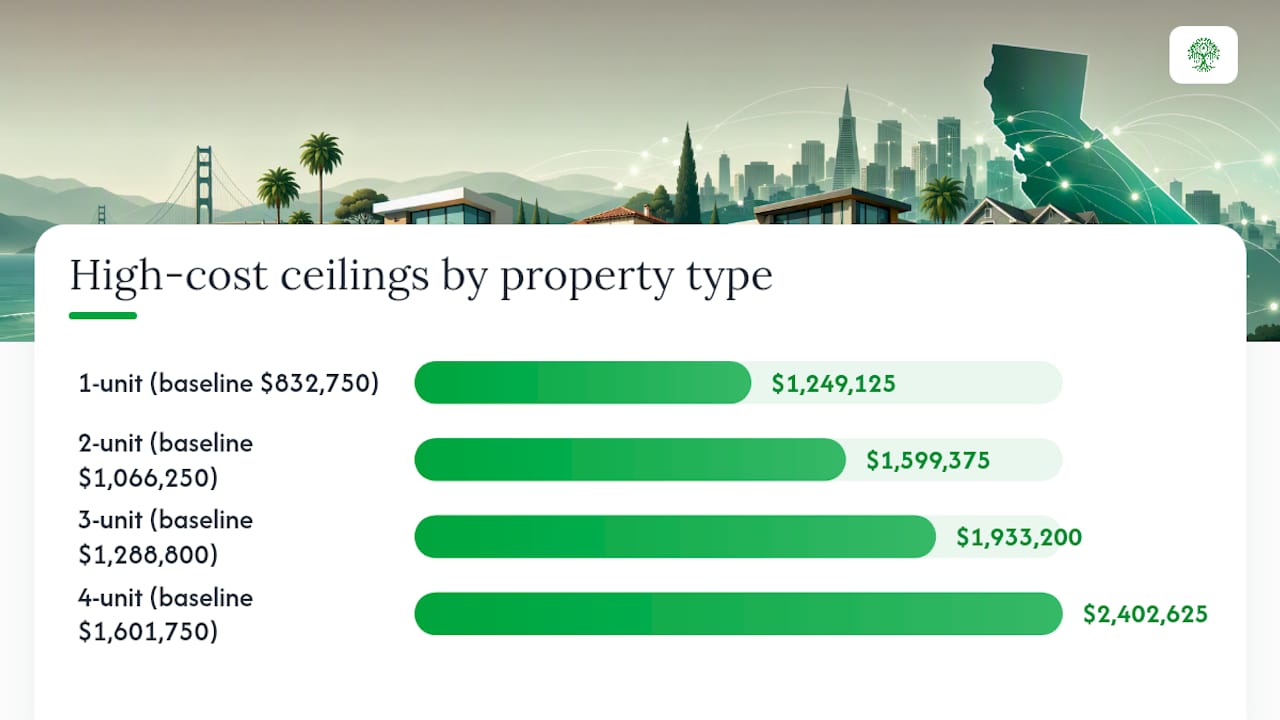
| Property Type | Baseline (Contiguous U.S.) | Alaska / Hawaii / Guam / USVI | High-Cost Ceiling | 2025 Baseline (for comparison) |
|---|---|---|---|---|
| 1-unit | $832,750 | $1,249,125 | $1,249,125 | $806,500 |
| 2-unit | $1,066,250 | $1,599,375 | $1,599,375 | $1,032,650 |
| 3-unit | $1,288,800 | $1,933,200 | $1,933,200 | $1,248,150 |
| 4-unit | $1,601,750 | $2,402,625 | $2,402,625 | $1,551,250 |
Sources: FHFA announcement and Fannie Mae Loan Limits page. County limits may be lower than the statutory ceiling shown above. Alaska, Hawaii, Guam, and the U.S. baseline.
Key figure: The 2026 high-cost ceiling of $1,249,125 for a one-unit property applies to counties where 115% of the local median home value exceeds the national baseline — a threshold many California coastal counties clear.
How do county-level limits work, and how do you verify yours?
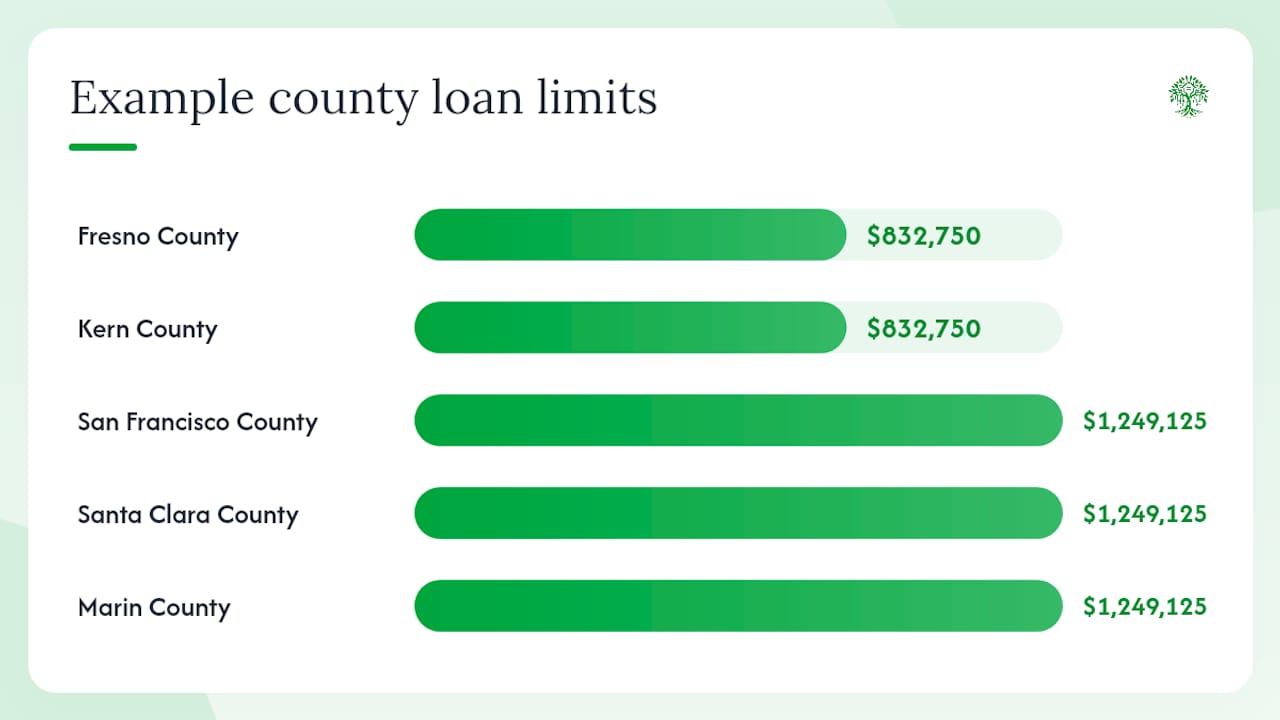
Not every California county gets the high-cost ceiling. Counties where that calculation falls below the baseline simply use the baseline. Inland counties like Fresno and Kern often sit at or near $832,750, while San Francisco, Santa Clara, and Marin counties reach the $1,249,125 ceiling. Your specific property address determines which limit applies, not the city or zip code.
Here is how to verify the exact limit for a property you are considering:
- Go to the FHFA lookup tool. Open the FHFA Conforming Loan Limit Values Map, enter the county name or property address, and record the limit returned for your unit count.
- Cross-check with Fannie Mae. Visit the Fannie Mae Loan Limits page and confirm the county-level value matches. Fannie Mae also references Lender Letter LL-2025-04 for detailed county tables.
- Verify with your lender’s system. Ask your loan officer to run the subject property address through Desktop Underwriter (DU) or Loan Product Advisor (LPA). Per Freddie Mac’s guidance, both systems were updated in December 2025 to reflect 2026 limits.
- Save your verification. Screenshot the FHFA lookup result or save the API response. You will want this if a limit question arises at underwriting.
Pro Tip: If a property sits near a county boundary, confirm the county of record on the purchase contract before running the lookup. The county of record, not the mailing address city, determines which limit applies. A property with a San Jose mailing address could technically fall in Santa Clara or Alameda County, each of which may have a different limit.
Also worth knowing: CalHFA income limits by county interact with conforming limits when you are layering down-payment assistance programs, so check both thresholds together.
What do the 2026 limits mean for your mortgage options?
The label on your loan changes your product options, pricing, and paperwork.
- Conforming (baseline): Loan at or below $832,750 in a standard county. Eligible for standard Fannie Mae and Freddie Mac purchase. Widest lender competition, typically the best pricing.
- High-balance conforming: Loan above the baseline but at or below the county’s high-cost ceiling (up to $1,249,125). Still eligible for GSE purchase, but lenders must use Special Feature Code 808 to identify it. Expect slightly higher rates and additional documentation requirements compared to a standard conforming loan.
- Jumbo: Any loan exceeding the county’s applicable 2026 limit. Not eligible for Fannie Mae or Freddie Mac purchase. Underwriting standards, pricing, and down payment requirements vary by lender and are generally stricter.
For most California buyers in high-cost counties, the difference between a $1,249,125 high-balance loan and a $1,250,000 jumbo loan is one dollar, but the rate spread can be meaningful. Ask your lender for a side-by-side pricing comparison.
Pro Tip: Ask your lender specifically: “Will this loan be delivered to Fannie Mae or Freddie Mac under 2026 limits, and does it qualify as high-balance or standard conforming?” That one question surfaces pricing differences and documentation requirements before you are deep in escrow.
On the QM side, the Qualified Mortgage points-and-fees thresholds are adjusted annually under Regulation Z. The Federal Register’s 2025 Regulation Z threshold update covers the 2026 methodology. Staying within QM guidelines gives your loan “safe harbor” status, which protects both lender and borrower. Confirm your loan’s points-and-fees total early, before rate lock.
When do the 2026 limits take effect, and which sources are official?
The effective date rule is delivery-based, not origination-based. Fannie Mae confirms that 2026 limits apply to loans delivered to the Enterprises on or after January 1, 2026, even if the loan was originated in late 2025. Freddie Mac mirrors this rule and notes that LPA and related tools were updated in December 2025 to support the new limits.
The authoritative sources, in order of priority:
- FHFA news release: — The primary announcement establishing the $832,750 baseline and $1,249,125 ceiling.
- FHFA Conforming Loan Limit Values Map: — County-by-county lookup for exact limits.
- Fannie Mae Loan Limits page: — Confirms limits and delivery-date rules.
- Lender Letter LL-2025-04: — Governs DU timing, Special Feature Code 808 for high-balance loans, and MBS pool effective dates.
- Freddie Mac 2026 loan limits article: — Confirms system update schedule and delivery eligibility rules.
Delivery-timing pitfalls to avoid:
Your 2026 loan limit action checklist for California buyers
Work through these steps before you make an offer.
- Verify your county’s limit. Run the subject property address through the FHFA lookup. Record the result for your unit count.
- Confirm lender delivery timing. Ask your loan officer when they plan to deliver the loan to Fannie Mae or Freddie Mac. If delivery falls in 2026, the 2026 limits govern.
- Get preapproval under the correct limit. Make sure your preapproval letter reflects the right county limit, not just the national baseline.
- Estimate the pricing difference. If your loan amount sits between the baseline and the high-cost ceiling, ask for a rate quote at both the conforming and high-balance tiers. Use Ficustree’s home affordability calculator to model how a rate difference affects your monthly payment.
- Confirm QM compliance. Ask your lender to confirm the loan’s points-and-fees total falls within the 2026 Regulation Z thresholds.
- Lock your rate with delivery timing in mind. If you are closing in late 2025 or early 2026, confirm whether the lock period covers the delivery date under the correct limit year.
Pro Tip: Ask your lender for the DU or LPA findings report and check the loan limit field directly. That field shows exactly which limit the automated system applied — a fast way to catch a limit mismatch before it becomes a closing-day problem.
For a broader walkthrough of the California buying process, the first home buying California guide covers the full sequence from search to keys.
Why buyers consistently miss the county-level detail
Most buyers I talk with assume the conforming loan limit is a single national number. They hear “$832,750” and stop there. The county layer is where California gets complicated, and where the real financing decisions live.
The delivery-timing issue catches even experienced buyers off guard. A buyer who originates in December 2025 and assumes their loan follows 2025 rules may be surprised when their lender flags a delivery-date issue in January 2026. The fix is simple: ask the delivery question early. But most buyers never think to ask it because no one explains that origination date and delivery date are two different things.
The other common mistake is trusting a lender’s verbal confirmation without checking the FHFA lookup independently. Lenders are human. System updates happen on a schedule, and a loan officer working from a cached limit table can quote the wrong county ceiling. A two-minute lookup on the FHFA map is the fastest way to verify the number yourself before it matters.
Ficustree helps California buyers get the loan limit right from day one
Knowing your county’s 2026 limit is step one. Knowing how it affects your offer strategy, down payment, and lender conversations is where most first-time buyers need support.
Ficustree is an AI-powered buyer representation platform built for first-time buyers in California. The platform includes affordability calculators that model payment differences across conforming, high-balance, and jumbo tiers, plus county-aware guidance so you are never working from the wrong limit. You get on-demand showing agents and the full platform free. No guessing about delivery dates, no surprises at underwriting.
Ready to buy with clarity? Start with Ficustree and get your county limit, affordability estimate, and buyer representation lined up in one place.
Sources
Official sources are the only reliable reference for conforming loan limits. County designations can change, and third-party summaries sometimes lag the FHFA’s published data by weeks. Go to the primary sources first.
- FHFA Announces Conforming Loan Limit Values for 2026
- Loan Limits
- Loan Limits Increase by 3.26% (Freddie Mac)
- FHFA Conforming Loan Limit Values Map
This article is general information, not a substitute for advice from a qualified financial advisor. Consult a qualified financial professional about your own circumstances before acting on anything here.
FAQ
What is the 2026 conforming loan limit for a single-family home in California?
The national baseline is $832,750, but many California counties qualify as high-cost areas with limits reaching up to $1,249,125 for a one-unit property. Use the FHFA county lookup to confirm the limit for your specific county.
Can a borrower get a $600,000 conforming loan for a single-family home in California?
Yes. $600,000 falls below the $832,750 national baseline, so it qualifies as a standard conforming loan in any California county, subject to normal Fannie Mae and Freddie Mac underwriting guidelines.
What are the qualified mortgage thresholds for 2026?
The QM points-and-fees thresholds are adjusted annually under Regulation Z. The Federal Register’s December 2025 update covers the 2026 methodology. Confirm your loan’s total points and fees with your lender early in the process to maintain QM safe harbor status.
What is the difference between a conforming loan and a jumbo loan in California?
A conforming loan stays at or below the applicable county limit, which can reach $1,249,125 in high-cost California counties, making it eligible for sale to Fannie Mae or Freddie Mac. A jumbo loan exceeds that county limit and is not eligible for GSE purchase, typically carrying stricter underwriting requirements and different pricing.
When do the 2026 conforming loan limits take effect?
The 2026 limits apply to loans delivered to Fannie Mae or Freddie Mac on or after January 1, 2026, even if the loan was originated in late 2025. Origination date alone does not determine which limit year governs.