
A first generation homebuyer program is a targeted financial assistance program for buyers whose parents have never owned a home in the United States. These programs go beyond standard first-time buyer grants by adding a second layer of eligibility tied to parental ownership history. In California, the CalHFA Dream For All program and in Texas, the TDHCA My First Texas Home program are the two primary state-administered options. Both offer meaningful down payment help, but each comes with income limits, credit score floors, and documentation requirements that catch many buyers off guard. This guide breaks down exactly what you qualify for, what you can receive, and how to apply without losing your spot.
What is a first generation homebuyer program and who qualifies?
A first generation homebuyer program combines two eligibility tests: you must be a first-time buyer, and your parents must not currently own a home. That second test is what separates these programs from standard homebuyer assistance programs. Standard first-time buyer programs only ask whether you have owned a home in the past three years. First generation programs also check your parents’ ownership history, sometimes going back seven years or for a lifetime depending on the program.
California’s Dream For All program requires a credit score of 660 or higher and sets income limits by county and household size. Texas’s My First Texas Home program sets the credit score minimum at 620, making it accessible to buyers still building their credit profile. Both states also require buyers to work with program-approved lenders and complete a homebuyer education certificate before closing.

The definition of “first generation” carries more weight than most buyers expect. Parental ownership checks include indirect ownership through trusts, inherited property, or partial interests, not just a deed in a parent’s name. If your parent holds a beneficial interest in a property through a family trust, that can disqualify you. The verification process is strict, and incomplete documentation is the leading cause of application denial.
Here is a quick summary of core eligibility requirements across both states:
- First-time buyer status: No ownership interest in a primary residence in the past three years
- First generation status: Neither parent currently holds title to a home in the program’s jurisdiction
- Credit score: 660+ for California Dream For All; 620+ for Texas My First Texas Home
- Income limits: Set by county and household size in both states; California limits vary significantly between coastal and inland counties
- Homebuyer education: Completion of an approved course and certificate required before loan closing
- Approved lender: You must apply through a CalHFA-approved lender in California or a TDHCA-approved lender in Texas
Pro Tip: Pull your parents’ property records before you apply. A title search on your parents’ names in every state they have lived in costs under $50 and can prevent a last-minute denial.
What financial assistance do these programs provide?
California’s Dream For All program offers up to 20% of the purchase price, capped at $150,000, as a shared appreciation loan. That means the state contributes to your down payment and receives a proportional share of your home’s appreciation when you sell, refinance, or pay off the loan. If your home doubles in value, the state’s repayment amount doubles too. That is the trade-off: significant upfront help in exchange for a share of future gains.
Texas’s My First Texas Home program works differently. It provides 2%–5% of the loan amount as a deferred second lien at 0% interest. You owe nothing on that second lien until you sell, refinance, or pay off the first mortgage. There is no appreciation sharing. The state simply waits to be repaid the original amount, with no interest accruing.
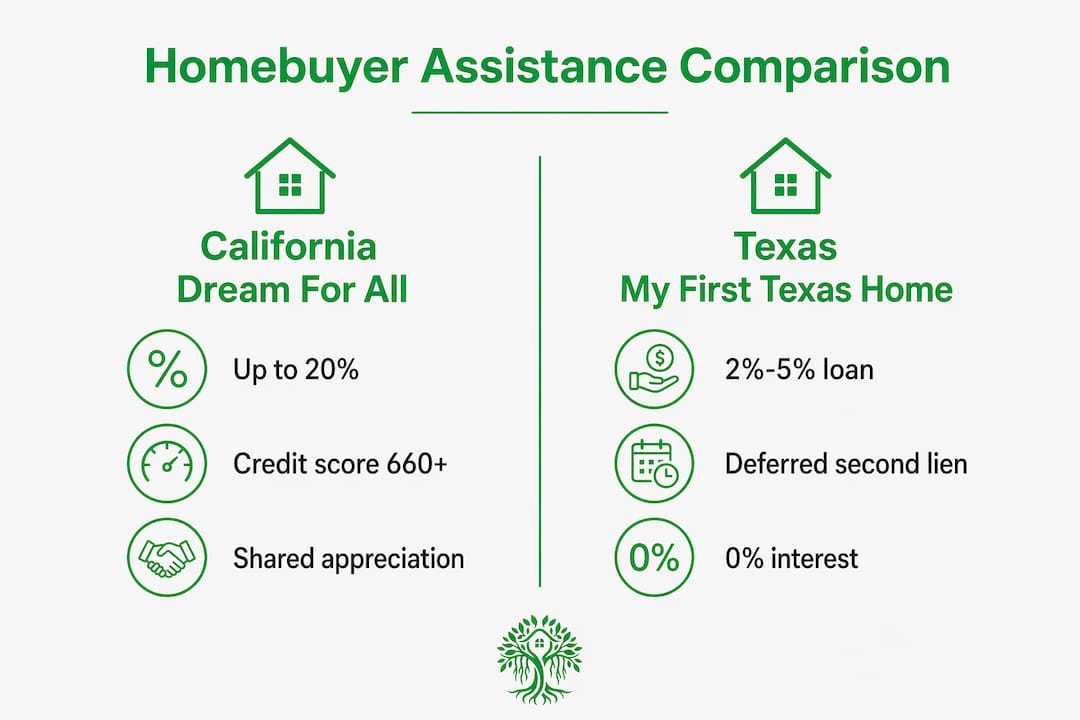
| Feature | California Dream For All | Texas My First Texas Home |
|---|---|---|
| Assistance amount | Up to 20% of purchase price, max $150,000 | 2%–5% of loan amount |
| Structure | Shared appreciation loan | Deferred 0% interest second lien |
| Repayment trigger | Sale, refinance, or payoff | Sale, refinance, or payoff |
| Appreciation sharing | Yes, proportional to state’s contribution | No |
| Credit score minimum | 660 | 620 |
| Application method | Lottery-based | First-come, first-served via approved lender |
CalHFA also administers additional programs that can layer with Dream For All. The MyHome and ZIP programs offer up to 3.5% as a deferred second loan and 3% for closing costs respectively. MyHome cannot be combined with Dream For All, but Dream For All can pair with ZIP closing cost assistance. That combination covers both your down payment and a portion of closing costs from a single application process.
Pro Tip: Ask your lender specifically about Special Purpose Credit Programs (SPCPs). These programs use first generation status under the Equal Credit Opportunity Act to offer reduced costs and better terms. Many lenders offer them but do not advertise them publicly.
Local city and county programs in both states can also stack with state aid. Cities like Los Angeles, San Jose, and Austin run their own down payment assistance funds. Stacking local and state programs requires a lender who understands both sets of rules, but the payoff can be substantial.
How do you apply for these programs in California and Texas?
The application process differs between the two states, but both follow a clear sequence. Working with the right lender from day one is the single most important decision you will make.
-
Select an approved lender. In California, find a CalHFA-approved lender at calhfa.ca.gov. In Texas, use the TDHCA lender locator at tdhca.state.tx.us. Not every mortgage lender participates, and using a non-approved lender disqualifies you automatically.
-
Complete homebuyer education. Both states require a certificate from an approved homebuyer education course before closing. HUD-approved counseling agencies offer these courses online. Budget four to eight hours and complete this early, since some programs require the certificate before you can even submit an application.
-
Gather documentation. You will need tax returns, pay stubs, bank statements, and proof of your parents’ ownership status. California’s Dream For All requires documentation of indirect ownership including trusts and inherited interests. Start collecting this paperwork before you find a property.
-
Submit your application through your lender. Your lender submits to CalHFA or TDHCA on your behalf. For Dream For All, applications are processed via a lottery. The most recent cycle closed march 16, 2026. Watch CalHFA’s website for the next opening. Texas My First Texas Home operates on a first-come, first-served basis with no lottery.
-
Receive your reservation and shop for a home. Once approved, you receive a program reservation. In California, this reservation has an expiration date. Move quickly once you have it.
-
Close with your assistance in place. Your lender coordinates the second lien or shared appreciation loan at closing. The funds appear on your closing disclosure alongside your primary mortgage.
Pro Tip: Experienced loan officers who specialize in layered assistance programs close these deals faster and with fewer surprises. Ask any lender how many CalHFA or TDHCA loans they closed in the past 12 months before you commit.
What challenges should first generation homebuyers watch for?
The biggest trap is assuming that qualifying as a first-time buyer automatically qualifies you as a first generation buyer. It does not. Parental ownership verification is the step where most applications stall or fail. A parent who sold a home two years ago, holds a timeshare, or is listed as a beneficiary on a family trust can trigger a denial if you have not documented the situation correctly.
Program stacking has real limits. Combining the wrong programs wastes time and can delay your closing. Here are the key restrictions to know:
- Dream For All and MyHome cannot be combined in California
- Dream For All can pair with ZIP closing cost assistance
- Texas My First Texas Home can layer with local city programs in many cases
- SPCPs from private lenders may stack with state programs but require lender verification
- County income limits vary widely; a household that qualifies in Fresno may not qualify in San Francisco
“The long-term cost of a shared appreciation loan depends entirely on how much your home appreciates. In a high-growth market like the Bay Area or Austin, the state’s repayment share on a Dream For All loan can exceed what you would have paid in PMI on a conventional loan. Run the numbers for your specific market before you commit.”
Buyers also underestimate how much county purchase price limits matter. California sets maximum purchase prices by county, and in high-cost areas those caps can exclude a large share of available inventory. If you are buying in Los Angeles or Santa Clara County, confirm the current cap with your lender before you start making offers. For guidance on house hunting pitfalls that affect program applicants specifically, reviewing common inspection and offer mistakes early saves time later.
The federal LIFT Homebuyers Act, if passed, would enable low-interest 20-year loans for first generation buyers, doubling equity build speed at comparable monthly payments. That legislation signals where federal policy is heading, but it is not law yet. For now, state programs remain your primary source of targeted financial aid for homebuyers.
Key Takeaways
First generation homebuyer programs in California and Texas offer the most substantial down payment assistance available to first-time buyers, but eligibility hinges on strict parental ownership verification and program-specific documentation.
| Point | Details |
|---|---|
| First generation definition is strict | Parents must not hold direct or indirect ownership, including trusts and inherited interests. |
| California Dream For All offers the most | Up to 20% of purchase price, capped at $150,000, as a shared appreciation loan. |
| Texas My First Texas Home is simpler | Provides 2%–5% as a deferred 0% interest second lien with no appreciation sharing. |
| Lender selection is critical | Only CalHFA-approved or TDHCA-approved lenders can process these applications. |
| Program stacking has rules | Dream For All pairs with ZIP but not MyHome; local programs may layer with state aid in Texas. |
What I have learned from watching buyers navigate these programs
I have seen buyers lose their Dream For All reservation because they spent three weeks searching for a home before confirming their parents’ ownership status. That is the wrong order. The documentation work comes first, before you fall in love with a property.
The shared appreciation structure of Dream For All is genuinely misunderstood. Buyers hear “free money” and stop reading. The state is not giving you $150,000. It is investing alongside you and expects a return. In a flat market, that return is modest. In a market where prices climb 30% in five years, the repayment is significant. I think buyers in high-appreciation California markets should model both scenarios before signing.
The federal LIFT Homebuyers Act is worth watching. A 20-year mortgage at a reduced rate for first generation buyers would be a structural change, not just a grant program. It would build equity faster without the appreciation-sharing trade-off. That is a better long-term deal for most buyers.
My strongest advice: treat lender selection like hiring a specialist surgeon, not a general practitioner. The right loan officer for a first generation buyer knows county income limits, program stacking rules, and the lottery calendar. A generalist mortgage broker does not. That difference can cost you your reservation, your rate lock, or your closing date.
Start your homebuyer education course the week you decide to buy. Do not wait until you have a property under contract. The certificate takes time, and some programs require it before your application can even be submitted. Getting ahead of that requirement is one of the simplest ways to compress your timeline. You can also use a home affordability calculator to confirm your true budget before you start the lender conversation.
— Anand
How Ficustree helps first generation buyers find the right path
First generation homebuyer programs involve more moving parts than most buyers realize. Ficustree’s AI-powered platform matches you with homes that fit your budget after factoring in down payment assistance, and it organizes the steps you need to complete before closing.

Ficustree works directly for you as the buyer. You pay $1,000 at closing plus 1% commission and keep a rebate of roughly 2% where legally permitted. The platform helps you identify which California programs you qualify for, connects you with approved lenders who specialize in layered assistance, and tracks your homebuyer education requirements. Start your search at Ficustree and go from program confusion to a clear offer strategy in weeks, not months.
FAQ
What makes a first generation homebuyer program different from a first-time buyer program?
A first generation homebuyer program adds a parental ownership check on top of the standard first-time buyer requirement. Your parents must not currently own a home, including indirect ownership through trusts or inherited property.
How much can I receive from California’s Dream For All program?
California’s Dream For All provides up to 20% of the purchase price, capped at $150,000, as a shared appreciation loan repaid when you sell or refinance.
Does Texas have a first generation homebuyer program?
Texas’s My First Texas Home program offers 2%–5% of the loan amount as a deferred 0% interest second lien. It does not require appreciation sharing and accepts credit scores as low as 620.
Can I combine multiple homebuyer assistance programs?
Yes, in many cases, but with restrictions. California’s Dream For All can pair with ZIP closing cost assistance but not with MyHome. Texas buyers can often layer state and local city programs. An experienced loan officer who knows both sets of rules is required to do this correctly.
What happens if my parents owned a home years ago but sold it?
Program rules vary. Some programs use a seven-year lookback period; others check current ownership only. Review the specific program guidelines with your lender and document your parents’ ownership history thoroughly before applying.