
A home inspector’s role in the buying process is to deliver an unbiased, detailed condition report on a home’s major systems and physical components shortly after offer acceptance, giving you the facts you need before you commit to closing. This is not a formality. The inspection report directly shapes your negotiation position, your lender’s approval conditions, and your decision to move forward or walk away. For first-time buyers in California and Texas, where purchase prices are high and surprises are expensive, understanding this step is one of the most practical things you can do before signing anything final.
What is the role of a home inspector in the buying process?
The home inspector’s job is to give you an objective picture of a property’s condition at a specific point in time. According to the National Association of REALTORS®, inspectors provide an unbiased, noninvasive evaluation that helps buyers avoid expensive surprises and keeps transactions from falling apart over unknown defects. That objectivity is the whole point. Your inspector is not emotionally invested in the sale. You are. They are not.

The inspector’s findings become your data. You use that data to negotiate repairs, request seller credits, push for a price reduction, or decide the property is not worth the risk. The inspection also feeds directly into your lender’s requirements. Inspection findings can influence mortgage financing when lenders require certain repairs before approving your loan. That means the report is not just for you. It matters to your bank and potentially your homeowner’s insurance underwriter too.
Think of the home inspector as your property’s first honest reviewer. They have no stake in whether you buy. That independence is exactly what makes their report so valuable.
What does a home inspector check during the inspection?
A home inspector performs a detailed visual walk-through of a property’s major systems, spending several hours documenting conditions, taking photos, and noting concerns. The inspection covers the roof, foundation, exterior walls, plumbing, electrical systems, HVAC (heating, ventilation, and air conditioning), insulation, windows, and doors. The inspector records what they can see and access. They do not dismantle walls, dig up foundations, or run invasive tests.
Here is what a standard home buying inspection checklist covers:
- Roof and attic: Shingles, flashing, gutters, ventilation, and signs of water intrusion
- Foundation and structure: Visible cracks, settling, and framing concerns
- Electrical system: Panel condition, wiring type, grounding, and safety hazards
- Plumbing: Pipe materials, water pressure, drainage, and water heater condition
- HVAC systems: Age, function, filters, and ductwork
- Interior: Ceilings, floors, walls, stairs, and evidence of moisture or mold
- Exterior: Grading, drainage, siding, and attached structures like garages
The final report itemizes every finding with a severity level and a recommended action. Some items are flagged as safety hazards. Others are noted as deferred maintenance. The report is not a pass/fail grade. It is a condition snapshot, and no inspection guarantees against future problems or hidden defects behind walls.
Pro Tip: Ask your inspector to walk you through the report verbally after the inspection. A five-minute conversation about the top three concerns is worth more than reading 40 pages alone.
Specialty inspections, such as sewer scope, mold testing, or structural engineering reviews, fall outside the standard scope. If your inspector flags a concern in any of those areas, you will need to hire a specialist separately.
How does the inspection fit into your buying timeline?
Timing is where many first-time buyers lose their leverage. The inspection typically occurs within 7–10 days after offer acceptance. That window is tight, and the inspection contingency period that follows is even tighter.
The inspection contingency window typically lasts 5–14 days and is often non-negotiable. Missing that deadline means you lose your right to request repairs or exit the contract without penalty. In competitive California markets, sellers sometimes push for shorter windows. You need to move fast.
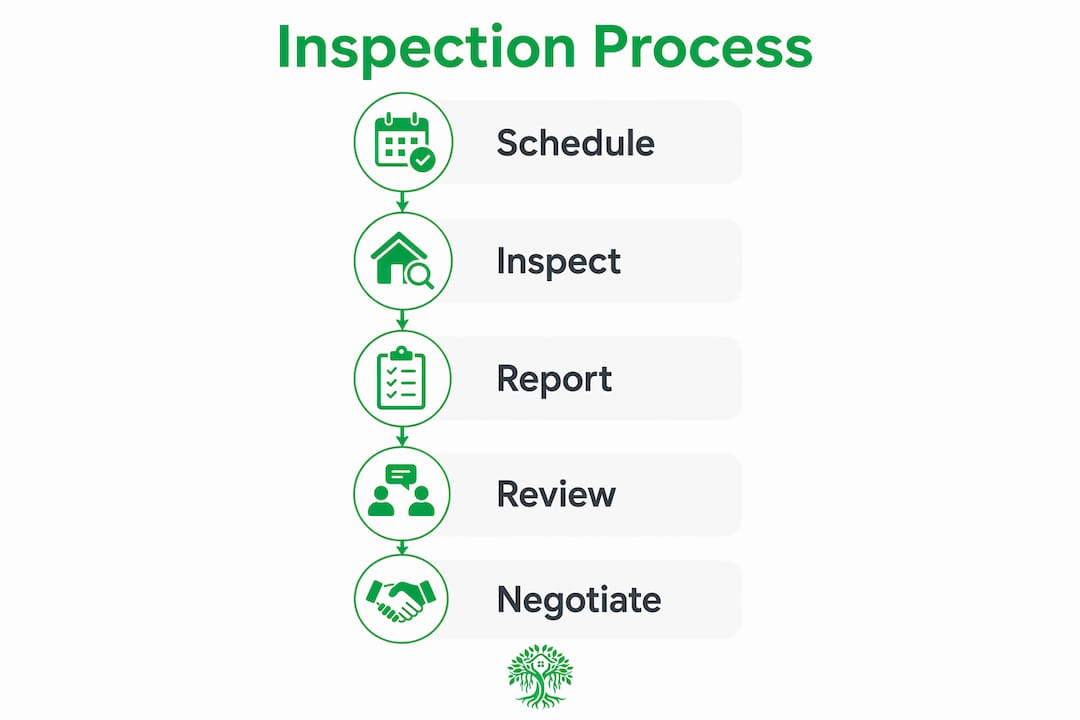
Here is the sequence that protects you:
- Schedule the inspection immediately after your offer is accepted. Do not wait two or three days. Call your inspector the same afternoon.
- Attend the inspection in person. You will learn more in three hours on-site than in three days reading the report alone.
- Read the full report within 48 hours of receiving it. Flag every item that concerns you.
- Consult specialists early if the report raises structural, electrical, or environmental red flags. Specialists need lead time.
- Submit your repair request or credit demand before the contingency deadline. Late submissions are often rejected.
The escrow and contingency timeline in California is particularly strict. Missing a contingency deadline can cost you your earnest money deposit, which in California often runs 1–3% of the purchase price. On a $700,000 home, that is $7,000–$21,000 at risk.
Pro Tip: Treat the inspection contingency like a project with a hard deadline. Put every step on your calendar the day you go under contract. No exceptions.
How do you read the report and use it to negotiate?
Most first-time buyers make one of two mistakes with the inspection report. They either panic over every item and try to negotiate everything, or they ignore findings because they are emotionally attached to the property. Neither approach serves you well.
Inspection reports show findings with severity levels and recommended actions. They are not mandatory fix lists. The inspector’s job is to document, not to dictate. Your job is to decide which findings are worth fighting for.
Here is how to sort what you are looking at:
| Finding Type | Examples | Recommended Action |
|---|---|---|
| Safety hazards | Faulty wiring, gas leaks, missing GFCI outlets | Request repair before closing |
| Major structural issues | Foundation cracks, roof failure, water damage | Get specialist estimate, negotiate credit or price cut |
| System end-of-life | HVAC over 20 years old, aging water heater | Request seller credit toward replacement |
| Routine maintenance | Caulking, minor grading, dirty filters | Accept as-is or use as minor negotiation point |
| Cosmetic issues | Scuffed floors, dated fixtures | Do not negotiate. These are not defects. |
Your negotiation options after the inspection include requesting the seller make specific repairs before closing, asking for a seller credit at closing so you handle repairs yourself, pushing for a price reduction, or terminating the contract if findings are severe enough. The report serves multiple parties, including your lender and insurer, so certain safety or structural repairs may not be optional. Your lender may require them before funding the loan.
For a deeper look at structuring your post-inspection ask, the Ficustree guide on getting the right seller credit walks through exactly how to frame your request without blowing up the deal.
How do you choose a qualified home inspector?
The quality of your inspection depends entirely on the person holding the flashlight. Licensing requirements vary by state. California requires home inspectors to carry errors and omissions insurance and meet specific education standards. Texas requires licensure through the Texas Real Estate Commission (TREC). Both states have online license lookup tools you should use before hiring anyone.
Beyond licensing, here is what to look for:
- Experience with the property type. An inspector who specializes in 1950s bungalows may not be the right choice for a new construction condo.
- Independence from the transaction. Avoid inspectors referred exclusively by the seller’s agent. Find your own through the American Society of Home Inspectors (ASHI) or the International Association of Certified Home Inspectors (InterNACHI).
- Sample reports. Ask to see a sample before you hire. A good report is detailed, photo-rich, and clearly organized by severity.
- Availability within your contingency window. A great inspector who cannot show up for five days is not the right inspector for your timeline.
- Willingness to answer questions. Your inspector should welcome your attendance and your questions. If they seem annoyed by your presence, find someone else.
When you arrive at the inspection, let the inspector work. Follow along, observe, and save your questions for natural pauses or the walkthrough at the end. Interrupting the process increases the chance that something gets missed.
Common first-time buyer mistakes in California often involve skipping the inspection entirely in competitive markets or waiving the contingency without fully understanding the financial risk. That is a decision you should make with clear eyes, not under pressure.
Key takeaways
A home inspector’s report is your most powerful decision-making tool in the buying process, and using it well requires speed, preparation, and clear thinking about what the findings actually mean.
| Point | Details |
|---|---|
| Inspector role is objective | Inspectors provide unbiased condition reports, not pass/fail grades or repair mandates. |
| Timing is non-negotiable | Schedule your inspection immediately after offer acceptance to protect your contingency rights. |
| Reports inform negotiation | Use findings to request repairs, seller credits, or price reductions before the contingency deadline. |
| Lenders care too | Certain safety or structural findings may trigger lender-required repairs before loan approval. |
| Choose your inspector carefully | Verify licensing through ASHI or InterNACHI and attend the inspection in person. |
What first-time buyers get wrong about inspections
I have watched buyers treat the inspection report like a report card. They either celebrate a “clean” report or spiral into anxiety over a 40-page document full of items that are completely normal for a 20-year-old house. Both reactions miss the point.
The inspection is not a verdict. It is data. Your job is to read it like a business decision, not an emotional one. The roof has 5 years of life left? That is a negotiation point, not a reason to panic. The electrical panel is a Federal Pacific Stab-Lok? That is a safety issue that warrants a real conversation with your agent and possibly your lender.
What I have found actually works is treating the contingency period like a sprint with a fixed finish line. You schedule the inspection on day one. You read the report on day two. You call a specialist if needed on day three. You submit your request on day five. That structure removes the anxiety because you always know what comes next.
The other thing buyers consistently underestimate is the lender’s role in the inspection findings. Your bank is not a passive observer. If the report flags a structural issue or a safety hazard, your lender may require a repair before they fund the loan. That changes your negotiation from optional to mandatory. Knowing that ahead of time gives you leverage, not stress.
The home inspection secrets that experienced buyers know come down to one thing: treat the inspection as a tool, not a test. Use it to buy smarter.
— Anand
How Ficustree helps you stay on top of the inspection process

The inspection step is where first-time buyers most often feel overwhelmed and alone. Ficustree is built to change that. The AI-powered platform at ficustree.ai helps you track inspection timelines, understand what your report findings mean, and prepare your negotiation position with clear, structured guidance. You get the context you need to act fast and act smart, without guessing.
Ficustree represents you directly as a buyer. You pay $1,000 at closing plus 1% commission, and you keep a rebate of roughly 2% where legally permitted. The platform is free to use. From offer acceptance through contingency management and closing, Ficustree keeps you moving with confidence. Start your search at ficustree.ai/buyer and see how decision intelligence changes the buying experience.
FAQ
What does a home inspector do during a home inspection?
A home inspector performs a visual, noninvasive walk-through of a property’s major systems, including the roof, foundation, plumbing, electrical, and HVAC, and documents findings in a detailed report with severity levels and recommended actions.
When does the home inspection happen in the buying process?
The inspection typically occurs within 7–10 days after offer acceptance, during the inspection contingency period, which usually lasts 5–14 days depending on the contract terms.
Can you negotiate after a home inspection?
Yes. Inspection findings give you the right to request repairs, ask for a seller credit, push for a price reduction, or exit the contract within the contingency window without losing your earnest money deposit.
Do i need to attend the home inspection in person?
Attending in person is strongly recommended. You will observe conditions directly, ask questions in real time, and understand the report far better than if you read it cold without context.
How do i find a qualified home inspector?
Search the American Society of Home Inspectors (ASHI) or the International Association of Certified Home Inspectors (InterNACHI) directories, verify state licensing, and review sample reports before hiring.