
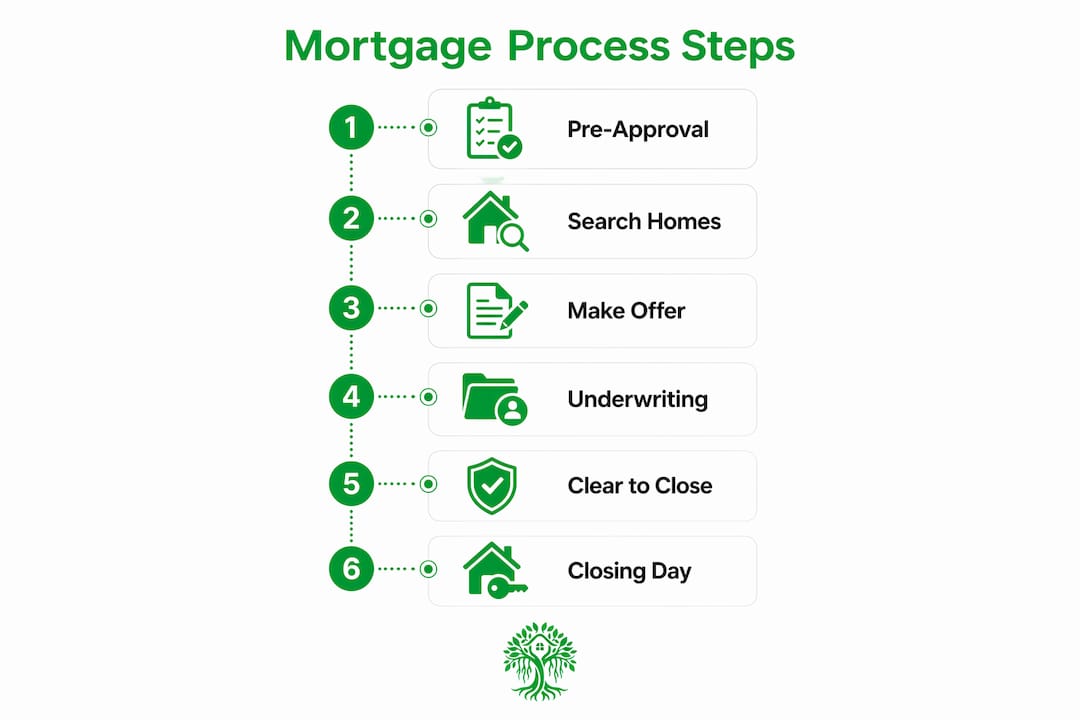
Pre-approval is a conditional lender estimate, not a loan guarantee. It tells you how much a lender is willing to lend based on a financial snapshot taken at one point in time. What happens after pre-approval is a defined sequence: start house hunting within your approved price range, make an offer, submit a formal loan application, clear the appraisal, move through underwriting, and reach “Clear to Close.” Every step has a lender verification trigger attached to it, and any financial change you make along the way can reopen that verification.
Here are the three immediate actions to take right now:
- Start searching within the price range on your pre-approval letter, not above it. Your approved amount is a ceiling, not a target.
- Get your agent and documents ready. Brief a buyer’s agent with your pre-approval letter and gather pay stubs, W-2s, bank statements, and ID before you need them.
- Prepare for the full loan application. Once your offer is accepted, your lender will re-verify everything. Fannie Mae underwriting standards and CFPB guidance both emphasize that the formal application triggers a deeper review than pre-approval did.
Ficustree’s buyer platform is built around exactly this sequence, helping first-time buyers in California and Texas move from pre-approval to clear-to-close without losing track of a single step.
Table of Contents
- How do you use your pre-approval to search effectively?
- What should your offer include to protect your financing?
- What documents does the lender re-check after your offer is accepted?
- What is the difference between a home inspection and an appraisal?
- How does underwriting work, and what does “conditional approval” mean?
- What are the most common reasons a mortgage gets denied after pre-approval?
- How long does the process take from pre-approval to clear-to-close?
- What are your options if you’re denied or the appraisal falls short?
- How do you protect your pre-approval with a quick-response protocol?
- Key Takeaways
- Why representation and organization matter most after pre-approval
- Ficustree helps you stay on track after pre-approval
- Useful sources and further reading
- FAQ
How do you use your pre-approval to search effectively?
Your pre-approval letter is a working document, not a trophy. Hand it to your buyer’s agent on day one, using tools like real estate photo editing for agents to enhance your listing presentation and marketing efforts. A good agent will use the approved loan amount, estimated monthly payment, and property-type restrictions to filter out homes that would never survive underwriting, saving you time and emotional energy.

Set your search parameters based on what the lender approved, not what you wish they had approved. That means filtering by price, factoring in your estimated down payment, and checking whether the loan type (FHA, conventional, VA) restricts property condition. An FHA loan, for example, will not close on a home with peeling paint or a broken HVAC system.
Pre-approval letters typically expire after a couple of months. If your search runs long, ask your lender for a refreshed letter before it lapses. Renewing requires updated pay stubs, bank statements, and a new credit pull, so give yourself a week’s lead time.
Pro Tip: Request a new pre-approval letter for each offer you write, adjusted to match that specific offer price. Showing a seller a letter for exactly $620,000 on a $620,000 offer is stronger than showing one for $700,000. It also protects your negotiation position by not revealing your full borrowing capacity.
While you search, practice what lenders call “financial silence.” Do not open new credit cards, finance a car, or make large unexplained transfers. Lenders re-verify credit and assets before closing, and any new liability can change your debt-to-income ratio (DTI) enough to void the pre-approval.
What should your offer include to protect your financing?
Your pre-approval letter travels with your offer. Listing agents use it to assess whether your financing is real, and sellers use it to compare competing bids. A letter from a well-known lender, dated recently, and matching the offer price signals a serious buyer.
Two contract elements directly protect your financing:
- Mortgage contingency: This clause lets you exit the contract and recover your earnest money if your loan is denied. Without it, a financing failure could cost you your deposit.
- Earnest money deposit: Typically a few percent of the purchase price, paid within a few days of offer acceptance. It shows the seller you are committed. If you back out for a reason not covered by a contingency, you lose it.
Consider the practical difference: an offer with a mortgage contingency protects you if underwriting turns up a problem. An offer without one (sometimes used in competitive markets to look stronger) puts your earnest money at risk if the loan falls through. In most first-time buyer situations, keeping the mortgage contingency is the right call.
Once your offer is accepted, your lender will ask for a copy of the purchase contract immediately. That document triggers the appraisal order, title work, and the formal loan application. Request an updated pre-approval letter to match the final accepted price before submitting it to the listing agent.
What documents does the lender re-check after your offer is accepted?
Accepting an offer flips the process from shopping to verifying. Your lender will pull an updated credit report, order an appraisal, open a title search, and send a Verification of Employment (VOE) to your employer, sometimes without telling you. The formal loan application, known as the Uniform Residential Loan Application (Form 1003), consolidates everything.
Expect to provide:
- Pay stubs from the last 30 days
- W-2s and federal tax returns for the past two years
- Bank statements for all accounts, all pages, for the past 60 days
- Government-issued ID
- Explanation letters for any large deposits that are not regular payroll
- Gift letters if any portion of your down payment is a gift
- Asset statements for retirement accounts, brokerage accounts, or other funds used for closing
Missing or incomplete paperwork is one of the most common reasons approvals stall. Underwriters need every page of every statement, including blank pages. Submitting a 10-page bank statement with pages 7 and 8 missing will pause your file.
Respond to every document request within 48–72 hours. Processors work multiple files simultaneously, and a slow response pushes your file to the back of the queue. Organize your documents in a labeled folder (digital or physical) before you even make an offer, so you can upload them the same day the request arrives.

What is the difference between a home inspection and an appraisal?
These two reports serve completely different purposes, and confusing them is a common first-time buyer mistake.
| Home Inspection | Appraisal | |
|---|---|---|
| Who orders it | Buyer (optional but strongly advised) | Lender (required) |
| Who pays | Buyer, typically $300 | Buyer, typically $500 |
| Purpose | Identify physical defects and safety issues | Establish market value of the property |
| Who uses the report | Buyer (and agent for negotiations) | Lender (to size the loan correctly) |
| Affects the loan? | Indirectly (if repairs trigger contingency) | Directly (low value can reduce loan amount) |
The appraisal is what your lender cares about most. The lender orders the appraisal and compares the appraised value to your loan amount to calculate the loan-to-value ratio (LTV). If you agreed to pay $650,000 but the appraiser values the home at $620,000, the lender will only lend against $620,000. You now have a $30,000 appraisal gap to resolve.
Your options when the appraisal comes in low:
- Renegotiate the price with the seller down to the appraised value (most common outcome).
- Bring additional cash to close to cover the gap out of pocket.
- Request a Reconsideration of Value (ROV) from the lender, submitting comparable sales the appraiser may have missed. This works best when the gap is small and recent comps support a higher value.
- Walk away under your appraisal contingency, recovering your earnest money.
An appraisal gap can also trigger a loan reduction or outright denial if you cannot cover the shortfall. Including an appraisal contingency in your offer is the cleanest protection.
How does underwriting work, and what does “conditional approval” mean?
Underwriting is the lender’s final, deep verification of everything in your file. A human underwriter (or an automated system like Fannie Mae’s Desktop Underwriter) reviews your credit, income, assets, employment, the appraisal, and the title report against the loan program’s guidelines.
The three stages buyers move through:
- Pre-approval: Initial affordability check, limited verification.
- Conditional approval: Underwriter has reviewed the file and approves the loan subject to specific conditions being met.
- Clear to Close (CTC): All conditions satisfied, loan is approved, closing can be scheduled.
Underwriters verify: updated credit score and report, Verification of Employment (VOE) confirming you are still employed, IRS tax transcripts matching your returns, sourcing of all large deposits, title report confirming clean ownership, and proof of homeowner’s insurance.
Common conditions you will likely receive:
- Updated pay stub dated within 30 days of closing
- Complete bank statements with all pages
- Gift letter from the donor with proof of transfer
- Signed letter of explanation for a large deposit or credit inquiry
- Proof of homeowner’s insurance binder
Typical underwriting timeline:
| Stage | Typical Duration |
|---|---|
| Appraisal ordered to received | 7 days |
| Underwriting review | 3–7 business days |
| Conditions response window | 48–72 hours per round |
| Title search and clearance | 5–10 business days |
| Clear to Close to closing day | 3–5 business days |
Conditions are normal. Responding within 48 hours with complete, exact documentation is what separates buyers who close on time from those who push their closing date.
What are the most common reasons a mortgage gets denied after pre-approval?
Pre-approval can be revoked because it is based on a financial snapshot. Underwriting is a live, updated review. Here are the five highest-probability denial triggers and how to avoid each:
- New debt: Financing a car, opening a credit card, or co-signing a loan raises your DTI. Ask your lender before taking on any new obligation. The rule is simple: if it shows up on a credit report, ask first.
- Job change or income gap: Switching employers, going from W-2 to self-employed, or taking unpaid leave can make your income unverifiable. Notify your lender before any employment change, not after.
- Missed or late payments: A single 30-day late payment after pre-approval can drop your credit score enough to push you out of the loan program’s minimum. Set every account to autopay through closing.
- Unexplained large deposits: A $10,000 transfer from a family member without a gift letter, or a cash deposit with no paper trail, will pause underwriting. Document the source of every large deposit before moving funds.
- Low appraisal or title issues: Covered in detail above. An appraisal gap or a title defect (an old lien, an ownership dispute) can block closing entirely.
Before any financial move during the buying process, ask yourself: “Will this change my DTI, my credit score, or my cash-to-close?” If the answer is yes or maybe, call your lender first.
How long does the process take from pre-approval to clear-to-close?
The home buying timeline from offer acceptance to closing usually runs about one to two months for most loan types. Here is a practical breakdown:
| Milestone | Typical Duration |
|---|---|
| Offer accepted to formal loan application | 1–3 days |
| Appraisal ordered to received | 7 days |
| Underwriting review (first pass) | 3–7 business days |
| Conditions gathered and resubmitted | 3–7 business days |
| Clear to Close issued | 1–2 days after final conditions |
| Closing day | 3–5 days after CTC |
Pre-approval letters expire after a couple of months. If your search extends past that window, renew before writing offers. Switching lenders after an accepted offer is possible but restarts underwriting and appraisal orders, adding roughly 7–10 days to your timeline and risking your closing date.
Checklist by stage:
- At offer: Pre-approval letter (price-matched), proof of earnest money funds, signed purchase contract
- At appraisal: Access to the property arranged, any recent comparable sales you want the appraiser to consider
- At underwriting: Updated pay stubs, complete bank statements, gift letters, explanation letters, homeowner’s insurance binder
- At closing: Closing cost funds (typically 2%–5% of the loan amount beyond the down payment), government-issued ID, certified or wire-transferred funds
Homeowner’s insurance is required before closing. Most lenders want proof of a paid binder at least three days before the closing date. Shop for coverage as soon as your offer is accepted, not the week of closing.
What are your options if you’re denied or the appraisal falls short?
A denial or an appraisal gap is not automatically the end. You have real options, and the right one depends on how much time remains in your contract and how large the gap is.
- Renegotiate the purchase price. Ask your agent to go back to the seller with the appraisal report. Sellers in slower markets often accept a price reduction rather than restart with a new buyer.
- Bring additional cash to close. If the gap is small (say, $10,000–$20,000) and you have reserves, covering it out of pocket keeps the deal alive without delay.
- Request a Reconsideration of Value. Submit recent comparable sales to your lender within the ROV window. This works when the appraiser missed a relevant comp, not when the market simply does not support the price.
- Shop a new lender. If the denial is credit- or program-related rather than property-related, a different lender with different guidelines may approve the loan. Budget 7–10 additional days and discuss timing with your agent before switching.
- Cancel under contingency. If you have an appraisal or mortgage contingency and the numbers do not work, exercising the contingency lets you exit and recover your earnest money. Missing a contingency deadline, however, can forfeit that protection.
If contractual deadlines are at risk, loop in your agent and a real estate attorney before acting. A housing counselor approved by HUD can also help you evaluate options without a sales agenda. This article is general information, not legal or financial advice; confirm the specifics of your contract and loan with your lender and a qualified professional.
How do you protect your pre-approval with a quick-response protocol?
The buyers who close on time share one habit: they treat every lender request like a same-day priority. Here is a practical protocol to adopt from offer acceptance through closing.
Timing rules:
- Notify your loan officer before any job change, even a promotion with a title shift.
- Avoid new credit inquiries entirely. Even a “soft pull” for a furniture store card can raise flags.
- Maintain financial silence through closing: no new debt, no large unexplained transfers, no co-signing.
Sample email template for document requests:
Keep it short, factual, and attach everything in one message. Underwriters flag incomplete submissions, and a second round of requests adds days.
Pro Tip: When you receive a condition from underwriting, read it word for word before gathering documents. “Most recent 30-day pay stub” means dated within the last 30 days, not last month’s stub. Sending the wrong document wastes 24–48 hours and can push your closing date.
Key Takeaways
The most important thing to remember after pre-approval: it is a conditional green light to shop, not a loan commitment, and every financial move you make between now and closing will be re-verified.
| Point | Details |
|---|---|
| Pre-approval is conditional | It expires in 60 days and can be revoked if your finances change before closing. |
| Financial silence protects you | Avoid new debt, credit inquiries, and large unexplained deposits from offer to closing day. |
| Respond to underwriting fast | Return every document request within 48–72 hours with complete, exact files to avoid delays. |
| Appraisal gaps need a plan | If the appraised value falls short, you can renegotiate, bring cash, request an ROV, or exit under contingency. |
| Ficustree guides the full sequence | Ficustree’s AI-powered platform helps first-time buyers in California and Texas stay organized from pre-approval through clear-to-close. |
Why representation and organization matter most after pre-approval
Most buyers assume the hard part is getting pre-approved. The harder part is staying approved. The post-pre-approval phase is where deals fall apart, not because buyers are unqualified, but because they are unorganized or unrepresented at the moments that matter most.
What I have seen repeatedly is that buyers who have a clear process, someone coordinating their documents, and a lender who communicates proactively close faster and with fewer surprises. The buyers who struggle are the ones navigating underwriting conditions alone, unsure which document to send or how to respond to a lender’s request. Ficustree’s decision intelligence layer exists precisely for this phase: keeping the buyer informed, organized, and one step ahead of every verification trigger.
Ficustree helps you stay on track after pre-approval
Getting pre-approved is step one. Staying approved through appraisal, underwriting, and closing is where most first-time buyers need real support.

Ficustree is built for exactly this phase. The platform coordinates your documents, tracks lender requests, and gives you clear guidance at every verification trigger, so you are never scrambling for a pay stub at 11 PM. Buyers pay $1,000 at closing plus 1% commission, keep a rebate of roughly 2% where legally permitted, and use the full platform free. You get hourly showing agents on demand and AI-powered decision support from offer to keys.
Ready to move from pre-approval to clear-to-close with a clear plan? Start with Ficustree and see how the platform walks you through every step.
Useful sources and further reading
These official and industry resources go deeper on the topics covered above:
- Consumer Financial Protection Bureau (CFPB): Guidance on disputing credit report errors that can affect your pre-approval and loan eligibility.
- National Credit Union Administration (NCUA): Federally regulated lender standards and consumer protection resources for mortgage borrowers.
- NMLS Consumer Access: Verify that your lender and loan officer are properly licensed before submitting any financial documents.
- Fannie Mae (via The Mortgage Reports): A nine-step breakdown of the full mortgage loan process, including underwriting standards and Desktop Underwriter guidelines.
- Ficustree First-Time Buyer Guide: A plain-language walkthrough of the full buying process for first-time buyers in California and Texas, from affordability to closing.
FAQ
Can you be denied after pre-approval?
Yes. Pre-approval is a conditional commitment based on a financial snapshot, and lenders can deny the loan if your credit changes, you take on new debt, your employment shifts, or the appraisal comes in below the purchase price.
How likely is full approval after pre-approval?
Most buyers who maintain financial stability and respond quickly to underwriting conditions do reach final approval. The risk rises sharply if you open new credit, change jobs, or have unexplained deposits between pre-approval and closing.
Does pre-approval mean you will get the loan?
No. Pre-approval means a lender reviewed your finances at one point in time and estimated what you could borrow. Final approval, or “Clear to Close,” only comes after underwriting verifies your updated credit, employment, assets, the appraisal, and the title.
How long does it take to get full approval after pre-approval?
From offer acceptance, most conventional loans reach Clear to Close in about one to one and a half months. Appraisal typically takes about one to two weeks, underwriting several business days, and conditions resolution similarly depends on responsiveness.
How long does pre-approval last?
Pre-approval letters typically expire after 60–90 days. If your search runs longer, ask your lender to renew it with updated pay stubs, bank statements, and a fresh credit pull.