
The minimum credit score to buy a house depends on your loan type. For a conventional loan, you need at least 620. FHA loans accept scores as low as 500 with a 10% down payment, or 580 with just 3.5% down. VA and USDA loans generally require credit scores considered to be in a moderate to good range. Here is a quick breakdown:
- Conventional loans: 620 minimum
- FHA loans: 500 with 10% down; 580 with 3.5% down
- VA loans: 620 minimum (lender-set; no official VA floor)
- USDA loans: 580+ typically required
These are program minimums. Many lenders set their own internal floors above these thresholds, so the score that gets you approved at one lender may not work at another. Your credit score also shapes your interest rate, your monthly payment, and how much house you can realistically afford.
How credit scores actually drive mortgage approval
Your credit score is a three-digit number on a 300–850 scale, and lenders treat it as a fast read on how reliably you repay debt. But it is one input among several. Lenders also weigh your income, your savings, the property’s value, and your debt-to-income ratio before making a decision.

The Federal Reserve Bank of St. Louis identifies five core risk dimensions lenders evaluate: credit history (FICO scores), debt-to-income ratio (DTI), loan-to-value ratio (LTV), employment stability, and liquid reserves. A strong score can offset a modest down payment. A weak score can sink an application even when income looks solid. Automated underwriting systems like Fannie Mae’s Desktop Underwriter weigh all five together, which is why two buyers with the same score can get very different outcomes.

Where credit score has the most direct, measurable impact is on your interest rate. The table below shows how FICO score tiers translate to mortgage APR on a 30-year loan, using data from The Mortgage Reports:
| FICO Score | Mortgage APR | Monthly Payment* | Total Interest (30 Years)* |
|---|---|---|---|
| 760–850 | 6.70% | $2,442 | $500,602 |
| 700–759 | 6.95% | $2,505 | $523,310 |
| 680–699 | 7.07% | $2,535 | $534,292 |
| 660–679 | 7.11% | $2,545 | $537,965 |
| 640–659 | 7.21% | $2,571 | $547,172 |
| 620–639 | 7.36% | $2,610 | $561,049 |
*Estimates based on a sample loan amount from FICO data.
The gap between the top and bottom tier is $168 per month and roughly $60,000 over the life of the loan. That is the real cost of a lower score, and it compounds every year you carry the mortgage.
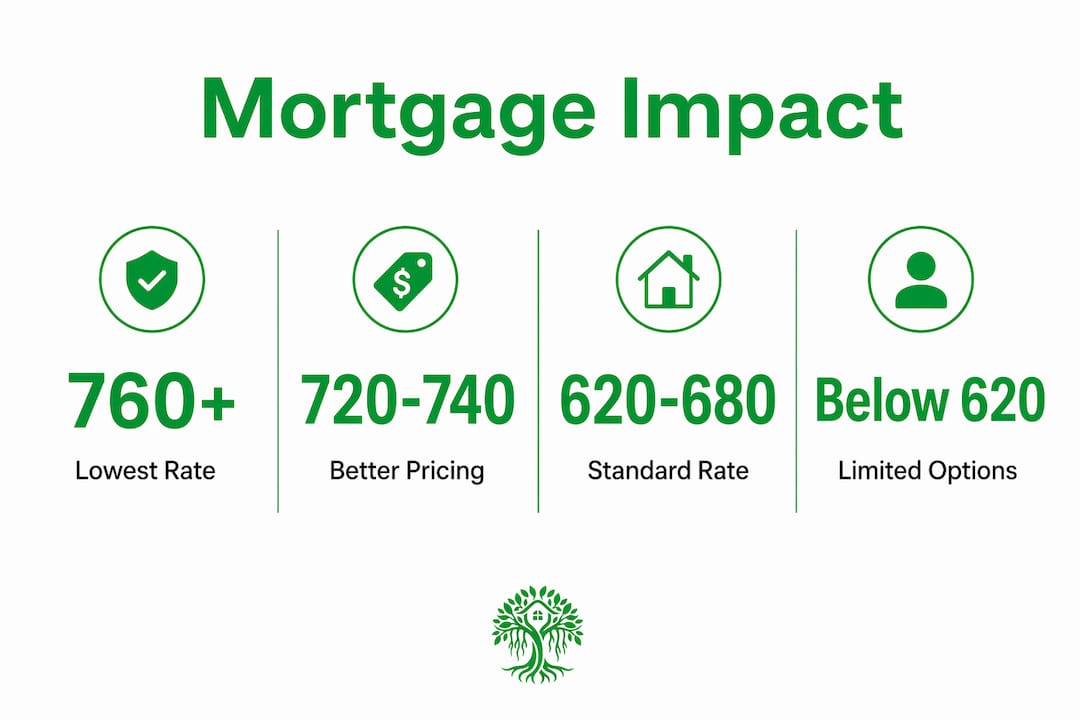
Lenders also use score breakpoints at 720 and 740 to unlock better pricing tiers. Hitting 740 is not just a nice milestone. According to Darrin Seppinni, president of HomeLife Mortgage, “pricing usually improves at 740, 760, and higher, depending on the loan program and down payment.” A score of 718 and a score of 720 may look nearly identical, but the two-point difference can move you into a cheaper rate tier before closing.
How to raise your credit score before applying for a mortgage
Credit scores can move faster than most buyers expect, especially when you focus on the factors that carry the most weight. Here is a practical sequence to follow in the months before you apply.
-
Pull all three credit reports and dispute errors. Errors on your Equifax, Experian, or TransUnion report can drag your score down without any fault of your own. The Consumer Financial Protection Bureau outlines how to dispute errors directly with each bureau. Corrections can restore points quickly, sometimes within 30 days.
-
Pay down credit card balances. Credit utilization, the ratio of your balance to your credit limit, accounts for roughly 30% of your FICO score. Getting each card below 30% of its limit helps. Getting below 10% helps more. This is often the single fastest lever available.
-
Avoid opening new credit accounts. Every new application triggers a hard inquiry and temporarily lowers your score. Opening a new card or financing furniture in the months before your mortgage application can cost you points at exactly the wrong time.
-
Keep existing accounts open. Closing old cards reduces your total available credit and raises your utilization ratio. Leave them open, even if you are not using them.
-
Ask about rapid rescoring. If you have paid down balances or corrected errors but your score has not updated yet, your mortgage lender can request a rapid rescore through the credit bureaus. Borrowers have improved scores by 40 points within 3–4 months using rapid rescoring combined with utilization reduction.
-
Set up autopay for every account. Payment history is the largest component of your FICO score. A single 30-day late payment can drop your score by dozens of points. Autopay removes the risk entirely.
-
Monitor your score monthly. Free monitoring through your bank or a service like Credit Karma lets you track progress and catch new errors before they become problems.
Pro Tip: Time your mortgage application to land after your credit card statements close but before the new balances report to the bureaus. Paying down a card right before the statement date means the lower balance is what lenders see.
Buying a house with a lower credit score: what actually works
A score below 620 does not automatically close the door. It narrows your options and raises your costs, but buyers with lower scores do get approved. The key is knowing which programs and strategies apply to your situation.
-
FHA loans are the most accessible path. With a score of 580, you can put down as little as 3.5%. With a score between 500 and 579, you need 10% down. FHA loans are insured by the Federal Housing Administration, which lets lenders accept more risk. Learn more about how FHA loans work and whether the program fits your profile.
-
Lender overlays are the hidden obstacle. Even though FHA policy allows scores as low as 500, many lenders set internal minimums at 580 or 620. Shopping multiple lenders is not optional when your score is on the lower end. Where you apply matters nearly as much as what you earn.
-
A larger down payment can offset a lower score. More equity at closing reduces the lender’s risk exposure. Some portfolio lenders (banks that hold loans rather than sell them) will approve lower-score borrowers who bring 20% or more to the table.
-
A co-signer can strengthen a weak application. Adding a creditworthy co-signer to the loan means the lender evaluates both credit profiles. This works best when the co-signer has a strong score and low DTI.
-
Buying mortgage points lowers your rate. If you cannot raise your score before closing, you can pay points upfront to buy down the interest rate. One point typically costs 1% of the loan amount and reduces the rate by a fraction of a percent. Run the math on how long it takes to break even.
-
A shorter loan term reduces total interest. A 15-year mortgage carries a lower rate than a 30-year, which partially offsets the cost of a lower credit score. Monthly payments are higher, but total interest paid drops.
Pro Tip: Get pre-qualified with at least three lenders before committing to one. Rate and approval criteria vary more than most buyers realize, and a lender who specializes in FHA or portfolio loans may offer terms a conventional lender will not.
Affordability and mortgage shopping go hand in hand with your score
Credit score is the entry ticket, but affordability is the ceiling. Even with a strong score, your DTI ratio determines how much you can actually borrow.
-
DTI is the leading cause of mortgage denials. Research from the Federal Reserve Bank of St. Louis shows that once DTI exceeds 50%, denial rates jump sharply. The 50% mark functions as the practical underwriting boundary for most lenders, even though the qualified mortgage standard historically referenced 43%. Use a DTI calculator to know your number before you apply.
-
Down payment size interacts directly with credit requirements. A larger down payment lowers your LTV ratio, which reduces lender risk. This can help compensate for a lower score or a higher DTI, especially with FHA and portfolio loan programs.
-
Credit mix and history depth matter at the margins. Lenders prefer to see a mix of installment loans (auto, student) and revolving credit (cards). A thin credit file with only one or two accounts can limit approval odds even if the score looks acceptable.
-
Recent credit activity raises flags. Opening multiple accounts in the 12 months before application signals financial stress to underwriters. Keep new credit activity minimal in the year leading up to your purchase.
-
Budget beyond the mortgage payment. Monthly PITI (principal, interest, taxes, and insurance) plus HOA fees, maintenance, and utilities is the real affordability number. A lower score raises your interest rate, which raises PITI, which shrinks the price range you can sustain. See the true cost of homeownership to build a realistic budget.
-
Shop lenders, not just rates. Approval criteria, overlays, and loan products vary by institution. Applying to multiple lenders within a 45-day window counts as a single hard inquiry under FICO’s rate-shopping rules, so there is no credit penalty for comparing offers.
Ready to move from credit prep to home search?

Ficustree is built for buyers who want clarity, not confusion. The platform guides you from credit readiness through offer strategy, with AI-powered tools that match you to homes and help you understand exactly what you can afford. Buyers pay $1,000 at closing plus 1% commission, keep a rebate of roughly 2% where permitted, and get access to the full platform free. Start your search and see how far your credit score can take you.
Key Takeaways
Your credit score determines not just whether you qualify for a mortgage, but what interest rate you pay, how much house you can afford, and which loan programs are available to you.
| Point | Details |
|---|---|
| Minimum scores by loan type | Conventional loans require 620; FHA accepts 500 with 10% down or 580 with 3.5% down; VA loans generally require 620 (lender-set); USDA loans typically require 580 or higher. |
| Rate tiers matter more than most buyers realize | Borrowers with scores 760–850 get APR around 6.70%; scores 620–639 face APR of 7.36%. |
| Rapid rescoring works | Focused credit actions can improve scores by 40 points in 3–4 months before application. |
| DTI is the other bottleneck | Once DTI exceeds 50%, denial rates jump sharply regardless of credit score. |
| Lender overlays raise the real floor | Many lenders require 580 or 620 internally, even when the loan program allows lower scores. |
FAQ
What credit score do I need to buy a house?
Most conventional loans require a minimum score of 620. FHA loans accept scores as low as 500 with a 10% down payment, making them the most accessible option for buyers with lower credit.
What is a good credit score to buy a house?
A score of 740 or higher typically unlocks the best mortgage rates. Lending experts note that pricing improves at 740, 760, and above, depending on the loan program and down payment size.
What credit score do I need to buy a $400,000 house?
The loan amount does not change the minimum score requirement. You still need 620 for a conventional loan or 580 for FHA with 3.5% down. However, a higher score reduces your rate and monthly payment, which directly affects how comfortably you can carry your mortgage.
What credit score do I need for a $250,000 house?
The same minimums apply: 620 for conventional, 580 for FHA with 3.5% down. The monthly payment difference between a 760 score (6.70% APR) and a 620–639 score (7.36% APR) adds up to meaningful savings over 30 years.
Can I get a mortgage with a 500 credit score?
Yes, through an FHA loan with a 10% down payment. In practice, many lenders set internal minimums at 580 or higher, so you will need to shop specifically for lenders who work with scores in the 500–579 range.