
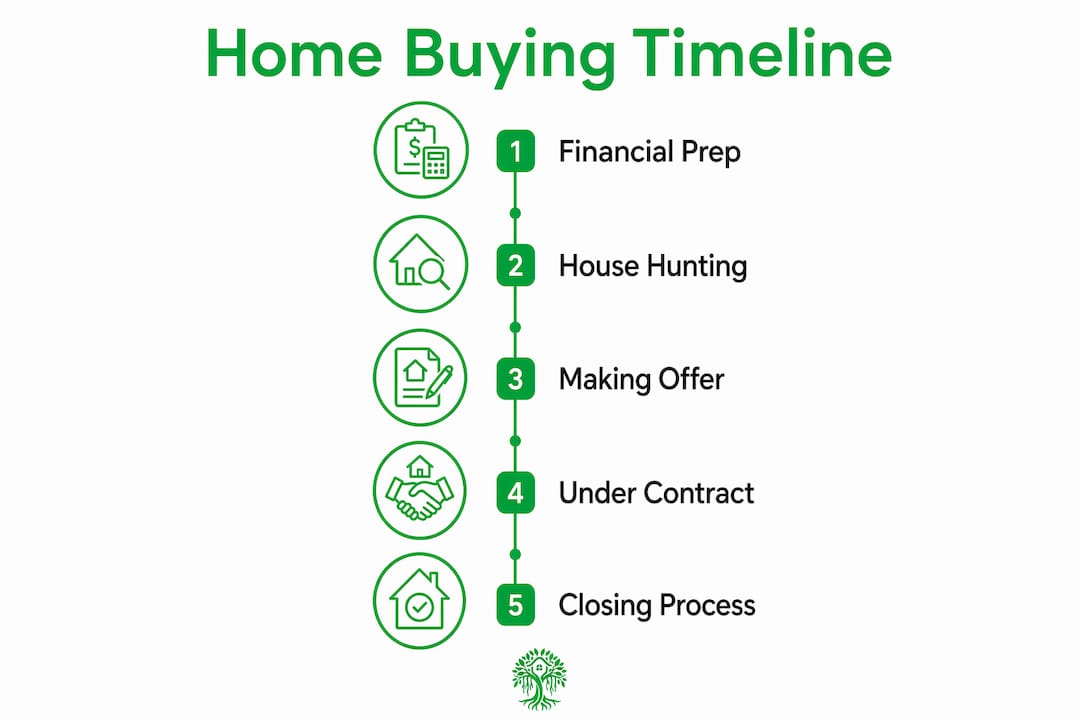
The home buying timeline is the structured sequence of stages every buyer follows from financial preparation to receiving keys at closing, typically spanning 3–7 months for first-time buyers. Each stage has its own tasks, deadlines, and decision points. Miss one, and you risk losing your earnest money, your rate lock, or the deal itself. The main phases are financial readiness, mortgage pre-approval, house hunting, offer and negotiation, inspection and appraisal, mortgage processing, and closing day. Key players include mortgage lenders, home inspectors, appraisers, and title companies, each of whom controls a piece of your timeline.
What is the home buying timeline, phase by phase?
The full home purchase timeline runs 3–7 months, with most of that time spent on financial readiness and house hunting. The closing process itself takes 30–47 days once you are under contract. Here is how each phase breaks down.
-
Financial preparation (2–6 months). Pull your credit report, pay down debt, and build your down payment savings. This phase takes the longest because credit improvement is not instant. If your score is below 620, expect to spend at least 6 months here before a lender will pre-approve you for a conventional loan.
-
Mortgage lender shopping (1–2 weeks). Compare rates from at least three lenders, including banks, credit unions, and mortgage brokers. Do all your rate shopping within a 45-day window so the credit bureaus treat multiple inquiries as a single hard pull. Shopping outside that window can lower your credit score unnecessarily.
-
Mortgage pre-approval and agent selection (1–3 weeks). Pre-approval signals to sellers that you are a serious buyer. Without it, most listing agents will not schedule tours, and sellers will not consider your offer. Submit your W-2s, tax returns, bank statements, and pay stubs to your chosen lender and expect a decision within 1–3 weeks.
-
House hunting (4–12 weeks). With pre-approval in hand, you can tour homes and make offers. The search phase varies widely. In competitive California markets like the Bay Area, you may lose several offers before one is accepted. In slower Texas markets, you might close on the first home you love.
-
Offer and negotiation (1 day to 2 weeks). Once you find the right home, your agent submits an offer. Sellers typically respond within 24–72 hours. Back-and-forth negotiation on price, repairs, or concessions can add a few days.
-
Inspection and appraisal (1–2 weeks). Inspection typically takes 2–5 days including report delivery. Experienced buyers use this period not just to accept or reject the home but to negotiate repairs, price reductions, or credits based on the inspector’s findings. The appraisal, ordered by your lender, runs parallel and usually takes 1–2 weeks.
-
Mortgage processing and underwriting (2–4 weeks). Your lender verifies every document you submitted. Underwriters may issue conditions requiring additional paperwork. Respond quickly to avoid delays.
-
Closing day (1–3 hours). You sign approximately 100–150 pages of documents, hand over your down payment via wire transfer or certified check, and receive your keys.
Pro Tip: Set calendar reminders for every contract deadline the day you go under contract. Missing a single inspection or appraisal deadline can cost you your earnest money deposit.
How do market conditions affect your purchase timeline?
The timeline for buying a house is not fixed. Personal circumstances and local market conditions push it shorter or longer in ways most first-time buyers do not anticipate.
- Credit health. A buyer with a 760 credit score can get pre-approved in days. A buyer rebuilding from a 580 may need 6 months of credit repair before any lender will approve a competitive rate.
- Market inventory. Low inventory markets like San Jose or Austin force buyers into bidding wars. You may tour 30 homes and lose 5 offers before winning one, adding weeks to your search.
- Loan type. FHA loans and VA loans often take longer to underwrite than conventional loans. If you are using a first-time buyer program with down payment assistance, expect additional processing time.
- Inspection findings. A clean inspection closes fast. A report flagging foundation issues, roof damage, or unpermitted additions triggers renegotiation and can add 1–2 weeks or kill the deal entirely.
- Cash vs. financed buyers. Cash buyers skip the mortgage process entirely and can close in as little as 2 weeks. Financed buyers need the full 30–47 day closing window.
- Seasonal timing. Spring and summer are peak buying seasons with more competition and faster-moving deals. Fall and winter typically offer less competition and more negotiating room, though inventory is thinner.
- Buyer decision speed. Hesitation costs you homes in hot markets. Buyers who take a week to decide on an offer often find the home already under contract.
What pitfalls slow down the home buying process?
Most timeline delays are preventable. These are the mistakes that consistently derail first-time buyers.
- Skipping pre-approval. Touring homes without a pre-approval letter is wasted time. Sellers and their agents will not take your offer seriously, and you risk falling for a home you cannot actually afford.
- Missing contract deadlines. Once under contract, you typically have 30–60 days to close. The contract spells out exact deadlines for inspection, appraisal, and mortgage contingency removal. Miss one, and you risk losing your earnest money deposit.
- Rate shopping outside the 45-day window. Spreading lender inquiries over two or three months triggers multiple hard pulls on your credit. Each one can drop your score by a few points, which matters when lenders are pricing your rate.
- Underestimating closing costs. Closing costs run 2%–5% of the purchase price. On a $500,000 home in California, that is $10,000–$25,000 on top of your down payment. Buyers who do not budget for this early scramble at the finish line.
- Ignoring the Closing Disclosure review window. Your lender must deliver the Closing Disclosure at least 3 business days before closing. Read it carefully and compare every line to your original Loan Estimate. Fees can shift, and you have the right to question discrepancies before you sign.
- Poor communication. Delays in responding to your lender’s document requests are the single most common reason closings get pushed back. Treat every lender email as urgent.
Pro Tip: Build a simple home buying checklist with every deadline from your purchase contract. Share it with your agent and lender so everyone is working from the same schedule.
How does the closing process affect your timeline?
Closing day is the finish line, but the steps leading up to it require careful preparation. Understanding what happens in the final week prevents last-minute surprises.
What to expect before closing day
Your lender delivers the Closing Disclosure at least 3 business days before your scheduled closing date. This document shows your final loan terms, monthly payment, and itemized closing costs. Compare it line by line against the Loan Estimate you received when you applied. Fees for services like title insurance, escrow, and recording should be close to the original estimates. If a number has jumped significantly, ask your lender to explain it before you arrive at the closing table.
A final walkthrough typically happens 24–48 hours before closing. This is your chance to confirm the home is in the agreed-upon condition, that any negotiated repairs are complete, and that the sellers have vacated. If something is wrong, you can delay closing or negotiate a credit.
What happens on closing day
| Closing Day Item | What to Know |
|---|---|
| Documents signed | Approximately 100–150 pages covering loan, title, and transfer |
| Payment method | Wire transfer or certified check; personal checks are typically rejected |
| ID required | Government-issued photo ID, such as a driver’s license or passport |
| Time required | Plan for 1–3 hours at the title company or escrow office |
| Closing costs due | 2%–5% of purchase price, paid at this appointment |
The title company coordinates the signing, verifies funds, and records the deed with the county. Once recording is confirmed, you receive your keys. The escrow process in California involves a neutral third party holding funds until all conditions are met, which adds a layer of protection for both buyer and seller.
Key takeaways
The home buying timeline runs 3–7 months from financial preparation to closing, and knowing each phase’s deadlines is what separates buyers who close smoothly from those who lose deals.
| Point | Details |
|---|---|
| Full timeline length | Expect 3–7 months total, with closing alone taking 30–47 days. |
| Pre-approval is non-negotiable | Get pre-approved before touring homes; sellers will not consider offers without it. |
| Rate shop within 45 days | Limit lender inquiries to a 45-day window to protect your credit score. |
| Budget for closing costs | Set aside 2%–5% of the purchase price early to avoid last-minute stress. |
| Review your Closing Disclosure | You have 3 business days to compare it to your Loan Estimate and flag discrepancies. |
What i’ve learned about first-time buyers and the timeline
Most first-time buyers I talk to underestimate one thing: the emotional weight of the timeline, not just the logistics. You can memorize every deadline and still feel blindsided when an inspection report comes back with 40 line items or a seller counters above your max budget.
The buyers who navigate this best share one habit. They treat the home buying process like a project, not a wish. They have a written checklist, they know their contract deadlines cold, and they respond to lender requests the same day. That discipline is not stressful. It is actually what removes stress, because you are never wondering what comes next.
The piece of advice I give most often is this: do not skip the Closing Disclosure review. I have seen buyers arrive at the closing table and discover fees that shifted by hundreds of dollars. They feel pressured to sign because movers are booked and leases are ending. Read that document the day it arrives. You have 3 business days for a reason.
One more thing. The common mistakes first-time buyers make are almost always timeline mistakes. Starting the search before getting pre-approved. Shopping for lenders too slowly. Waiting too long to respond to a counteroffer. The timeline is not your enemy. Ignoring it is.
— Anand
How Ficustree helps you stay on track
Ficustree is built for exactly the kind of buyer who reads this article: someone who wants clarity, not confusion, and a process that moves at the right pace.

The Ficustree platform gives first-time buyers in California and Texas an AI-powered layer of decision support across every phase of the home purchase timeline. From matching you with the right neighborhoods to flagging key milestones before deadlines hit, Ficustree compresses months of guesswork into a clear, guided path. You pay $1,000 at closing plus 1% commission, keep a rebate of roughly 2% where permitted, and get hourly showing agents on demand. Start your search at ficustree.ai/buyer and see how fast the process moves when the house finds you.
FAQ
How long does the home buying process take?
The home buying process typically takes 3–7 months from financial preparation to closing. The closing phase alone runs 30–47 days once you are under contract.
When should i start the home buying process?
Start at least 6 months before you want to move in. Use the first 2–6 months for credit repair and savings, then move into pre-approval and active searching.
What documents do i need at closing?
Bring a government-issued photo ID and proof that your down payment and closing costs have been wired or are available as certified funds. Personal checks are typically not accepted for large payments.
What is the closing disclosure and why does it matter?
The Closing Disclosure is a final cost summary your lender must deliver at least 3 business days before closing. Review it against your Loan Estimate to catch any fee increases before you sign.
Can i speed up the home buying timeline?
Yes. Getting pre-approved before you search, responding quickly to lender requests, and working in a lower-competition market all shorten the timeline. Cash buyers can close in as little as 2 weeks by skipping the mortgage process entirely.