
The first time home buyer tax credit today primarily refers to the Mortgage Credit Certificate (MCC), a federal tax credit available through state housing finance agencies that directly reduces your tax bill based on mortgage interest paid. The original federal program that offered up to $8,000 expired in 2010 and is no longer available. What remains is a layered system of credits, deductions, and state programs that can still save you thousands. Knowing the difference between a credit and a deduction is the single most important thing you can do before filing.
What is the first time home buyer tax credit in 2026?
The Mortgage Credit Certificate is the primary federal-level tax benefit currently available to first-time buyers. A tax credit reduces your tax bill dollar for dollar. A deduction only reduces your taxable income, which saves you less depending on your tax bracket. That distinction matters more than most buyers realize.
The MCC is not a refund check. It is a credit you claim each year on your federal return for as long as you hold the mortgage and live in the home. The credit is calculated as a percentage of the mortgage interest you paid that year. Most programs set that percentage between 20% and 25%.

The MCC credit is capped at $2,000 per year when the credit rate exceeds 20%. Any unused credit can carry forward for up to three years. That means a buyer who qualifies but owes less than $2,000 in taxes does not lose the full benefit. The carryforward provision makes the MCC especially useful in years when your tax liability is low.
How does the Mortgage Credit Certificate work?
The MCC program works through your state or local housing finance agency, not directly through the IRS. You apply before closing, and the agency issues a certificate that you attach to your annual tax filing. Missing the pre-closing window means losing the credit entirely. Applications cannot be made retroactively after the sale is finalized.
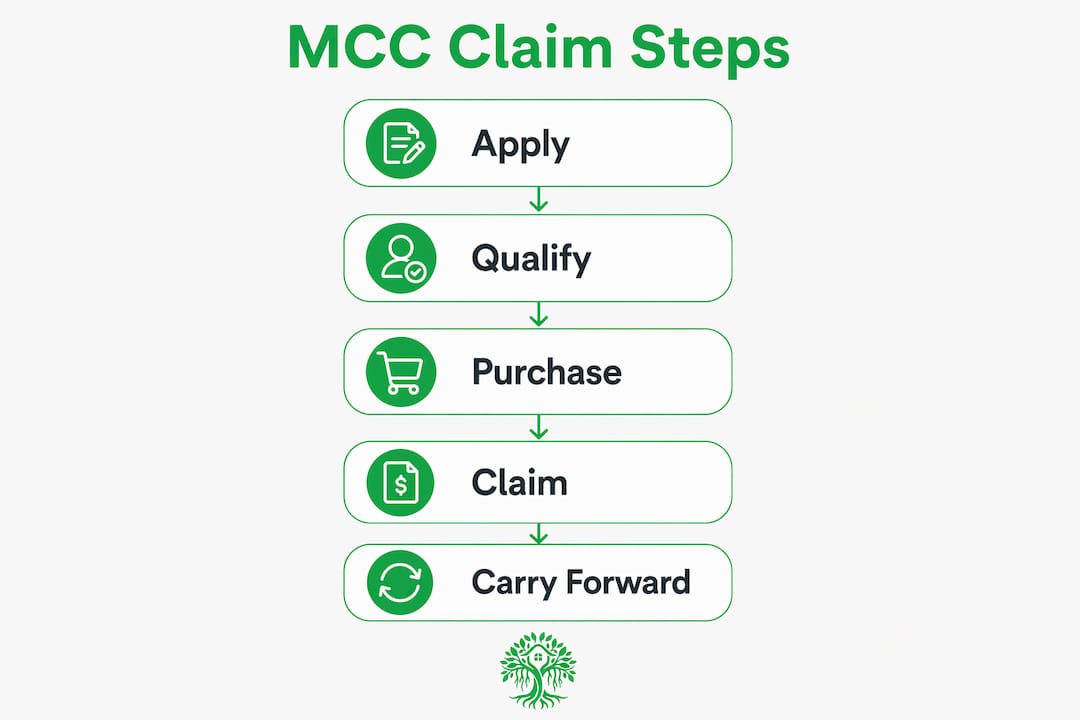
Here is what the MCC process looks like from start to finish:
- Confirm eligibility. Most programs define a first-time buyer as someone who has not owned a primary residence in the past three years. Income limits apply and are set by your state agency.
- Apply through your lender. Your loan officer coordinates with the state housing finance agency. Start this conversation early, ideally before you go under contract.
- Receive your certificate. The agency issues the MCC before or at closing. Keep this document. You will need it every year you claim the credit.
- File IRS Form 8396. This form calculates your annual credit based on mortgage interest paid. Attach it to your federal return each year.
- Adjust your mortgage interest deduction. If you itemize, you must reduce your deduction by the amount of MCC credit claimed. Failing to do this can trigger an IRS audit.
Pro Tip: Ask your loan officer about MCC availability on your first call, not after you find a house. Some state programs have limited funding and close when the money runs out.
The credit rate and income limits vary by state. California’s CalHFA MCC program, for example, sets specific income and purchase price limits that differ from those in Texas. Always verify current terms with your state housing finance agency before assuming you qualify.
What other federal tax benefits can first-time buyers claim?
Beyond the MCC, several federal tax deductions reduce the cost of homeownership. These are not credits. They reduce your taxable income, which means the actual savings depend on your marginal tax rate. Still, for buyers who itemize, they add up quickly.
- Mortgage interest deduction. You can deduct interest paid on up to $750,000 of mortgage debt if you itemize. For most first-time buyers, this is the largest annual deduction available.
- Property tax deduction. State and local property taxes are deductible, subject to the $10,000 SALT cap. If you live in a high-tax state like California or New York, this cap limits your benefit significantly.
- Mortgage discount points. Points paid at closing are typically deductible in full in the year of purchase. One point equals 1% of the loan amount, so on a $500,000 loan, two points equals $10,000 in deductible costs.
- IRA withdrawal for home purchase. First-time buyers can withdraw up to $10,000 from a traditional IRA without the standard 10% early withdrawal penalty. You still owe income tax on the amount withdrawn, but avoiding the penalty saves money.
Understanding the true cost of homeownership means factoring in these deductions from day one, not as an afterthought at tax time. Buyers who plan their purchase around the full tax picture make better decisions about loan size, points, and timing.
What state and local programs are available?
State programs are where first-time buyers often find the most immediate financial relief. These programs vary widely by location, funding level, and eligibility rules. Some offer tax credits. Others offer grants or interest-free loans for down payments.
Maryland waives the buyer’s share of state transfer taxes for qualifying first-time buyers. Massachusetts offers interest-free down payment assistance up to $25,000 as of 2026. California’s CalHFA program combines down payment assistance with MCC access. Texas offers programs through the Texas State Affordable Housing Corporation (TSAHC) that include both mortgage assistance and tax credit certificates.
| State | Program Type | Key Benefit |
|---|---|---|
| Maryland | Transfer tax waiver | Buyer’s share of state transfer tax eliminated |
| Massachusetts | Down payment assistance | Up to $25,000 interest-free loan |
| California | MCC + down payment | Combined credit certificate and assistance |
| Texas | MCC + mortgage assistance | Tax credit certificate with loan support |
| South Carolina | MCC (sunsetting) | Program ends june 30, 2026 |
Income limits for these programs are adjusted annually based on HUD’s Area Median Income data. That means a household that qualified last year may not qualify this year if AMI limits shifted. Always verify current eligibility at the time you apply, not when you start your search.
Some states have phased out MCC programs entirely. South Carolina’s MCC program sunsets on june 30, 2026 due to funding constraints. Buyers in states with limited program availability should check their state housing finance agency website before assuming a program exists.
Pro Tip: California buyers should review the California first-time buyer programs page at Ficustree for a current breakdown of CalHFA and local assistance options. Programs change faster than most buyers expect.
If you are buying in Arizona, the first-time Sedona home buyers guide at OwnInAZ covers local program availability and regional considerations worth reviewing before you close.
How do you qualify for and claim these credits?
Qualifying for the MCC and related programs requires meeting three core criteria: first-time buyer status, income limits, and purchase price limits. Most programs define first-time buyer as no primary residence ownership in the past three years. That definition includes buyers who owned a home previously but have rented for three or more years.
Here is what you need to gather and do:
- Confirm your first-time buyer status. Pull your tax returns from the past three years. If you claimed a mortgage interest deduction during that period, you likely do not qualify.
- Apply for the MCC before you close. Coordinate with your lender and the state housing finance agency early. The MCC must be obtained before closing. No exceptions.
- Collect your tax documents. You need IRS Form 1098 from your lender showing mortgage interest paid, your MCC certificate, and IRS Form 8396 to calculate the credit.
- File Schedule A if itemizing. To claim the mortgage interest deduction, you must itemize. If your standard deduction exceeds your itemized total, skip Schedule A and take the standard deduction instead.
- Reduce your mortgage interest deduction by the MCC credit. This step trips up many buyers. IRS Form 8396 filing requires you to subtract the MCC credit from your itemized mortgage interest deduction. Missing this step risks IRS penalties.
- Work with a tax professional. The interaction between the MCC credit and the mortgage interest deduction is one of the most commonly mishandled items in first-time buyer tax returns. A CPA familiar with real estate transactions is worth the cost.
The home buying timeline matters here. Buyers who wait until they are under contract to ask about MCC programs often find the application window too tight. Start the conversation at pre-approval.
Key Takeaways
The Mortgage Credit Certificate is the primary federal tax credit available to first-time buyers in 2026, and missing the pre-closing application window eliminates your eligibility permanently.
| Point | Details |
|---|---|
| MCC is the main credit | The MCC reduces your federal tax bill by up to $2,000 per year based on mortgage interest paid. |
| Credits beat deductions | A $2,000 tax credit saves $2,000 in taxes; a $2,000 deduction saves far less depending on your rate. |
| Apply before closing | MCC applications cannot be submitted after closing, so coordinate with your lender early. |
| State programs vary widely | Maryland, Massachusetts, California, and Texas each offer distinct programs with different income limits. |
| Income limits change annually | HUD adjusts AMI-based income limits each year, so verify eligibility at application time, not search time. |
Why most buyers leave money on the table
The biggest mistake I see first-time buyers make is treating tax benefits as an afterthought. They focus entirely on the mortgage rate and down payment, then scramble at tax time to figure out what they missed. By then, the MCC window is closed and the state program funding is gone.
The second mistake is confusing deductions with credits. A deduction is not a refund. It reduces your taxable income, which means the actual savings depend on your tax bracket. A buyer in the 22% bracket saves $440 on a $2,000 deduction. That same buyer saves $2,000 on a $2,000 credit. The math is not subtle.
Federal tax credits for first-time buyers are limited right now. The MCC is the primary tool, and not every state offers it. That makes state and local programs more important than ever. Maryland’s transfer tax waiver, Massachusetts’ down payment assistance, and California’s CalHFA MCC are real money. But they require you to ask for them before you close, not after.
My honest advice: build your tax strategy before you build your offer strategy. Know your MCC eligibility, know your state’s income limits, and bring a tax professional into the conversation at pre-approval, not at filing. Buyers who plan this way consistently capture benefits that others leave behind.
— Anand
How Ficustree helps you capture every first-time buyer benefit
Ficustree is built for buyers who want clarity, not confusion. The platform walks you through the full financial picture of a home purchase, including the tax credits and deductions that most buyers miss.

Ficustree’s home affordability tools factor in PITI, HOA, insurance, and maintenance so you see the real cost before you commit. The platform also connects you with resources on MCC programs, state assistance, and home buying workflow steps that keep you on track from pre-approval to closing. Buyers in California and Texas pay $1,000 at closing plus 1% commission and keep a rebate of roughly 2% where permitted. Visit Ficustree to see how the platform compresses months of confusion into a clear, confident purchase.
FAQ
What is the first time home buyer tax credit in 2026?
The primary federal tax credit available to first-time buyers in 2026 is the Mortgage Credit Certificate (MCC), which reduces your tax bill by up to $2,000 per year based on mortgage interest paid. The original $8,000 federal credit expired in 2010 and is no longer available.
How do I qualify for the MCC tax credit?
You must meet your state housing finance agency’s income and purchase price limits, have not owned a primary residence in the past three years, and apply for the MCC before your closing date. Post-closing applications are not accepted.
What forms do I need to claim the MCC?
You need IRS Form 8396 to calculate the annual credit, Form 1098 from your lender showing mortgage interest paid, and your MCC certificate issued by the state agency. If you also itemize deductions, you must reduce your mortgage interest deduction by the MCC credit amount on Schedule A.
Are state first-time buyer programs available everywhere?
No. State MCC programs and down payment assistance vary by location and funding. Some states, including South Carolina, have sunset their MCC programs as of mid-2026. Check your state housing finance agency’s website for current availability before assuming a program exists.
What is the difference between a tax credit and a tax deduction for home buyers?
A tax credit reduces your tax bill dollar for dollar, while a deduction only reduces your taxable income. A $2,000 MCC credit saves you $2,000 in taxes. A $2,000 mortgage interest deduction saves you a fraction of that amount depending on your tax bracket.