
A first time buyer down payment calculator is the fastest way to find out exactly how much cash you need before you can close on a home. Most first-time buyers focus only on the down payment percentage and miss the full picture. Your actual upfront cost includes closing costs, prepaid expenses, and cash reserves on top of the down payment itself. Loan programs like FHA, conventional, VA, and USDA each carry different minimums, and your credit score changes those numbers further. The median down payment for first-time buyers in 2025 was 8–10%, which means most buyers never hit the 20% threshold. Understanding your real number from the start saves months of confusion.
How does a first time buyer down payment calculator work?

A mortgage down payment calculator takes a handful of inputs and turns them into a clear cash estimate. The math is straightforward, but the inputs matter more than most buyers realize.
Key inputs the calculator needs
- Home price: Your target purchase price sets the baseline for every calculation.
- Loan type: FHA, conventional, VA, and USDA each carry different minimum percentages and insurance rules.
- Down payment percentage: You can test multiple scenarios, such as 3%, 5%, or 10%, to see how each changes your monthly payment.
- Credit score: Your score determines which loan programs you qualify for and what interest rate you will receive.
- Location: State and county loan limits affect FHA and conforming loan eligibility.
What the calculator outputs
A well-built home affordability calculator returns more than a single dollar figure. It shows your estimated monthly payment broken into principal, interest, taxes, and insurance (PITI). It also calculates private mortgage insurance (PMI) if your down payment falls below 20%, and it projects when PMI cancels based on your equity schedule.
PMI typically costs 0.3–1.5% of the loan amount annually. On a $400,000 loan, that is roughly $250 per month added to your payment. That number disappears once you reach 20% equity on a conventional loan, but FHA mortgage insurance premium (MIP) lasts the life of the loan unless you refinance.
Pro Tip: Run at least three scenarios in any down payment estimator: your minimum qualifying amount, a mid-range option, and 20% down. Comparing all three shows you the real cost of each choice over time.
What are the minimum down payment requirements by loan type?
Down payment minimums vary significantly depending on the loan program and your credit profile. Here is what each major program requires in 2026.
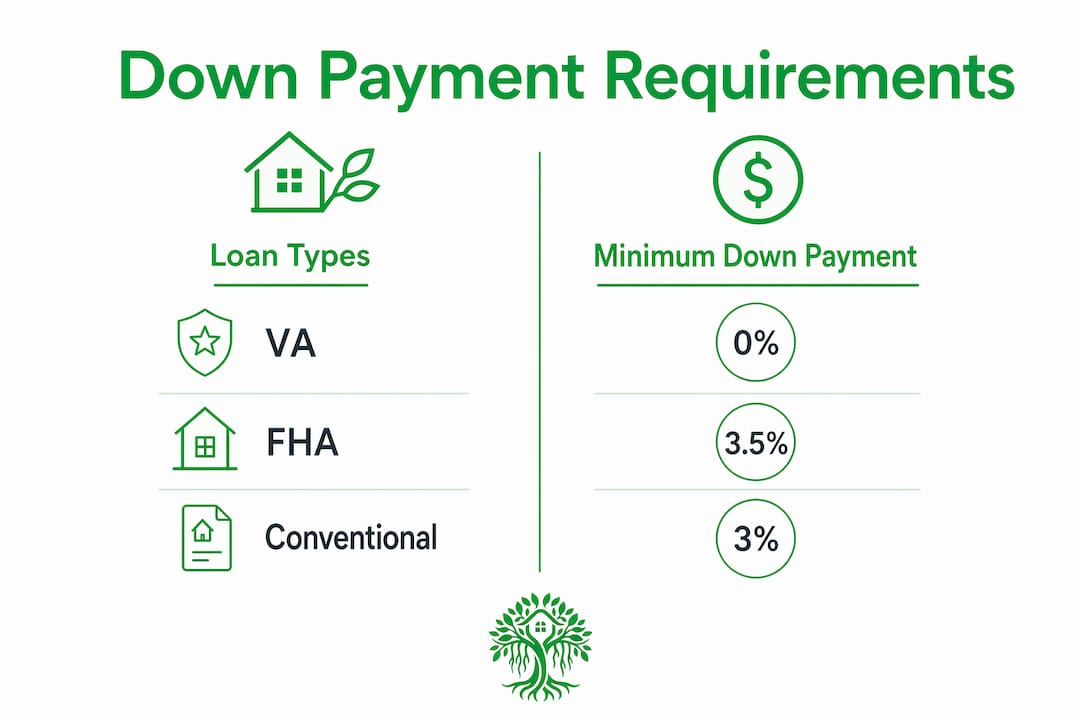
| Loan Type | Minimum Down Payment | Credit Score Requirement |
|---|---|---|
| VA | 0% | No set minimum (lender varies) |
| USDA | 0% | Typically 640+ |
| Conventional 97 | 3% | 620+ |
| FHA | 3.5% | 580+ |
| FHA (lower credit) | 10% | 500–579 |
The 20% down myth deserves a direct correction. Putting 20% down avoids PMI, but it is not a requirement. Most first-time buyers in 2026 choose low-down programs and pay PMI rather than delay their purchase by years. The real question is whether the PMI cost is worth buying sooner versus saving longer.
Choosing the wrong loan program can add $40,000–$100,000 in costs over a 30-year term. That gap comes from differences in interest rates, mortgage insurance structures, and fees across FHA, conventional, VA, and USDA loans. Comparing programs before you commit is not optional. It is the most important financial decision in the entire process.
Down payment assistance programs
Over 2,400 state and local assistance programs exist across the U.S. to help first-time buyers reduce upfront costs. Programs like CalHFA in California and My First Texas Home in Texas offer grants or forgivable loans covering 3–5% of the purchase price. These programs can effectively bring your out-of-pocket down payment to zero on qualifying properties.
- Grants do not require repayment if you meet occupancy requirements.
- Deferred loans postpone repayment until you sell or refinance.
- Matched savings programs multiply what you deposit into a dedicated account.
Pro Tip: Search your state housing finance agency’s website before assuming you need to save the full down payment yourself. California buyers can explore state assistance options that most buyers never find on their own.
How to use a down payment calculator to build a savings plan
A calculator gives you a number. A savings plan gives you a path to that number. Here is how to connect the two.
- Set your target home price. Use current median prices in your target neighborhood, not statewide averages. A $550,000 home in Austin and a $550,000 home in Sacramento carry different tax and insurance costs that affect your total payment.
- Choose your loan scenario. Pick the loan type that matches your credit score and eligibility. If you qualify for VA or USDA, start there. If not, compare FHA against conventional based on your credit profile.
- Add closing costs to your total. Closing costs add 2–5% of the purchase price on top of your down payment. On a $500,000 home, that is $10,000–$25,000 in additional cash needed at closing. This is the number most first-time buyers miss.
- Add a cash reserve. Lenders often want to see 2–3 months of mortgage payments in savings after closing. Factor this into your total target.
- Calculate your monthly savings requirement. Divide your total cash-to-close by the number of months until your target purchase date. That is your monthly savings goal.
The three primary levers that actually move your timeline are extending your purchase date, lowering your target home price, or increasing your income. Small expense cuts rarely speed savings enough to make a meaningful difference. Focusing on the big three produces faster results.
You can also use a monthly payment estimator to test how different down payment amounts change your PITI before you finalize your savings target.
Pro Tip: Open a dedicated high-yield savings account for your down payment fund. Keeping it separate from your checking account reduces the temptation to spend it and makes it easier to track progress.
What mistakes do buyers make with down payment calculators?
A calculator is only as accurate as the inputs you give it. Several common errors produce misleading results.
- Treating the down payment as the total cash needed. Your cash-to-close includes the down payment, closing costs, prepaid property taxes, homeowner’s insurance, and reserves. Buyers who plan only for the down payment often arrive at closing short.
- Using national average home prices instead of local ones. A calculator set to a $350,000 national median gives you useless numbers if you are buying in San Jose or Dallas.
- Ignoring the credit score field. Your credit score changes both your loan eligibility and your interest rate. A 620 score and a 740 score produce very different monthly payment estimates on the same home.
- Forgetting post-closing costs. Repairs, moving expenses, and immediate maintenance costs are not included in any calculator. Budget an additional 1–2% of the home price for year-one costs.
Borrowers who use personal loans or undocumented gifts for their down payment risk raising their debt-to-income ratio and triggering a loan denial. Lenders scrutinize every dollar of your down payment source during underwriting. Properly documented gift funds from family members are acceptable, but borrowed funds from a personal loan are not.
“A down payment calculator tells you what you need. Your lender’s underwriter decides whether your source of funds qualifies. Plan both before you start saving.”
Check your estimates against a full mortgage calculator that includes taxes and insurance. A bare principal-and-interest estimate can understate your true monthly cost by $400–$800 per month in high-tax states.
Key Takeaways
A first-time buyer’s total cash-to-close equals the down payment plus 2–5% for closing costs plus cash reserves, and choosing the right loan program determines how much of that you actually need to save.
| Point | Details |
|---|---|
| Down payment minimums vary by loan | VA and USDA require 0%; FHA requires 3.5% at 580+ credit; conventional starts at 3%. |
| PMI adds real monthly cost | PMI runs 0.3–1.5% annually and stays until you reach 20% equity on conventional loans. |
| Closing costs are non-negotiable | Budget 2–5% of the purchase price beyond your down payment for closing costs and reserves. |
| Assistance programs reduce upfront cash | Over 2,400 programs exist; CalHFA and My First Texas Home offer 3–5% in grants or forgivable loans. |
| Wrong loan choice is expensive | Selecting the wrong program can cost $40,000–$100,000 extra over a 30-year mortgage term. |
What I’ve learned from watching buyers use these calculators wrong
Most first-time buyers I work with arrive with a number in their head. It is usually the down payment percentage they read somewhere, stripped of every other cost. They have done the math on 3.5% of a home price and stopped there. That number is real, but it is incomplete.
The buyers who move fastest are the ones who run their calculator with their actual credit score, their actual target zip code, and a realistic home price for that market. National averages are useless in California and Texas, where prices, taxes, and insurance costs diverge sharply from the median. A buyer in Plano, Texas, and a buyer in Pasadena, California, face completely different cash-to-close numbers even at the same purchase price.
The other thing I see consistently: buyers who skip the FHA loan details and default to FHA because it is familiar. FHA is the right call for lower credit scores. For buyers above 680, a conventional loan with PMI often costs less over five years because the mortgage insurance cancels. That comparison is worth running before you commit to any program.
My honest advice: treat the calculator as a starting point, not a final answer. Use it to narrow your range, then verify with a lender who can pull your actual credit and give you a real loan estimate.
— Anand
How Ficustree helps you calculate and plan your down payment
Figuring out your down payment is one piece of a much larger financial puzzle, and Ficustree is built to help you see the whole picture.

Ficustree’s AI-powered platform gives first-time buyers in California and Texas access to mortgage calculators, loan comparison tools, and a guided workflow that connects your savings target to real homes in your price range. You can test FHA versus conventional scenarios, factor in assistance programs, and track your cash-to-close progress in one place. Ficustree charges $1,000 at closing plus 1% commission, and buyers keep a rebate of roughly 2% where legally permitted. The platform is free to use. Start planning your purchase and see how much home your savings can actually reach.
FAQ
What is a first time buyer down payment calculator?
A first time buyer down payment calculator estimates the upfront cash you need based on your target home price, loan type, and credit score. It outputs your required down payment, estimated closing costs, and projected monthly payment including mortgage insurance.
How much should a first-time buyer save for a down payment?
The minimum depends on your loan type: 0% for VA and USDA, 3% for conventional, and 3.5% for FHA with a 580+ credit score. Add 2–5% of the purchase price for closing costs to get your true cash-to-close target.
Does a down payment calculator include closing costs?
Most basic calculators show only the down payment amount. A full cash-to-close estimate requires adding 2–5% of the purchase price separately to cover title fees, inspections, prepaid taxes, and insurance.
Can I use down payment assistance with a calculator?
Yes. Enter your reduced out-of-pocket down payment after subtracting any grant or forgivable loan amount. Over 2,400 assistance programs exist nationwide, and programs like CalHFA can cover 3–5% of the purchase price for eligible buyers.
Does my credit score change my down payment requirement?
Your credit score directly affects which loan programs you qualify for. An FHA loan requires 3.5% down at 580+ but jumps to 10% down for scores between 500 and 579. Conventional loans require at least 620 to access the 3% minimum.