
Real estate commission is a percentage-based fee paid to agents after a home sale closes, compensating both the listing agent and the buyer’s agent for their roles in the transaction. Understanding realtor commissions is one of the most financially significant things you can do before buying or selling a home. The national average total commission sits at approximately 5.7%, which on a $500,000 home equals $28,500 in fees. That number alone makes the real estate sales commission process worth understanding in full, especially after the landmark 2024 NAR settlement changed how these fees are disclosed and paid.
How real estate commission works: rates and negotiation
Real estate commission is calculated as a percentage of the home’s final sale price, paid at closing from the seller’s proceeds. No law sets a fixed rate. All commission terms are negotiable, and buyer and seller agreements govern their respective fees independently. This is the single most misunderstood fact in the entire commission process.
The typical range runs from 5% to 6% of the sale price, with the national average landing near 5.7%. Each agent’s side generally earns between 2.5% and 3%. On a $400,000 home, that means roughly $10,000 to $12,000 per agent side, before any brokerage splits.
How are real estate fees calculated beyond the standard percentage? Three models now compete in the market:
- Percentage-based commission: The traditional model where each agent earns a set percentage of the sale price. Rates are negotiable and often drop in higher-priced markets where dollar amounts are large.
- Flat-fee models: Flat fees range from $1,200 to $7,000 and typically reduce services like professional staging or photography. They work best for sellers who are confident in their market and need limited support.
- Hybrid or discount models: These charge 3% to 4% total and bundle select services. They sit between full-service and flat-fee offerings.
Factors that push rates lower include high property values, competitive local markets, and sellers who are repeat clients. Factors that push rates higher include rural markets with fewer transactions, lower-priced homes where percentage math produces thin agent earnings, and complex sales requiring extra negotiation.
Pro Tip: Before signing a listing agreement, get written commission quotes from at least three agents. Even a 0.5% reduction on a $600,000 home saves you $3,000.
Who pays the real estate commission?
Traditionally, the seller paid the full commission out of closing proceeds, covering both their own agent and the buyer’s agent. That model has shifted significantly since August 2024.

The 2024 NAR settlement introduced greater transparency but also increased complexity for buyers negotiating agent fees. Buyer agent commissions are no longer advertised on the MLS. Buyers must now sign a written agreement outlining their agent’s fee before touring any home. This is a binding contract, not a formality.
Here is how buyer agent fees can be paid under the new structure:
- Direct buyer payment: The buyer pays their agent out of pocket at closing. This is the most straightforward arrangement and gives buyers full clarity on what they owe.
- Seller concession: The buyer negotiates for the seller to cover the buyer’s agent fee as part of the purchase agreement. Sellers often agree to this to attract more offers and remain competitive.
- Financed into the mortgage: In some loan programs, buyers can roll agent fees into the mortgage amount. This spreads the cost over time but increases total interest paid.
- Seller covers fee voluntarily: Some sellers still offer to pay the buyer’s agent fee upfront to encourage showings, particularly in slower markets where buyer traffic matters.
Buyers remain responsible if sellers do not fully cover agent fees, which makes understanding your buyer agreement before signing non-negotiable. If you are a first-time buyer, reviewing common buyer mistakes around agent agreements can save you from a costly surprise at closing.
Pro Tip: Ask your agent to walk you through the exact dollar amount of their fee before you sign the buyer agreement. A percentage sounds abstract; a dollar figure makes the commitment concrete.
How is commission split among agents and brokerages?
Most buyers and sellers assume the agent they work with keeps the full commission. The reality is a multi-level split that significantly reduces what any individual agent takes home.
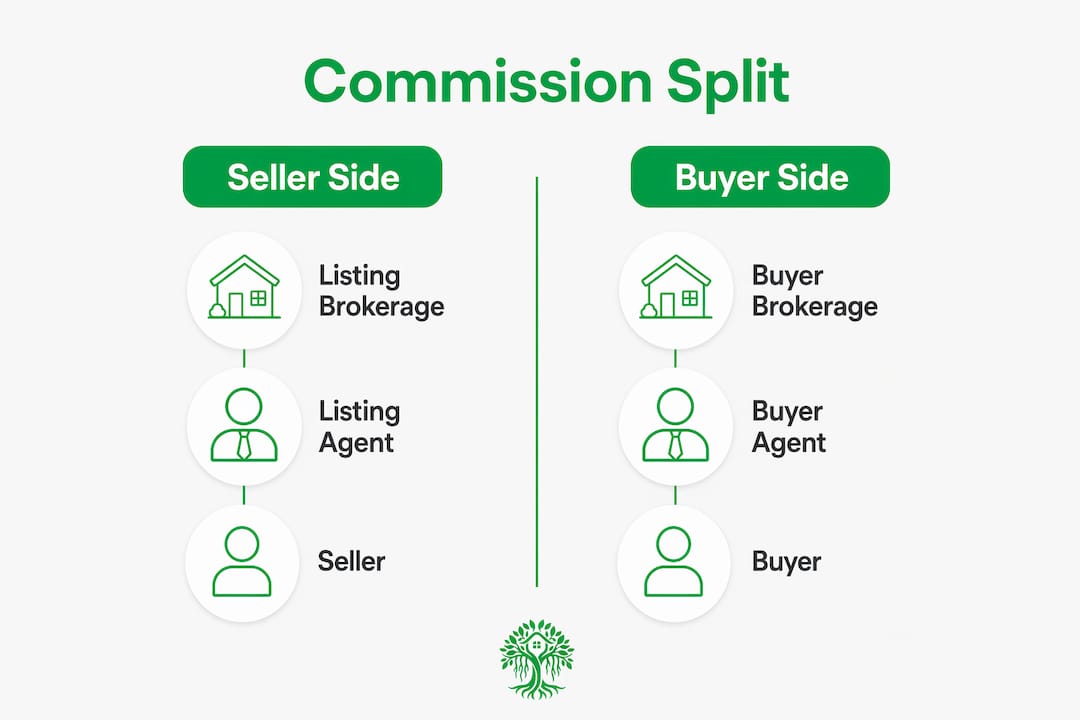
The four-way split works like this: the total commission is first divided between the listing brokerage and the buyer’s brokerage, typically 50/50. Each brokerage then splits its share with the individual agent who did the work. Agents typically retain between 50% and 90% of their brokerage’s portion, depending on their experience level and the terms of their agreement.
| Split stage | Example on $28,500 total (5.7% of $500K) |
|---|---|
| Listing brokerage receives | $14,250 (50% of total) |
| Buyer’s brokerage receives | $14,250 (50% of total) |
| Listing agent keeps (80/20 split) | $11,400 |
| Buyer’s agent keeps (70/30 split) | $9,975 |
Common split structures between agents and brokers run 70/30 or 80/20, with experienced agents commanding the higher end. New agents often start at 50/50, meaning half their commission goes directly to the brokerage. After accounting for business expenses like marketing, errors and omissions insurance, MLS fees, and office costs, a new agent’s net income from a single transaction can be a fraction of the gross commission figure.
This breakdown matters to you as a buyer or seller because it explains why agents price their services the way they do. An agent asking for 3% is not pocketing $15,000 on a $500,000 sale. After splits and overhead, they may net $7,000 to $9,000 before taxes. Understanding this makes commission negotiations more grounded and productive for both sides.
What buyers and sellers should know before closing
The post-2024 commission environment rewards preparation. Both buyers and sellers who go in without a clear understanding of their agreements are at a disadvantage.
For sellers, the most important shift in mindset is this: focus on net proceeds, not the commission percentage. Net proceeds account for mortgage payoff, closing costs, transfer taxes, and agent fees together. A seller who negotiates a listing agent down from 3% to 2.5% but overlooks $4,000 in unnecessary closing costs has not actually improved their financial outcome.
For buyers, the key considerations in 2026 include:
- Read your buyer agreement carefully. It specifies the exact fee your agent expects, when it is due, and what happens if the seller does not cover it. Signing without reading this document is the most common and costly mistake first-time buyers make.
- Negotiate before you tour. Since August 2024, buyers must sign the agreement before home tours begin. You have the most leverage before you are emotionally invested in a specific property.
- Factor agent fees into your total budget. If you are paying your agent directly, that cost comes at closing alongside your down payment and other fees. Review the true cost of homeownership before you set your purchase price ceiling.
- Use seller concessions strategically. Asking the seller to cover your agent’s fee is a legitimate negotiation tactic, particularly in markets where homes are sitting longer. In California, understanding how to ask for seller concessions can make a meaningful difference in your closing costs.
- Compare agent models. A full-service agent at 3% and a discount agent at 1.5% are not the same product. Evaluate what services each includes before deciding on price alone.
The transparency improvements from the 2024 settlement benefit buyers and sellers who do their homework. Those who do not read their agreements or ask direct questions about fees are still exposed to surprises at closing.
Key takeaways
Real estate commission is a negotiable, performance-based fee split across multiple parties, and understanding the full breakdown is the most direct way to protect your financial outcome in any transaction.
| Point | Details |
|---|---|
| Commission is negotiable | No law fixes rates; typical range is 5% to 6%, with alternatives including flat fees and hybrid models. |
| Payment responsibility shifted in 2024 | Buyers must now sign fee agreements before touring homes; sellers may still cover buyer agent costs as a concession. |
| Four-way split reduces agent take-home | Commission divides between brokerages first, then between brokers and agents, with agents keeping 50% to 90% of their side. |
| Sellers should focus on net proceeds | Commission percentage alone does not reflect true sale outcome; mortgage payoff and closing costs matter equally. |
| Negotiation timing matters | Buyers have the most leverage before signing a buyer agreement and before touring specific properties. |
What I have learned about commissions after watching buyers get blindsided
I have spent years watching first-time buyers walk into the commission conversation completely unprepared, and the 2024 NAR settlement did not fix that. It added a new layer of paperwork without guaranteeing that buyers actually understand what they are signing.
The most persistent myth I see is that commission is the seller’s problem. It never was, not fully, and it certainly is not now. Buyers who assume their agent is “free” because the seller traditionally paid are in for a rude awakening when their purchase offer falls apart over an unresolved agent fee.
What I tell buyers is this: treat your buyer agreement like a contract with a contractor. You would not hire a plumber without knowing the rate. Your agent is no different. Ask for the dollar amount, not just the percentage. Ask what happens if the seller refuses to cover it. Get the answers in writing before you fall in love with a house.
For sellers, the real opportunity in 2026 is using buyer agent concessions as a competitive tool rather than a reluctant obligation. In markets where inventory is rising, offering to cover the buyer’s agent fee can be the difference between a quick sale and a listing that sits for 60 days. That is not a loss. That is a pricing strategy.
The commission system is more transparent than it was two years ago. But transparency only helps the people who actually read what is in front of them.
— Anand
How Ficustree helps you navigate agent fees with confidence
Understanding how commission works is one thing. Having a platform that guides you through every fee, agreement, and negotiation step in real time is another.

Ficustree is an AI-powered home buying platform built specifically for first-time buyers who want clarity, not confusion. From your first property search to the moment you sign at closing, Ficustree surfaces the costs, explains the agreements, and helps you ask the right questions at every stage. You should not need a real estate attorney to understand what you are paying your agent. Start your search on Ficustree and see how the platform makes the entire buying process, including agent fees and commission credits, something you can actually understand and control. Explore the buyer tools at Ficustree to get started today.
FAQ
What is the average real estate commission rate?
The national average total commission is approximately 5.7%, split between the listing agent and buyer’s agent, with each side typically earning 2.5% to 3%. On a $500,000 home, that equals roughly $28,500 in total fees.
Who pays the buyer’s agent commission now?
Since August 2024, buyer agent fees are negotiated separately and can be paid by the buyer directly, covered by the seller as a concession, or in some cases financed into the mortgage. Buyers must sign a written agreement specifying the fee before touring homes.
Can you negotiate real estate commission rates?
Yes. No law sets a fixed commission rate, and all terms are negotiable. Alternatives to the standard percentage include flat fees ranging from $1,200 to $7,000 and hybrid discount models charging 3% to 4% total.
How does the commission split between agents work?
The total commission is first divided between the listing brokerage and the buyer’s brokerage, then each brokerage splits with its individual agent. Agents typically keep between 50% and 90% of their brokerage’s share, depending on their experience and agreement terms.
When is real estate commission paid?
Commission is paid only after closing, deducted from the seller’s proceeds at the time of settlement. No commission is owed if the sale does not close, which aligns agent incentives directly with completing a successful transaction.