
Private mortgage insurance, known as PMI, is the extra monthly cost lenders charge when your down payment falls below 20% of the home’s purchase price. For first-time buyers in California and Texas, knowing how to avoid PMI as a first-time buyer can save hundreds of dollars every month. PMI typically costs between 0.30% and 1.15% of your loan amount annually. That translates to roughly $30 to $150 per month for every $100,000 borrowed. The good news: several proven strategies let you skip it entirely or remove it faster than you think.
How to avoid PMI as a first-time buyer: the 20% down payment path
Putting 20% down is the most direct way to avoid private mortgage insurance. Lenders treat that threshold as proof you have enough skin in the game, so they drop the PMI requirement entirely. The math is simple. The execution, especially in California and Texas, is harder.

In high-cost California markets like the Bay Area or Los Angeles, a 20% down payment on a $700,000 home means saving $140,000 before you close. That is a significant barrier for most first-time buyers. Texas prices are lower on average, but fast-growing metros like Austin and Dallas have pushed median home prices well above national norms.
A few tools can close that gap:
- Down payment assistance programs. State and local programs in California and Texas provide grants or subsidized loans that boost your equity at closing, sometimes enough to clear the 20% threshold.
- Gift funds. Gift money from family members is accepted by most lenders when properly documented with a signed gift letter. This is one of the fastest ways to reach 20% without years of additional saving.
- Buying at a lower price point. Targeting homes priced below your maximum approval amount can make 20% down achievable with your current savings.
- California-specific programs. The California first-time buyer programs available in 2026 include deferred-payment loans that effectively act as a second mortgage to cover part of your down payment.
Pro Tip: Freddie Mac research shows that draining your savings to hit 20% down can threaten your financial stability after closing. Keep at least three to six months of living expenses in reserve, even if it means accepting PMI temporarily.
Can a piggyback loan help you skip PMI?
A piggyback loan, most commonly structured as an 80-10-10, lets you borrow 80% on a primary mortgage, 10% on a second loan, and put 10% down yourself. Because your primary loan stays at 80% of the purchase price, you never trigger PMI. This structure is a legitimate PMI alternative for buyers who have solid credit but cannot reach 20% down on their own.
The mechanics work like this:
- Primary mortgage (80%). This is your conventional loan at standard market rates.
- Second mortgage (10%). This carries a higher interest rate than your primary loan. Secondary financing in a piggyback arrangement comes with more qualification steps and administrative complexity.
- Your down payment (10%). You bring this to closing from your own savings or gift funds.
- Dual qualification. You must qualify for both loans simultaneously, which means lenders scrutinize your debt-to-income ratio more carefully.
- Closing costs on two loans. You pay origination fees on both the primary and secondary loan, which increases your upfront costs.
The trade-off is real. A higher second-mortgage rate can cost more per month than PMI would have. Run the numbers before committing. If your credit score is below 700, the second loan’s rate may be punishing enough to make monthly PMI the cheaper option.
Pro Tip: Ask your lender to model the total monthly payment for a piggyback structure versus a single loan with PMI. The difference is often smaller than buyers expect, and the piggyback adds complexity that can slow your closing timeline.
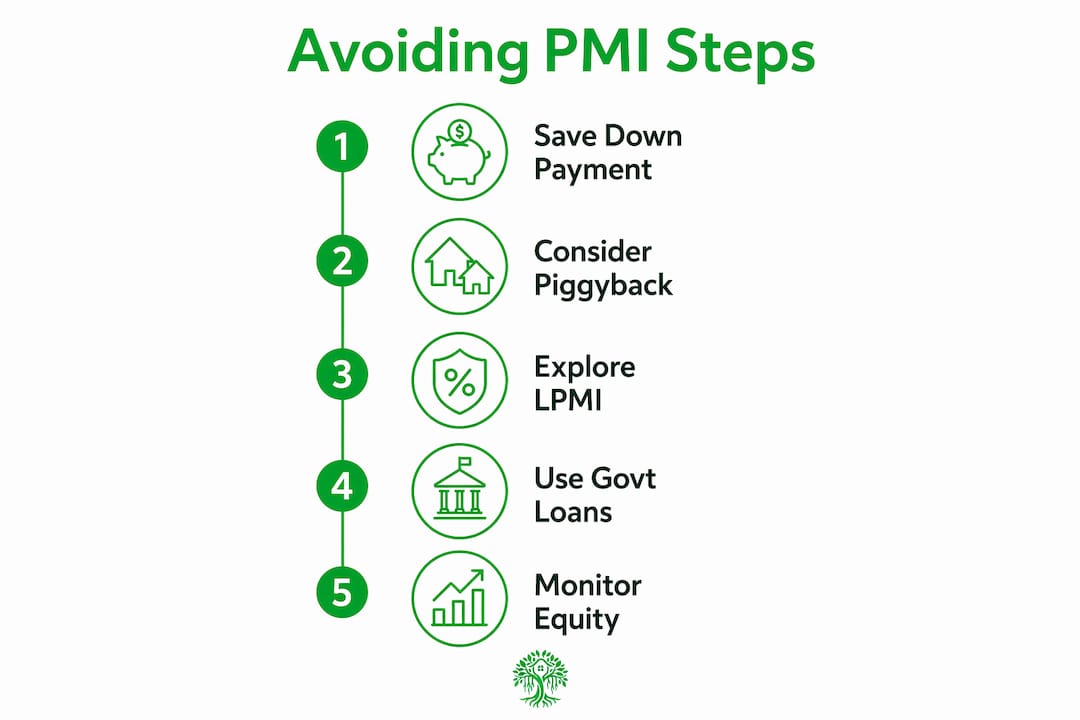
Lender-paid PMI and government-backed loans as PMI alternatives
Not all PMI avoidance strategies require a large down payment. Two other paths exist: lender-paid PMI (LPMI) and government-backed loan programs.
Lender-paid PMI
With LPMI, your lender covers the PMI premium in exchange for a permanently higher interest rate on your mortgage. There is no separate monthly PMI line item on your statement. The cost is baked into your rate instead. Lender-paid PMI raises your interest rate permanently and cannot be removed without refinancing the entire loan. For buyers who plan to sell or refinance within five to seven years, LPMI can make sense. For buyers who plan to stay long-term, monthly PMI that cancels at 80% loan-to-value (LTV) is usually cheaper over the life of the loan.
VA loans
VA loans require no PMI and no down payment for eligible veterans and active-duty service members. This is the most powerful PMI avoidance tool available, and it is completely free to use if you qualify. California and Texas both have large veteran populations, making this option widely relevant.
USDA loans
USDA loans serve buyers purchasing in eligible rural and suburban areas. They carry no PMI requirement and allow low down payments. Parts of California’s Central Valley and many Texas communities outside major metros qualify under USDA geographic guidelines.
FHA loans and MIP: not the same as PMI
FHA loans are popular with first-time buyers but carry a different cost structure. FHA loans require Mortgage Insurance Premium (MIP) for the life of the loan unless you refinance into a conventional mortgage. That is a critical distinction. Conventional PMI cancels automatically at 78% LTV. FHA MIP does not. Read the full breakdown in the FHA loan guide before choosing this path. For buyers who plan to build equity quickly, a conventional loan with PMI often costs less over time than an FHA loan with permanent MIP.
How local assistance programs and home appreciation remove PMI faster
You do not have to avoid PMI at the start to eliminate it quickly. Several strategies accelerate your path to the 20% equity threshold after closing.
- State and local down payment assistance. California’s CalHFA programs and Texas’s TSAHC grants can push your starting equity above 10%, shortening the time before you hit 80% LTV and can request PMI cancellation.
- Home appreciation. Rising home values build equity without any extra payments from you. Home appreciation can help you reach 20% equity faster, enabling PMI removal after a formal appraisal. Budget $300–$500 for that appraisal when the time comes.
- Extra principal payments. Paying even $100 to $200 extra per month toward principal accelerates your LTV reduction. This is especially effective in the early years of a 30-year mortgage when most of your payment goes to interest.
- Timely cancellation requests. Federal law mandates automatic PMI cancellation at 78% LTV, but you can request cancellation at 80% LTV. Do not wait for the automatic trigger. Submit a written request to your lender the moment your balance crosses 80%.
- Lump-sum or split-premium PMI. Some lenders offer a single upfront PMI premium paid at closing, or a split structure combining a smaller upfront payment with reduced monthly premiums. These options lower your ongoing costs and can be worth negotiating.
Monitoring your equity position every year is a habit worth building. California’s strong appreciation history means many buyers reach 20% equity faster than their amortization schedule would suggest.
How do you choose the right PMI avoidance strategy?
The best strategy depends on your credit score, savings, how long you plan to stay in the home, and the specific market you are buying in. There is no universal answer.
- High credit score (740+). You qualify for the lowest PMI rates and the best second-mortgage rates on a piggyback loan. Both options are viable. Compare total monthly costs side by side.
- Credit score below 680. PMI rates rise significantly, but second-mortgage rates rise even faster. Monthly PMI on a conventional loan may be your cheapest path.
- Short time horizon (under 7 years). Lender-paid PMI can make sense here because you will not stay long enough for the higher rate to outpace the savings from no monthly PMI.
- Long time horizon (10+ years). Monthly PMI that cancels at 80% LTV almost always beats LPMI over the long run. The break-even calculation is straightforward: divide the total PMI you will pay by the monthly rate difference between LPMI and standard PMI.
- California and Texas market conditions. Both states have seen strong appreciation cycles. Buying sooner with PMI and riding appreciation to the 80% LTV threshold can be financially smarter than waiting years to save a full 20% down payment.
Pro Tip: Avoiding common first-time buyer mistakes around PMI starts with running three scenarios before you apply: 20% down, piggyback loan, and conventional loan with monthly PMI. The numbers will tell you which path fits your timeline and savings.
Key Takeaways
The most effective way to avoid PMI as a first-time buyer is to combine a targeted down payment strategy with a clear understanding of your loan options, equity timeline, and local assistance programs.
| Point | Details |
|---|---|
| 20% down eliminates PMI | Gift funds, state assistance, and lower price points can make this threshold reachable. |
| Piggyback loans carry trade-offs | Secondary loan rates are higher and qualification is more complex; compare total costs carefully. |
| LPMI costs more long-term | A permanently higher rate cannot be canceled without refinancing, unlike monthly PMI. |
| VA and USDA loans skip PMI entirely | Eligible veterans and rural buyers can avoid PMI with no down payment required. |
| Request cancellation at 80% LTV | Federal law allows a borrower request at 80% LTV; do not wait for the automatic 78% trigger. |
The PMI decision most buyers get wrong
I have watched first-time buyers in California spend two extra years saving toward 20% down while home prices climbed faster than their savings account. By the time they hit that threshold, the home they originally wanted cost $80,000 more. The PMI they were trying to avoid would have cost them far less than the price appreciation they missed.
The conventional wisdom says “avoid PMI at all costs.” My experience says that is wrong about half the time. Paying PMI temporarily to buy sooner is a legitimate financial strategy, especially in markets where appreciation is outpacing savings rates. The real cost of waiting is rarely discussed in the same breath as PMI costs, but it should be.
Piggyback loans deserve more scrutiny than they usually get. I have seen buyers take on a second mortgage at a punishing rate just to avoid a $150 monthly PMI payment, only to realize six months later that the second loan’s rate was costing them $200 more per month. Run the math before you commit.
The one thing I would tell every first-time buyer: do not drain your emergency fund to hit 20% down. Owning a home with no financial cushion is far more stressful than paying PMI while you rebuild your savings. Homeownership stability matters more than a clean mortgage statement.
— Anand
Ficustree helps you model every PMI scenario before you commit
First-time buyers in California and Texas face a genuinely complex set of financing decisions. Ficustree is built to cut through that complexity.

The Ficustree platform gives you AI-powered tools to compare loan structures, model PMI costs against appreciation timelines, and surface down payment assistance programs specific to your target market. You pay $1,000 at closing plus 1% commission, keep a rebate of roughly 2% where permitted, and get full platform access free. Ficustree’s home buying workflow tracks your equity position and flags when you are eligible to request PMI cancellation. For buyers who want clarity faster, start your search here and let the platform match you with homes that fit your financing strategy.
FAQ
What is PMI and when is it required?
PMI, or private mortgage insurance, is required by lenders when a buyer’s down payment is less than 20% of the home’s purchase price on a conventional loan. It protects the lender, not the buyer, if the borrower defaults.
How much does PMI cost per month?
PMI costs between 0.30% and 1.15% of your loan amount annually, which equals roughly $30 to $150 per month for every $100,000 borrowed. Your exact rate depends on your credit score and loan-to-value ratio.
When can I remove PMI from my mortgage?
You can request PMI cancellation in writing once your loan balance reaches 80% of the original home value. Federal law requires lenders to cancel PMI automatically when your balance drops to 78% LTV.
Is an FHA loan a good way to avoid PMI?
FHA loans do not use PMI but charge Mortgage Insurance Premium (MIP), which lasts the life of the loan unless you refinance into a conventional mortgage. For buyers who build equity quickly, a conventional loan with cancellable PMI often costs less over time.
Can I avoid PMI without a 20% down payment?
Yes. Piggyback loans, lender-paid PMI, VA loans, USDA loans, and San Diego first-time buyer strategies all offer paths to skip or minimize PMI without a full 20% down payment. Each option has different cost and qualification requirements.