
A mortgage lender funds and underwrites your loan directly; a mortgage broker shops your application to multiple wholesale lenders but never funds anything itself. Go direct to a lender if you have clean credit, steady W2 income, and want speed. Go with a broker if your income is complex, your credit needs shopping around, or you want access to niche loan products. Cost, speed, and accountability all shift depending on which path you pick.
TL;DR:
- Borrowers with clean credit and steady income typically benefit from faster closings with direct lenders, who handle underwriting in-house.
- Complex income, mid-range credit scores, or niche loan needs often make brokers more suitable because of broader product access and wholesale network options.
- Comparing APRs is the most accurate way to evaluate costs, as broker fees are usually built into the rate and vary between 0.5% and 2.75% of the loan.
- Faster closing times and more straightforward problem resolution are common advantages of direct lenders, while brokers provide access to specialized loan programs.
- Prioritizing the mortgage channel based on income type, credit score, and speed needs ensures a more tailored and cost-effective borrowing experience.
Table of Contents
- What Is a Mortgage Lender, and How Does the Process Work?
- What Is a Mortgage Broker, and How Does the Wholesale Channel Work?
- How Do Costs, Speed, and Accountability Actually Compare?
- Should You Work With a Broker or Go Direct to a Lender?
- How Do You Actually Compare Broker and Lender Offers?
- How Ficustree Helps You Choose Between a Broker and a Lender
- An Editorial Take on Choosing Between a Broker and a Lender
- Get Clarity on Your Mortgage Path With Ficustree
- Sources
- FAQ
What Is a Mortgage Lender, and How Does the Process Work?
A mortgage lender is a bank, credit union, or nonbank mortgage company that originates, underwrites, and funds your loan with its own money or credit line. That single fact drives almost everything else about the experience: one company handles your file from application to closing, which means one point of contact and one set of underwriting rules to satisfy. The Consumer Financial Protection Bureau draws this line clearly: lenders fund loans directly, while brokers do not.
Lenders come in a few flavors:
- Retail lenders work directly with you, the borrower, start to finish.
- Correspondent lenders originate and fund loans, then sell them to bigger investors after closing.
- Direct lenders (often banks or credit unions) may offer relationship pricing, like a fee waiver if you already hold a checking account there.
Because underwriting happens in-house, direct lenders can often move faster and negotiate fees more flexibly for existing customers, something a broker simply cannot replicate since brokers don’t control underwriting or funding decisions. Federal rules require every lender to give you a standardized Loan Estimate within three business days of application, followed by a Closing Disclosure before you sign.
What Is a Mortgage Broker, and How Does the Wholesale Channel Work?
A mortgage broker is an independent middleman who submits your application to multiple wholesale lenders and does not fund loans directly. Brokers earn a living by matching borrowers, especially those with complicated files, to lenders willing to approve them, and the CFPB’s origination guidance formally distinguishes this wholesale channel from retail lending. In some table funded deals, the broker briefly closes as the listed creditor before immediately assigning the loan to the actual funding source, a paperwork nuance worth asking about.
Broker pay works one of three ways:
- Borrower paid, typically 1% to 2% of the loan amount, paid at closing.
- Lender paid, built into your interest rate so you never see a line item.
- A blend of both, depending on the wholesale lender’s compensation plan.
Compensation can run roughly 0.5% to 2.75% of the loan amount depending on the lender and loan type. Because brokers don’t underwrite or fund your loan, your timeline depends on a third party you never speak to directly, and that handoff is exactly where broker deals tend to lose time.
Pro Tip: Before signing anything, look up any broker or loan officer on the NMLS Consumer Access database. It’s free, takes thirty seconds, and shows license status, disciplinary history, and every state they’re authorized to work in.
How Do Costs, Speed, and Accountability Actually Compare?
The honest answer is that neither option wins on every axis, so the factors that matter to your specific loan should decide the winner.
Costs: Broker compensation generally lands between 0.5% and 2.75% of your loan amount, while direct lenders charge origination fees that often run in a similar range but can be waived for existing customers through relationship pricing. The only way to compare fairly is by APR, since it bundles rate and fees into one number.
Speed: Loans handled entirely in house typically close faster because there’s no relay between broker and wholesale underwriter. Brokered loans can take longer simply because your file passes through an extra set of hands before final approval.
Product access: Brokers earn their fee when your file is unusual. Non-QM loans, jumbo products, and specialty programs for self-employed borrowers often live in a broker’s wholesale network, not on a single bank’s shelf.
Accountability: With a lender, one company owns every mistake and every fix. With a broker, responsibility splits between the broker and the wholesale lender, which can slow down problem resolution if something goes wrong late in underwriting.
| Factor | Direct lender | Mortgage broker |
|---|---|---|
| Costs and fees | Origination fees, possible relationship discounts | 0.5% to 2.75% compensation, borrower or lender paid |
| Closing speed | Often faster, in-house underwriting | Often slower, relies on wholesale channel |
| Product access | Limited to that lender’s programs | Wider access, especially niche or complex loans |
| Accountability | Single point of contact | Split between broker and wholesale lender |
Should You Work With a Broker or Go Direct to a Lender?
Your income type, credit profile, and timeline should decide this before rate shopping even starts.
Brokers tend to fit best if you:
- Are self-employed or have nontraditional, hard-to-document income.
- Have credit in the mid-range and need a lender willing to work with it.
- Need a jumbo loan, non-QM product, or another specialty program.
Direct lenders tend to fit best if you:
4. Have credit scores of 740 or higher with a clean, documented income history.
5. Already bank with a lender offering relationship pricing or fee waivers.
6. Need to close fast, such as for a tight offer deadline or expiring rate lock.
Run through this checklist before you make your first call: Is your income W2 or self-employed? Is your credit above 740? Do you need a standard 30-year fixed or something specialized? Is speed more important than shopping multiple offers? Do you already have a banking relationship worth leveraging? Are you buying with student loan debt or other unusual liabilities complicating your file?
Pro Tip: If you answer “complex” to two or more questions above, start with a broker conversation first. Complexity is exactly what wholesale networks are built to absorb, and a low credit score doesn’t have to mean a dead end.
How Do You Actually Compare Broker and Lender Offers?
Comparing rates alone is how buyers overpay. Here’s the process that actually works:
- Request a Loan Estimate from at least three sources, mixing direct lenders and brokers so you’re comparing channels, not just companies.
- Compare APR, not just interest rate. APR folds in points, fees, and lender credits, giving you the real cost of each offer.
- Ask brokers directly how they’re paid and whether their quoted rate already includes their compensation.
- Build in extra time for rate locks on brokered loans, since the wholesale handoff can eat into your lock window.
- Check the FTC’s mortgage shopping worksheet to line up every quote side by side on paper.
Before you request quotes, gather:
- Two years of tax returns and W2s or 1099s.
- Two months of bank statements.
- A preapproval letter or documentation of your current preapproval status.
How Ficustree Helps You Choose Between a Broker and a Lender
Deciding between a broker and a direct lender is really just one piece of a much bigger affordability puzzle, and that’s the layer Ficustree was built to simplify. Instead of leaving you to compare Loan Estimates alone at midnight, Ficustree’s home affordability calculator shows what you can actually carry each month before you even start collecting quotes.
Ficustree pairs that clarity with direct buyer representation: you pay $1,000 at closing plus 1% commission, with a rebate of roughly 2% where state law allows it. That structure matters here because it means Ficustree has no incentive tied to which lender or broker you choose. It works well for first-time buyers who feel behind on affordability math or unsure which mortgage channel fits their income situation.
- Affordability calculator that accounts for PITI, HOA, and insurance, not just principal and interest.
- On-demand showing agents so you’re not waiting days for a tour.
- Preapproval guidance that lines up with your mortgage channel decision.
An Editorial Take on Choosing Between a Broker and a Lender
The conventional advice, “just shop around,” undersells how different these two channels actually are. Shopping five direct lenders gets you five versions of the same retail process. Shopping one broker against two direct lenders gets you a genuinely different comparison, because you’re testing wholesale access against relationship pricing, not just rate against rate.
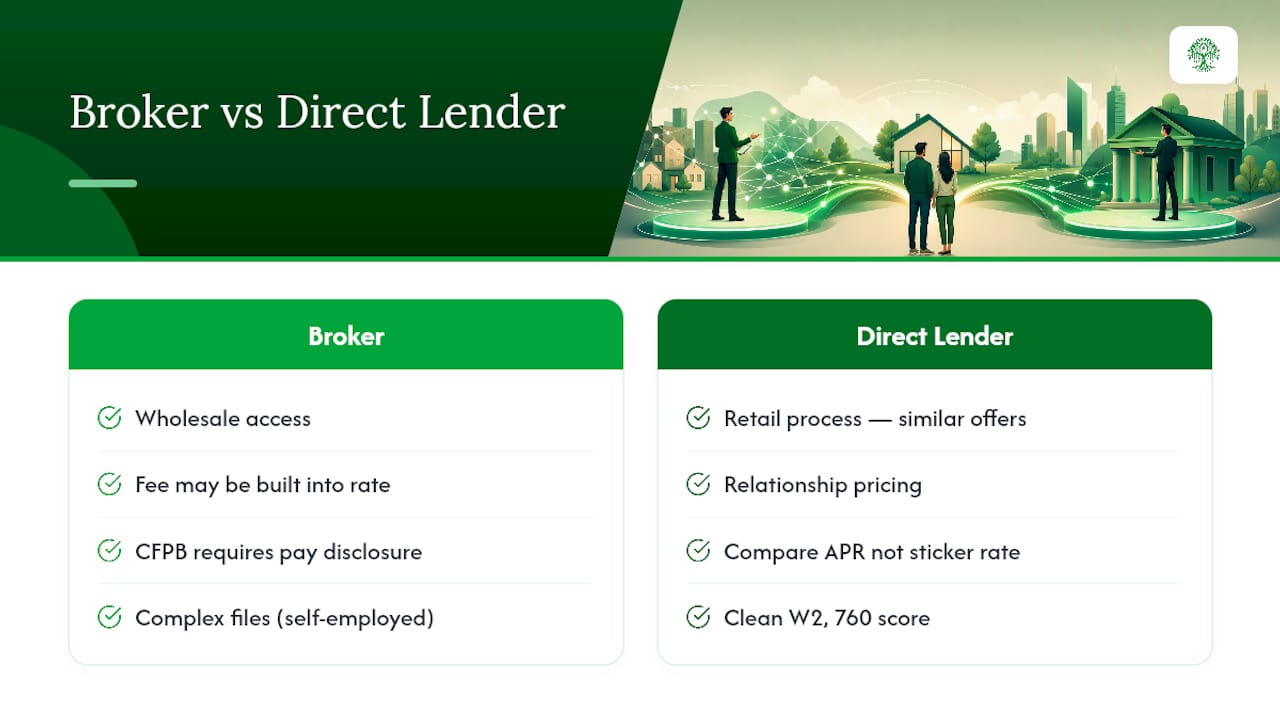
Where most guides fall short is treating broker compensation as a footnote instead of the headline it deserves to be. A rate that looks half a point better might have that broker fee quietly built in, and you’d never know without asking directly and comparing APR, not the sticker rate. The CFPB’s own guidance on broker pay makes that disclosure a right, not a favor.
If you take one thing from this, prioritize matching the channel to your file’s complexity before you chase a rate. A borrower with a clean W2 and 760 credit score is leaving money on the table by not starting with their own bank. A self-employed borrower forcing that same bank to understand two years of Schedule C income is doing the opposite.
— Anand
Get Clarity on Your Mortgage Path With Ficustree
Ficustree exists to remove the guesswork from exactly this kind of decision. For $1,000 at closing plus 1% commission, with a rebate of roughly 2% available where permitted by state law, you get direct buyer representation alongside a free platform built for first-time buyers in California and Texas.

Rather than comparing broker fees and lender rates in isolation, start with your actual numbers. Run your budget through the home affordability calculator to see what PITI, HOA, and insurance really cost you each month, then visit the buyer landing page to see how representation works alongside whichever mortgage channel you choose. Ficustree doesn’t originate loans or take broker compensation, so the guidance you get stays tied to your outcome, not a lender’s incentive.
Sources
- What is the difference between a mortgage lender and a mortgage broker? | Consumer Financial Protection Bureau
- Mortgage Broker vs. Lender: Key Differences | Chase
- Mortgage Origination Examination Procedures | CFPB
- Shopping for a mortgage: FAQs | FTC
FAQ
Is It Better to Use a Mortgage Broker or a Direct Lender?
Neither wins universally. Direct lenders often close faster and cost less for clean, straightforward borrowers, while brokers add value for complex income, mid-range credit, or specialty loan products.
How Much Does a Mortgage Broker Make on a $500,000 Loan?
Broker compensation typically runs 0.5% to 2.75% of the loan amount, which corresponds to a proportional amount depending on the loan size, depending on how the broker is paid.
Is a Mortgage Better Through a Lender or a Broker?
The “better” mortgage is the one with the lowest APR for your specific profile, not the channel itself. Compare Loan Estimates from both a direct lender and a broker before deciding.
What Is the 3-7-3 Rule in Mortgages?
Definitions of this rule vary across the industry, and it isn’t a standardized regulatory term, so treat any specific version you see online with caution rather than as an official CFPB or FTC standard.
Can Ficustree Help Me Decide Between a Broker and a Lender?
Ficustree doesn’t originate mortgages, but its affordability calculator and buyer representation help you enter either conversation with clear numbers and no conflicting incentives.