
Online mortgage lenders are the right call for most straightforward W-2 borrowers who want speed, lower fees, and a digital process from application to closing. If your income is nonstandard or your case is complex, pair a couple of online quotes with a local, human-underwritten option before deciding. For first-time buyers who want more than a rate quote, Ficustree pairs decision intelligence with real buyer representation. Either way, your first move is the same: collect three or four preapprovals and compare Loan Estimates side by side.
TL;DR:
- Online lenders are ideal for straightforward W-2 borrowers seeking fast approval, low fees, and digital convenience, but less suitable for complex income or credit situations.
- Comparing the Loan Estimate, including APR and total cash to close, is essential since interest rates alone can be misleading and fees vary significantly.
- Verified licensing through NMLS and understanding lender offerings across loan programs like FHA, VA, and jumbo are crucial before applying or accepting a quote.
- Speed benefits from online lenders include faster closing times, often around 22 days, achieved through automation like soft pulls, e-closings, and automated income verification.
- First-time buyers should combine lender shopping with buyer representation platforms like Ficustree to clarify affordability, improve offer strategy, and access local agent support.
Table of Contents
- At a Glance: Who Benefits Most From Online Mortgage Lenders
- How Do You Choose an Online Mortgage Lender?
- Why Can Online Lenders Close Faster and Cheaper?
- Your Week-By-Week Plan to Shop Online Mortgage Lenders
- Why Ficustree Fits First-Time Buyers Who Want Speed Plus Guidance
- An Editor’s Take on Speed, Cost, and Certainty
- Get Started With Ficustree
- Primary Sources for Verifying Lender Data
- Sources
- FAQ
At a Glance: Who Benefits Most From Online Mortgage Lenders
The best online mortgage lenders reward borrowers who value speed and transparency over hand-holding. They’re less suited to buyers whose income, credit, or property situation needs a human underwriter’s judgment call. Here’s how to place yourself before you start applying.
Three borrower profiles that map to the right lender type:
- Speed and low-fee seekers: W-2 employees with steady income, solid credit, and a straightforward purchase. Digital mortgage lenders are built for this borrower, and this is where they win on both price and turnaround time.
- Low down payment buyers: First-time buyers stretching for a 3% or 3.5% down payment benefit from online lenders that specialize in conventional and FHA programs, though state assistance programs still require a knowledgeable guide. Ficustree’s California first-time buyer programs resource is a useful companion piece here.
- Complex-case borrowers: Self-employed applicants, buyers with irregular income, or anyone with credit dings should treat online quotes as one data point, not the only one. A manual-underwrite lender may see nuance an algorithm won’t.
Three trade-offs worth weighing before you commit:
- The lowest advertised rate doesn’t always match your actual profile. Confirm it against your credit tier and loan amount, not the homepage teaser rate.
- Online lenders trade in-person guidance for chat and phone support. That’s fine for confident borrowers, less fine if you want someone walking a contract with you.
- Not every online lender offers every loan program. Confirm they carry FHA, VA, or jumbo options before ruling out competitors on price alone.
Your immediate action items: request preapprovals from three or four lenders within a two-week window, verify each one’s NMLS license, and ask every lender for a formal Loan Estimate rather than a verbal rate quote.
How Do You Choose an Online Mortgage Lender?
Picking the best online home loan lenders comes down to reading the fine print correctly, not chasing the flashiest homepage rate. The Loan Estimate, a standardized three-page federal disclosure, is where the real comparison happens.
1. Read the Loan Estimate, not the marketing rate. Every lender must give you this document within three business days of application. Compare the APR (which folds in most lender fees) and the total estimated cash to close, not just the interest rate on page one. A rate comparison from Tomo Mortgage makes the same point: two lenders quoting an identical rate can differ by thousands of dollars once fees are factored in.
2. Confirm the loan programs each lender actually offers. Conventional, FHA, VA, jumbo, and non-QM products aren’t universal across every digital lender. If you’re a veteran or active-duty service member, verify VA loan eligibility and current limits directly through the Department of Veterans Affairs rather than trusting a lender’s marketing page.
3. Verify licensing and consumer track record. Every legitimate lender is registered with the Nationwide Multistate Licensing System, and you can look up any company’s license status and approved states through NMLS Consumer Access. Cross-check complaint history with the Consumer Financial Protection Bureau, scan Better Business Bureau reviews, and where available, check J.D. Power’s annual mortgage origination and servicing surveys. Being digital doesn’t mean being unregulated. Online lenders and traditional banks answer to the same NMLS and CFPB oversight.
4. Weigh service indicators beyond rate. Ask directly: How many days does your average close take? Do you offer e-closing? Can I edit my preapproval letter myself if my offer changes? What channels can I reach a loan officer through, and what are the hours? These questions separate lenders who talk fast from lenders who actually close fast.
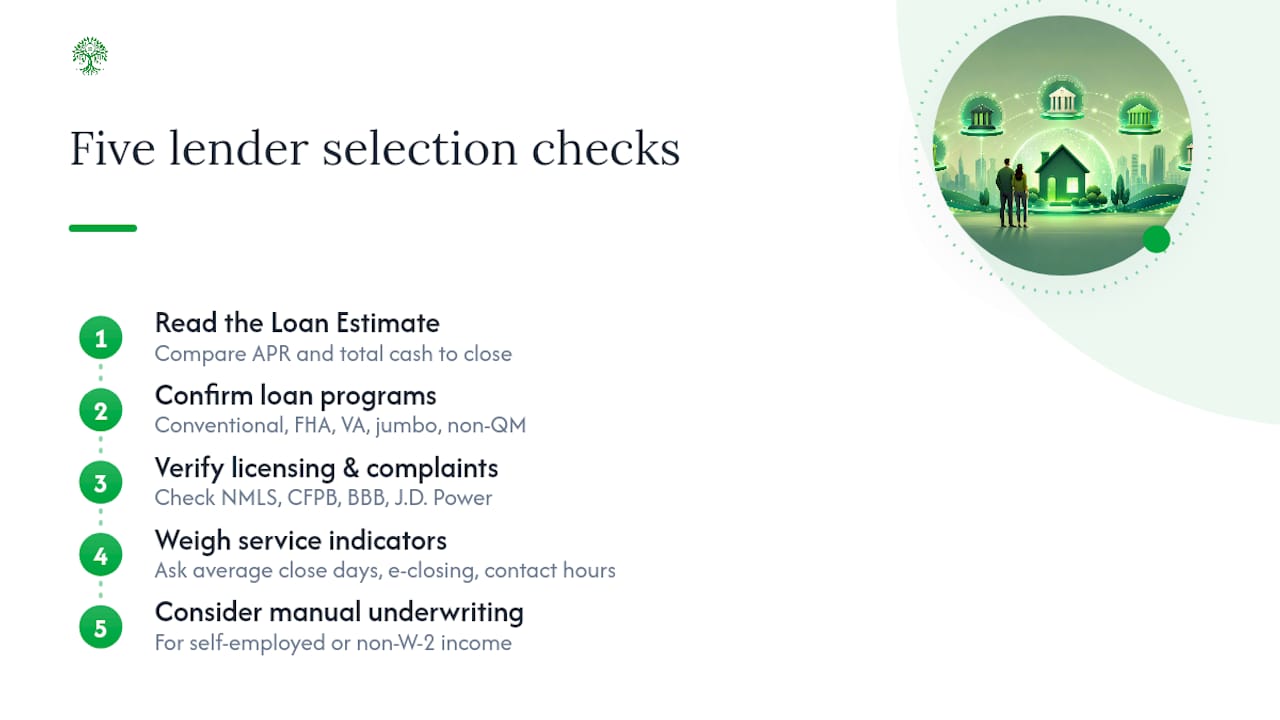
5. Know when to add a local or manual-underwrite lender to your list. If you’re self-employed, recently changed jobs, or have income that doesn’t fit a W-2 template, a portfolio lender with manual underwriting can approve scenarios that automated systems flag or decline outright.
Pro Tip: Ask every lender the same three questions in the same order: your rate, your total fees, and your average closing time in days. Lenders who dodge the fee question are usually the ones padding it.
Before you request quotes, it helps to know your numbers cold. Run your debt-to-income ratio and check your credit score against typical lender thresholds so you’re not guessing what tier of rate you’ll actually qualify for.
Why Can Online Lenders Close Faster and Cheaper?
Online and nonbank lenders more than doubled their share of mortgage originations between 2013 and 2023, climbing from 24% to 55% of the market, according to the CFPB’s mortgage market activity report. That shift didn’t happen by accident. Digital lenders stripped out branch overhead and rebuilt the process around automation, and the savings show up in both speed and price for the right borrower.
By the Numbers: Online lenders often close roughly 20% faster than traditional banks, with Rocket Mortgage averaging around 22 days to close in one comparative analysis. That’s meaningfully tighter than the 30 to 45 day window many branch lenders still quote.
The mechanics behind that speed:
- Soft-pull rate checks let you see personalized pricing before a hard credit inquiry, so you can shop without dinging your score early.
- E-closings replace stacks of paper signatures with a scheduled digital session, cutting days off the back end of the timeline.
- Automated income and asset verification pulls bank and payroll data directly instead of waiting on you to scan and upload PDFs.
- Origination fees at digital lenders often run at or below the industry’s typical 0.5% to 1% range, and some waive them entirely for repeat customers.
None of that automation eliminates every manual step. Title work, appraisal scheduling, and municipal recording still run on human and institutional timelines no algorithm controls. And if your income doesn’t fit a clean W-2 pattern, or your file needs a documentation exception, automated underwriting tends to be less flexible than a human loan officer reviewing supplemental paperwork. There’s also a quieter risk: many online lenders sell servicing rights shortly after closing, meaning the company you applied with may not be the one you’re mailing payments to a year later.
Your Week-By-Week Plan to Shop Online Mortgage Lenders
Comparing mortgage lenders online doesn’t require weeks of research if you work through it in order. Here’s the sequence that gets you comparable, trustworthy offers fastest.
-
Apply to three or four lenders within a 14-day window. Credit scoring models treat multiple mortgage inquiries within this window as a single shopping event, so your score takes one hit instead of several, according to guidance on rate-shopping windows.
-
Request a formal Loan Estimate from each one, not a verbal quote. Line up the APR and total cash to close across all four side by side. A quarter-point rate difference can be erased entirely by a $3,000 gap in fees.
-
Verify NMLS licensing and confirm state availability. Not every online lender operates in every state, and license status can change. A two-minute NMLS lookup confirms you’re dealing with a legitimate, active company.
-
Apply the total-cost-plus-service-fit rule. The lowest rate on paper isn’t the winner if that lender is slow to respond, inflexible on closing dates, or missing a loan program you need. Weigh price against how the lender actually treats you during the application.
-
Add a local, manual-underwrite lender if your income is nonstandard. Self-employed borrowers, gig workers, and anyone with recent income changes should get at least one quote from a lender known for flexible, human-reviewed underwriting before ruling out that route.
If you’re stretching for a low down payment, run the numbers through a down payment calculator first, and check whether 3% down conventional programs or FHA financing fit your situation better than a standard 20% down assumption. Buyers exploring no-money-down options or first-generation buyer programs should confirm which lenders on their shortlist actually support those programs, because not all of them do.
Why Ficustree Fits First-Time Buyers Who Want Speed Plus Guidance
Comparing rate quotes solves one piece of the puzzle. It doesn’t tell you which house fits your budget, how to structure an offer, or who’s representing your interests once you’re in escrow. That’s the gap Ficustree is built to close for first-time buyers in California and Texas.
Ficustree isn’t a lender. It’s a buyer representation platform that layers decision intelligence on top of your home search. You get personalized home matching, on-demand showing agents you can book by the hour, and a real buyer’s agent working your transaction, all while using the premium platform for free.
Where Ficustree changes the timeline for first-time buyers:
- It clarifies true affordability up front, including PITI, HOA dues, insurance, and maintenance, so you’re not shopping lenders for a price point you can’t actually sustain.
- It compresses the confusion most first-time buyers hit around offers, disclosures, and contingencies into a guided, step-by-step process.
- It gives you a dedicated advocate during negotiation and inspection, something a call center loan officer isn’t positioned to do.
| What You Need | Online Lender Alone | Ficustree |
|---|---|---|
| Rate and fee comparison | Yes, direct | Guides you to compare lender quotes |
| Buyer representation | No | Yes, included |
| Affordability and offer strategy | No | Yes |
| Local showing access on demand | No | Yes, hourly booking |
| Commission rebate | Not applicable | Roughly 2% where legal |
Think of it this way: your mortgage lender prices the loan, but Ficustree helps you decide which house, which offer, and which terms make sense before the loan even matters. The two aren’t competitors. Gather your lender quotes first, then let a platform like Ficustree’s buyer portal help you turn those numbers into an actual purchase decision. If you want to see how the two workflows connect in practice, this piece on home buying workflow automation walks through it.
An Editor’s Take on Speed, Cost, and Certainty
Most advice on this topic treats rate shopping like the whole game. It isn’t. The real skill is knowing when speed matters more than the lowest possible rate, and when it’s the reverse.
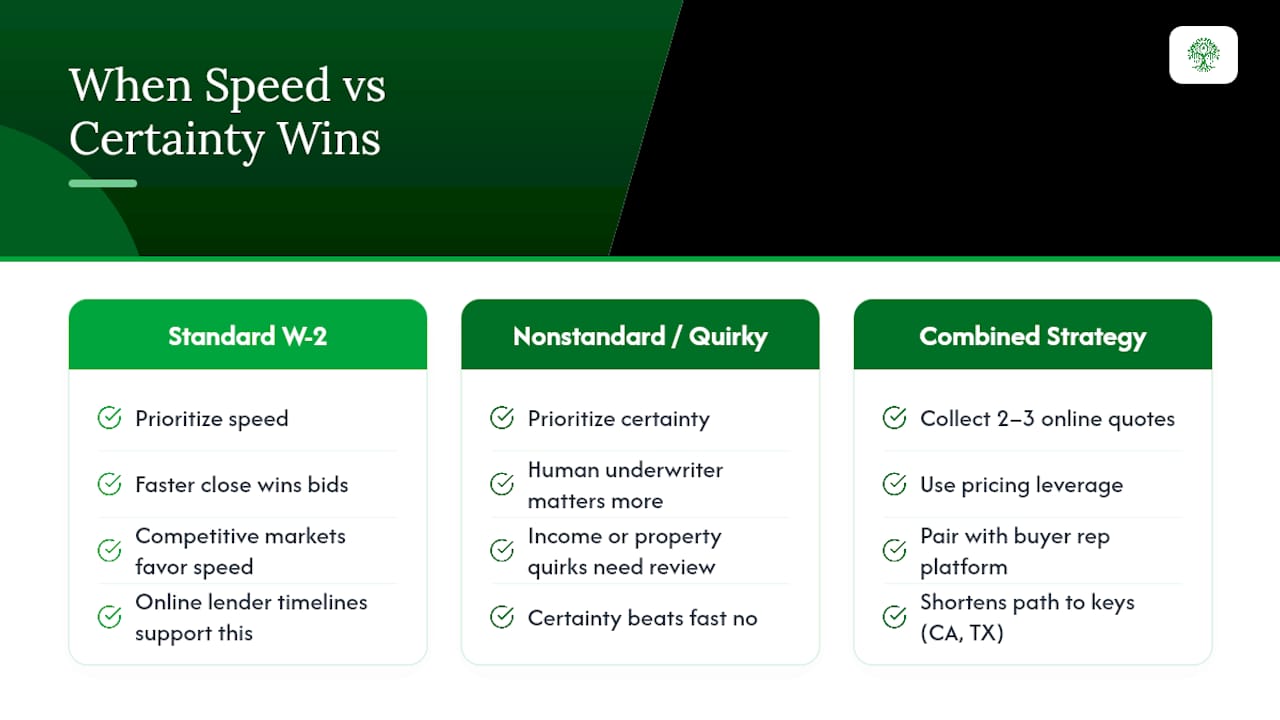
If you’re a confident, standard W-2 borrower in a competitive market, speed often wins. A faster close can be the difference between winning a bid and losing it, and the data on online lender timelines backs that up clearly. If your income is nonstandard, or you’re buying a property with quirks, certainty beats speed every time. A human underwriter who understands your file is worth more than a fast no.
The smartest approach combines both. Collect two or three online lender quotes for pricing leverage, then pair that with a buyer representation platform for the parts a rate quote never covers, like offer strategy and negotiation. For first-time buyers in California and Texas specifically, that combination, not a single lender choice, is what actually shortens the path from looking to keys.
— Anand
Get Started With Ficustree
You’ve compared lenders. Now compare what happens after you’re preapproved, because that’s where most first-time buyers actually lose time. Ficustree replaces the scattered mix of agent calls, spreadsheet math, and guesswork with one guided workflow: personalized home matching, on-demand showing agents booked by the hour, and a dedicated buyer’s agent working your offer and negotiation.
The process starts simply. You share your budget and preferences, Ficustree surfaces homes that actually fit your numbers, and you book showings on your schedule instead of waiting on a traditional agent’s calendar. The premium platform, including affordability calculators and neighborhood insights, costs nothing to use. If you’re ready to see how it fits your search, start with Ficustree and get matched with homes and a buyer’s agent this week.
Primary Sources for Verifying Lender Data
Every claim in this guide traces back to a source you can check yourself. The CFPB’s mortgage market activity report documents the market share shifts and servicing trends referenced above. For veterans confirming loan eligibility, the VA’s official housing assistance pages list current limits and criteria directly from the source. Before applying with any lender, run its name through NMLS Consumer Access to confirm active licensing and approved states. For broader comparative context on lender types, Bankrate’s breakdown of lenders versus banks and CNBC Select’s analysis of online mortgage pros and cons are both worth a direct read.
This article is general information, not a substitute for advice from a qualified financial advisor. Consult a qualified financial professional about your own circumstances before acting on anything here.
Sources
- CFPB: Mortgage market activity and trends — 2023/2024 report
- Online mortgages: Lenders, pros and cons — CNBC Select
- Online lender vs. bank: rate comparison — Tomo Mortgage blog
- VA: Home loan eligibility — U.S. Department of Veterans Affairs
- NMLS consumer access — company license entry (example)
FAQ
What is the #1 mortgage lender in America?
There’s no single lender that ranks as the objective “best” for every borrower. Rocket Mortgage and other large online lenders originate high volumes and close quickly for standard W-2 profiles, but the right lender depends on your loan program, credit tier, and how complex your income is.
Is an online lender or a traditional bank better for a mortgage?
Online lenders typically win on speed and fees for straightforward borrowers, since nonbank lenders now originate 55% of mortgages, up from 24% in 2013. Traditional banks and manual underwriters still have an edge for complex income situations or borrowers who want in-person guidance.
How much does a loan officer earn on a $500,000 loan?
Loan officer compensation isn’t standardized across the industry and varies by lender and commission structure, so there’s no single verified figure to cite here. What you can verify is the lender’s own origination fee, disclosed on your Loan Estimate, which commonly runs 0.5% to 1% of the loan amount.
Which mortgage lenders are easiest to get approved with?
Lenders offering FHA loans, non-QM programs, or manual underwriting tend to approve a wider range of credit and income profiles than lenders relying solely on automated underwriting. If your credit or income is nonstandard, ask specifically whether a lender offers manual underwriting before applying.
Should first-time buyers use an online lender or a platform like Ficustree?
They solve different problems. An online lender prices and originates your loan, while Ficustree provides buyer representation, affordability guidance, and negotiation support around that loan. Most first-time buyers benefit from doing both: shopping lender quotes for rate and fees, and using a platform like Ficustree to navigate the purchase itself.