
Yes, you can buy a home with just 3% down using first-time home buyer mortgage options available right now. The main options are Conventional 97, Fannie Mae HomeReady, Freddie Mac Home Possible, and Freddie Mac HomeOne — all of which allow a 3% minimum down payment on a primary residence. Note that FHA loans require 3.5% (not 3%), while VA and USDA loans may require 0% down for eligible veterans and rural buyers.
Here is a quick program-to-buyer match to orient you:
- Conventional 97: Any first-time buyer with solid credit who earns above area income limits and wants a straightforward conventional loan.
- HomeReady (Fannie Mae): First-time or repeat buyer whose income is at or below 80% of the area median income (AMI); offers pricing advantages and flexible income sources.
- Home Possible (Freddie Mac): Similar to HomeReady with an 80% AMI cap; allows gifts, grants, and employer assistance for the down payment.
- HomeOne (Freddie Mac): First-time buyer who earns above AMI limits and wants no geographic or income restrictions; at least one borrower must be a first-time buyer.
- FHA: Buyers with credit scores as low as 580 who can put 3.5% down and want more flexible underwriting.
- VA / USDA: Eligible veterans or rural buyers who qualify for zero down.
For most first-time buyers in California and Texas, HomeReady or HomeOne will be the starting point worth exploring with a lender.
Table of Contents
- Which 3% down programs should you compare?
- How does 3% down change your loan math?
- What are the eligibility requirements for each program?
- What does a 3% down mortgage actually cost you?
- Is a 3% down mortgage the right choice for you?
- How do you actually get a 3% down mortgage?
- What are your alternatives if 3% down doesn’t fit?
- HomeOne vs. HomeReady and Home Possible: which fits your situation?
- Key Takeaways
- Why first-time buyers get tripped up on low down payment loans
- How Ficustree helps first-time buyers navigate low down payment options
- Useful sources
- FAQ
Which 3% down programs should you compare?
Not all low down payment mortgage options are built the same. The table below captures the core decision dimensions across the main programs.

| Program | Min. Down / Max LTV | Who Is Eligible | Credit Score Guidance | Mortgage Insurance | Loan Purpose |
|---|---|---|---|---|---|
| Conventional 97 | 3% / 97% | At least one first-time buyer (some versions allow repeat buyers) | Typically 620+ | Private mortgage insurance (PMI); cancelable | Primary residence only |
| HomeReady (Fannie Mae) | 3% / 97% | First-time or repeat buyer; income ≤ 80% AMI | Typically 620+ | Reduced PMI; cancelable | Primary residence only |
| Home Possible (Freddie Mac) | 3% / 97% | First-time or repeat buyer; income ≤ 80% AMI | Typically 660+ | Reduced PMI; cancelable | Primary residence only |
| HomeOne (Freddie Mac) | 3% / 97% | At least one first-time buyer; no income or geographic limits | Typically 620+ | Standard PMI; cancelable | Primary residence only |
| FHA | 3.5% / — | Any buyer; no first-time requirement | 580+ for 3.5% down | MIP (upfront + annual); harder to cancel | Primary residence only |
| VA | 0% / — | Eligible veterans, active duty, surviving spouses | No minimum set by VA | No PMI | Primary residence only |
| USDA | 0% / — | Buyers in eligible rural/suburban areas; income limits apply | Typically 640+ | Guarantee fee (upfront + annual) | Primary residence only |
Key practical differences to keep in mind:
- Income caps matter. HomeReady and Home Possible both cap qualifying income at 80% of AMI for the property location. HomeOne has no income or geographic limits, but requires at least one borrower to be a first-time buyer.
- PMI is not equal across programs. HomeReady and Home Possible often carry reduced mortgage insurance costs compared to standard Conventional 97, which can meaningfully lower your monthly payment.
- Down payment sources are more flexible on some programs. Home Possible allows gifts, Affordable Seconds, employer assistance, and in some cases sweat equity — sources that standard conventional loans may not accept.
- FHA’s mortgage insurance is harder to remove. Unlike conventional PMI, FHA’s mortgage insurance premium (MIP) typically stays for the life of the loan if you put less than 10% down.
- Homeownership education is required for some programs when all occupying borrowers are first-time buyers. That certificate must be in your loan file before closing.
Gotcha: HomeOne has no income or geographic limits, but it does require at least one borrower to be a first-time homebuyer. HomeReady and Home Possible offer better pricing for income-eligible buyers but cap qualifying income at 80% AMI.
How does 3% down change your loan math?
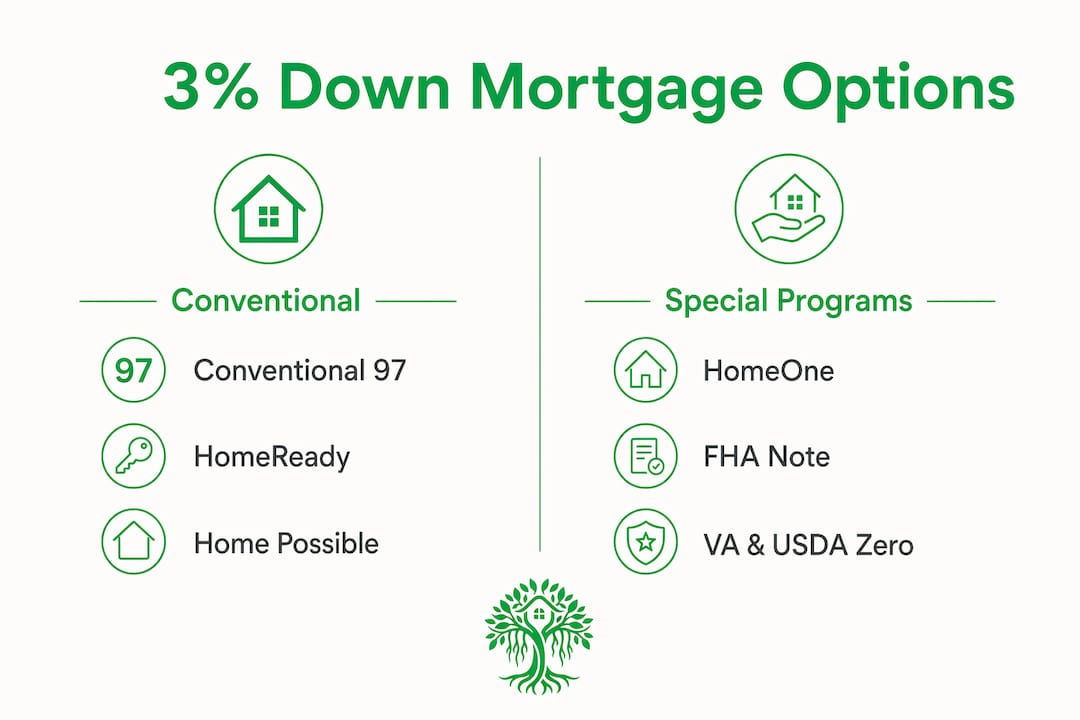
Putting 3% down raises your loan-to-value ratio (LTV) to 97%, which has two direct consequences: you borrow more principal, and you pay private mortgage insurance until you build enough equity. Here is how the numbers actually work.

Two numeric examples: $250,000 and $300,000 purchase price
$250,000 home:
- Down payment: 3% of the purchase price.
- Loan amount is the purchase price minus the down payment.
- LTV is approximately 97%.
- Estimated PMI generally ranges from about 0.5% to 1.5% of the loan amount annually, varying by credit score and program; this translates to a rough monthly PMI cost.
- Principal and interest payments depend on your interest rate and loan term.
- Adding taxes, insurance, and PMI results in a total monthly housing cost that varies based on location and other factors.
$300,000 home:
- Down payment: 3% of the purchase price.
- Loan amount is the purchase price minus the down payment.
- LTV is approximately 97%.
- Estimated PMI varies but typically falls in a range depending on your credit score and program.
- Principal and interest payments depend on your interest rate and loan term.
- Total monthly housing costs including taxes and insurance vary by location and other factors.
These are illustrative figures. Your actual rate, PMI rate, taxes, and insurance will vary. Use a down payment calculator to run your specific numbers.
How PMI works and when it goes away
Private mortgage insurance protects the lender, not you, if you default. On conventional loans, PMI rates typically range from 0.5% to 1.5% of the loan amount annually, with your credit score and LTV being the biggest pricing factors. A 760+ credit score at 97% LTV will carry a much lower PMI rate than a 640 score at the same LTV.
The good news: conventional PMI is cancelable. Lenders must automatically terminate PMI when your loan balance reaches 78% of the original purchase price. You can also request cancellation once you reach 80% LTV, provided you have a good payment history and, in some cases, a new appraisal. FHA MIP, by contrast, typically stays for the life of the loan if your down payment is under 10%.
Pro Tip: Some lenders offer lender-paid mortgage insurance (LPMI), where they cover the PMI cost in exchange for a slightly higher interest rate. This can lower your monthly payment, but the higher rate is permanent — unlike PMI, which you can eventually cancel. Run both scenarios before deciding.
What are the eligibility requirements for each program?
Before you call a lender, it helps to know where you stand. Here is a program-by-program breakdown of the core underwriting requirements.
Conventional 97
- First-time buyer rule: At least one borrower must be a first-time buyer on most versions (defined as no ownership interest in a primary residence in the past three years).
- Income limits: None on standard Conventional 97.
- Credit score: Typically 620 minimum; better pricing above 720.
- DTI: Generally up to 45%–50% with strong compensating factors.
- Down payment sources: Personal savings, gift funds, DPA grants.
- Non-occupant co-borrowers: Allowed on some versions; confirm with lender.
- Homeownership education: Required when all borrowers are first-time buyers.
HomeReady (Fannie Mae)
- First-time buyer rule: Not required — repeat buyers can qualify if income is within AMI limits.
- Income limit: Total qualifying income may not exceed 80% of AMI for the property location.
- Credit score: 620 minimum; pricing improves significantly above 680.
- DTI: Up to 50% with DU approval.
- Down payment sources: Gifts, grants, Affordable Seconds, and boarder/roommate income can count toward qualifying.
- Non-occupant co-borrowers: Permitted; income counted at a reduced percentage.
- Homeownership education: Required when all occupying borrowers are first-time buyers; certificate must be in the loan file before closing.
- Pricing advantage: Fannie Mae’s Desktop Underwriter (DU) automatically flags HomeReady eligibility and may identify a $2,500 borrower credit for very low-income buyers.
Home Possible (Freddie Mac)
- First-time buyer rule: Not required.
- Income limit: Qualifying income capped at 80% of AMI for most uses.
- Credit score: Typically 660 minimum.
- DTI: Up to 45% generally; confirm with lender.
- Down payment sources: Gifts, Affordable Seconds, employer assistance, and sweat equity in some cases.
- Non-occupant co-borrowers: Allowed under program rules.
- Homeownership education: Required for first-time buyers.
- Important 2026 change: Freddie Mac removed unsecured loan proceeds as eligible assets for Home Possible effective April 2026. If you planned to use a personal loan for reserves or closing costs, that path is now closed under this program.
HomeOne (Freddie Mac)
- First-time buyer rule: At least one borrower must be a first-time buyer; no income or geographic limits apply.
- Income limit: None.
- Credit score: Typically 620 minimum.
- DTI: Up to 45% generally.
- Down payment sources: Personal savings, gifts; confirm eligible sources with lender.
- Non-occupant co-borrowers: Not permitted under standard HomeOne guidelines.
- Homeownership education: Required when all borrowers are first-time buyers.
FHA (brief note)
FHA requires 3.5% down, not 3%, so it falls outside the strict 3% category. It is worth considering if your credit score is between 580 and 619, where conventional programs become harder to access. Read the full breakdown in how FHA loans work for first-time buyers.
VA and USDA (zero-down options)
VA purchase loans require no down payment and no PMI for eligible veterans, active-duty service members, and surviving spouses. USDA’s Single Family Housing Guaranteed Loan Program offers zero-down financing in eligible rural and suburban areas with income limits. If you qualify for either, they almost always beat a 3% conventional loan on total cost.
Statistic callout: Buyers who meet AMI income limits for HomeReady or Home Possible may receive better pricing — lower credit fees or mortgage insurance advantages — compared to buyers who must use a standard 97% conventional option. That pricing difference can add up to hundreds of dollars per year in PMI savings alone.
What does a 3% down mortgage actually cost you?
The 3% down payment is just the beginning. Here is the full budget picture.
Costs to plan for
- Down payment: 3% of purchase price.
- Closing costs: Typically 2%–5% of the loan amount, covering lender fees, title insurance, appraisal, and prepaid items.
- Prepaid items: First year of homeowners insurance, prepaid interest, and initial escrow deposits for taxes and insurance.
- PMI: Monthly cost until you reach 80% LTV (conventional) or for the loan’s life (FHA under 10% down).
- Reserves: Many programs require 1–2 months of housing payments in savings after closing.
Monthly cost snapshot
| Scenario | Loan Amount | Est. PMI/Month | Est. P&I/Month (7%) | Est. Total Monthly Cost |
|---|---|---|---|---|
| $250,000 home, 3% down | $250,000 | — | — | — |
| $300,000 home, 3% down | $291,000 | — | — | — |
Note: For a $300,000 home, a 3% down payment is $9,000, resulting in a loan amount of $291,000. This matches the FAQ and Key Takeaways section figures for consistency.
P&I = principal and interest. Total monthly cost adds estimated taxes, insurance, and PMI. Actual figures vary by location, credit score, and lender pricing.
The long-term cost of borrowing more
Starting with a 97% LTV loan means you carry a larger principal balance for longer. Every dollar of principal you do not put down at closing earns interest for the full loan term. On a $291,000 loan at 7% over 30 years, total interest paid exceeds $406,000 — compared to roughly $350,000 on a $250,000 loan at the same rate. That gap is real, and it is why the decision to buy now versus save longer deserves honest math, not just optimism about appreciation.
PMI removal is the other lever. Once you reach 80% LTV through payments and appreciation, you can request PMI cancellation and recover that monthly cost. Buyers who plan to stay in the home five or more years often find the PMI cost worthwhile given the equity they build over time. Buyers planning to sell within three years may find the math tighter.
Pro Tip: Shopping at least three lenders for PMI rates is as important as shopping for your interest rate. PMI is priced by the insurer, and different lenders work with different insurers — the same credit score can yield meaningfully different PMI quotes. See how to avoid PMI for strategies specific to California buyers.
Is a 3% down mortgage the right choice for you?
A low down payment mortgage gets you into a home faster, but it comes with real trade-offs. Here is a clear-eyed checklist.
Benefits
- Lower upfront cash requirement. On a $300,000 home, 3% down is $9,000 versus $60,000 at 20%. That gap is the difference between buying now and waiting years.
- Access to homeownership sooner. In rising markets, waiting to save a larger down payment can cost more in purchase price appreciation than you save in PMI.
- Program underwriting flexibilities. HomeReady and Home Possible allow non-occupant co-borrowers, boarder income, and flexible down payment sources that standard loans do not.
- Keeps cash reserves intact. Preserving savings for repairs, emergencies, and moving costs reduces financial stress in the first year of ownership.
Trade-offs
- Higher monthly payment. A larger loan balance means more principal and interest every month, plus PMI on top.
- Slower equity building. Starting at 97% LTV means a market dip of even 5% puts you underwater. That is a real risk in volatile markets.
- PMI adds cost. Even at a modest rate, PMI on a $291,000 loan costs roughly $1,940–$4,365 per year depending on your credit score and program.
- Possible higher interest rate. Some lenders price 97% LTV loans slightly higher than 95% LTV loans; the difference is usually small but worth confirming.
- Risk of negative equity. If home values fall after purchase, a 3% down buyer has very little cushion before the loan balance exceeds the home’s value.
Decision triggers
- Credit score below 620? Conventional 3% programs become inaccessible; FHA at 3.5% or credit repair first are the realistic paths. See buying a house with a low credit score for a practical roadmap.
- Planning to stay fewer than 5 years? The long-term cost of PMI and higher interest may outweigh the benefit of buying sooner. Run the numbers honestly.
- Local market falling? A 3% cushion evaporates quickly in a declining market. A larger down payment or waiting may be the safer call.
- Emergency fund depleted by the down payment? Most financial planners recommend keeping 3–6 months of expenses in reserve after closing. If a 3% down payment wipes out your savings, that is a warning sign.
How do you actually get a 3% down mortgage?
Here are the concrete steps, in order.
-
Check your credit score and DTI. Pull your credit report from all three bureaus. Calculate your debt-to-income ratio: add up all monthly debt payments and divide by gross monthly income. Most 3% programs want DTI at or below 45%–50%.
-
Gather your documents. You will need: two years of W-2s and tax returns, 30 days of pay stubs, two to three months of bank and asset statements, and a gift letter if any of your down payment is a gift.
-
Get preapproved with at least two or three lenders. Request program-specific pricing for HomeReady, Home Possible, and HomeOne. The same DU approval does not guarantee identical pricing across lenders — automated underwriting flags eligibility, but lenders set their own rates and overlays.
-
Confirm program eligibility. Ask each lender to run an AMI check for HomeReady and Home Possible. If your income exceeds 80% AMI, HomeOne or Conventional 97 are your conventional options.
-
Request and compare Loan Estimates. Within three business days of a completed application, lenders must provide a standardized Loan Estimate. Compare APR, PMI rate, closing costs, and cash-to-close across lenders.
-
Proceed to contract and underwriting. Once you have an accepted offer, your lender orders the appraisal and begins underwriting. Respond to document requests quickly — delays here are the most common cause of closing timeline slippage.
Questions to ask every lender
- Does this loan allow non-occupant co-borrowers?
- Are gift funds or DPA grants acceptable for the full down payment?
- What is the PMI rate for my credit score and LTV on this specific program?
- Do you have any lender overlays that restrict eligibility beyond the program guidelines?
- If I use student loan income-based repayment, how do you calculate my DTI? (Relevant if you carry student debt — see buying a house with student loans for details.)
Realistic timeline
- Preapproval: 1–5 business days once documents are submitted.
- House hunting: Varies widely; budget 30–90 days in most markets.
- Underwriting and appraisal: 2–4 weeks after an accepted offer.
- Closing: Typically 30–45 days from contract to keys.
What are your alternatives if 3% down doesn’t fit?
Sometimes a 3% conventional loan is not the right tool. Here are the realistic alternatives.
- Save for 5%–20% down. Crossing from 97% to 95% LTV can lower your PMI rate and sometimes your interest rate. At 20%, PMI disappears entirely. The trade-off is time in the market.
- FHA at 3.5% down. Better for buyers with credit scores between 580 and 619. The downside: MIP typically stays for the loan’s life if you put less than 10% down. Detailed breakdown at how FHA loans work.
- VA loan (0% down). No down payment, no PMI, and competitive rates for eligible veterans and active-duty service members. The VA funding fee applies but can be financed into the loan.
- USDA loan (0% down). Zero down for buyers in eligible rural and suburban areas who meet income limits. Check eligibility at USDA’s program page.
- Down payment assistance (DPA) programs. State and local agencies offer grants, forgivable loans, and second liens that can cover some or all of your 3% down and closing costs. These pair well with HomeReady and Home Possible. California buyers should check California first-time buyer programs; the HUD resource page lists programs by state.
- Co-borrowers or co-signers. Adding a creditworthy non-occupant co-borrower can strengthen your application on programs that allow it. HomeReady explicitly permits this; HomeOne does not.
- Loan assumption. In rare cases, a seller’s existing low-rate mortgage can be assumed by the buyer. This path is uncommon and requires lender approval, but it can be worth asking about in a high-rate environment.
- Rent longer and save. If your local market is declining or your financial position is thin, renting another 12–24 months while building savings and credit is a legitimate strategy. See buying a house with no money down for a look at zero-down paths when you are ready.
HomeOne vs. HomeReady and Home Possible: which fits your situation?
The practical choice between these programs often comes down to one question: does your income fall within 80% of the area median income?
If your income exceeds 80% AMI: HomeOne is likely your best conventional 3% option. It has no income or geographic limits, requires at least one first-time buyer, and offers standard conventional pricing. You will not get the reduced credit fees that HomeReady and Home Possible provide, but you will not be disqualified by income either.
If your income is at or below 80% AMI: HomeReady or Home Possible may offer meaningfully better pricing. Buyers who meet AMI limits can access lower credit fees and potentially reduced PMI costs compared to standard 97% conventional options. HomeReady also allows boarder and roommate income to count toward qualifying — a real advantage for buyers in high-cost markets where a housemate’s rent is part of the household budget.
Example scenarios:
- Buyer earning $85,000 in a market where 80% AMI is $78,000: Over the AMI cap, so HomeReady and Home Possible are not available. HomeOne is the right conventional path if this buyer is a first-time buyer.
- Buyer earning $65,000 in the same market: Under the AMI cap. HomeReady or Home Possible may offer better PMI pricing and credit fee advantages. Worth running both programs through a lender to compare Loan Estimates.
One critical caveat: program rules change. Freddie Mac removed unsecured loan proceeds as eligible assets for Home Possible effective April 2026 — a change that caught some borrowers off guard. Always confirm current underwriting guidelines directly with your lender at application time, not just from articles published months earlier.
Statistic callout: Fannie Mae’s DU automatically identifies HomeReady-eligible loans, which means your lender’s automated underwriting submission can flag the program for you — but that flag does not guarantee the best pricing. Always request a side-by-side Loan Estimate comparison across programs.
Key Takeaways
A 3 percent down mortgage is accessible through four main conventional programs — Conventional 97, HomeReady, Home Possible, and HomeOne — each with distinct eligibility rules that determine which one saves you the most money.
| Point | Details |
|---|---|
| Four main 3% programs | Conventional 97, HomeReady, Home Possible, and HomeOne each allow 3% down with different income and eligibility rules. |
| AMI cap splits the choice | HomeReady and Home Possible cap qualifying income at 80% AMI; HomeOne has no income limit but requires a first-time buyer. |
| PMI is cancelable on conventional loans | Conventional PMI cancels automatically at 78% LTV; request cancellation at 80% LTV with a good payment history. |
| Real cash-to-close on a $300k home | 3% down is $9,000, plus closing costs of roughly 2%–5% of the loan amount, plus prepaid items and reserves. |
| Ficustree for CA and TX buyers | Ficustree matches first-time buyers to the right program and lender path, with AI decision support and buyer representation at $1,000 plus 1% commission. |
Why first-time buyers get tripped up on low down payment loans
The programs exist. The eligibility rules are published. So why do so many first-time buyers end up in the wrong loan — or worse, miss out on pricing advantages they qualified for?
The honest answer is that the gap between what a program allows and what a specific lender offers is wider than most buyers realize. Automated underwriting flags eligibility, but lenders set their own overlays, PMI relationships, and pricing. A DU “Accept” on HomeReady does not mean every lender will offer you the same rate or PMI cost. The buyer who shops three lenders and asks for program-specific Loan Estimates consistently gets a better deal than the buyer who takes the first preapproval and runs.
There is also a timing problem. Program rules change faster than most online guides update. The April 2026 Freddie Mac change removing unsecured loan proceeds from Home Possible eligibility is a recent example. Buyers who had planned their cash-to-close around that source had to pivot quickly. The fix is simple but requires discipline: verify current rules with your lender at application time, every time.
The other underrated risk is the ownership horizon. A 3% down loan makes financial sense for buyers who plan to stay long enough for equity to build and PMI to cancel. For buyers who might move in three years, the math often favors renting longer or saving for a larger down payment. That calculation is worth doing before you fall in love with a specific property.
How Ficustree helps first-time buyers navigate low down payment options
Sorting through HomeReady, HomeOne, Home Possible, and FHA while also comparing lender pricing and PMI quotes is a lot to manage alone. Ficustree is built for exactly this situation.
Ficustree is an AI-powered buyer representation platform for first-time buyers in California and Texas. Instead of paying a traditional agent 2%–3% commission, you pay $1,000 at closing plus 1% and keep a rebate of roughly 2% where legally permitted. The platform gives you a document checklist, lender comparison tools, and program matching guidance so you walk into every lender conversation knowing which program to ask about and what questions to push on.
For buyers weighing a 3% down path, Ficustree’s decision intelligence layer helps you calculate your real cash-to-close, compare PMI scenarios across programs, and identify whether DPA programs in your area can reduce your upfront costs further. The platform is free to use; you pay only at closing.
Ficustree serves buyers in California and Texas. If you are ready to move from research to action, start with Ficustree or explore the home-buying workflow tools to see how the platform guides you from preapproval to keys.
Useful sources
Program rules change. Verify all details with your lender at application time.
- Fannie Mae HomeReady: Official program page covering AMI limits, underwriting flexibilities, and DU eligibility messaging.
- Freddie Mac Home Possible: Official program page with income limits, eligible funding sources, and credit fee details.
- Freddie Mac HomeOne overview: Summary of HomeOne’s no-income-limit, first-time-buyer requirements.
- Home Possible fact sheet (PDF): Detailed list of eligible down payment sources including gifts, Affordable Seconds, and employer assistance.
- HUD — Helping Americans with Loans: State-by-state DPA program finder and FHA loan resources.
- VA Purchase Loan: Eligibility and program details for VA zero-down home loans.
- VA Funding Fee and Closing Costs: Official VA guidance on funding fee amounts and financing options.
- USDA Single Family Housing Guaranteed Loan Program: Eligibility maps, income limits, and program details for zero-down rural loans.
- CFPB — What is private mortgage insurance?: Plain-language explanation of PMI, how it is calculated, and who it protects.
- CFPB — When can I remove PMI?: Official guidance on automatic PMI termination at 78% LTV and borrower-requested cancellation at 80%.
- Freddie Mac April 2026 program change: Example of how quickly underwriting guidelines can shift; confirms removal of unsecured loan proceeds from Home Possible eligible assets.
This article is general information, not professional financial or legal advice. Confirm current program rules and eligibility with a licensed lender or HUD-approved housing counselor before making decisions for your specific situation.
FAQ
Can you put 3% down on a mortgage?
Yes. Conventional programs including Conventional 97, HomeReady, Home Possible, and HomeOne all allow a 3% minimum down payment on a primary residence purchase. FHA requires 3.5%, not 3%.
How much is 3% down on a $300,000 house?
Three percent of $300,000 is $9,000. The loan amount is $291,000 after the down payment. Add closing costs and prepaid items, and your total cash-to-close on a $300,000 home varies depending on location and lender.
How much is 3% down on a $250,000 house?
Three percent of $250,000 is $7,500. The loan amount is $242,500 after the down payment. With closing costs and prepaids, total cash-to-close on a $250,000 home varies depending on location and lender.
Is it possible to get a 3% mortgage with no income limits?
Yes. Freddie Mac’s HomeOne program allows 3% down with no income or geographic limits, provided at least one borrower is a first-time homebuyer. HomeReady and Home Possible both cap qualifying income at 80% of the area median income.
Does a 3% down payment mean you will pay PMI forever?
No. On conventional loans, PMI cancels automatically when your loan balance reaches 78% of the original purchase price, and you can request cancellation at 80% LTV with a good payment history. FHA mortgage insurance is harder to remove and typically stays for the life of the loan if your down payment is under 10%.