
Title companies protect your ownership. Escrow companies hold your money and paperwork until every contract condition is met, then release everything at once. Both roles can live under one roof or two separate companies depending on where you buy, so the real question isn’t “title company vs escrow.” It’s who is doing which job in your specific closing, and whether you’ve confirmed that in writing before you wire a dollar.
TL;DR:
- Most states have regional models that determine whether one or separate companies handle closing funds, documents, and title insurance, affecting costs and timelines.
- Confirm in writing who holds your funds and who is issuing your title policy to prevent confusion and reduce fraud risks before wiring any money.
- Title companies focus on ownership protection and issue policies, while escrow companies manage the disbursement of funds and verify contract conditions during closing.
- In states like Texas, one company often does both title and escrow work, whereas in California, separate licensed companies are typically involved, influencing the closing process.
- Securing an owner’s title insurance and verifying wire instructions by phone are essential first steps for first-time buyers to protect their investment and prevent last-minute issues.
Table of Contents
- What an Escrow Company Actually Does
- What a Title Company Actually Does
- Escrow vs Title: The Practical Differences
- How Escrow and Title Work Together at Closing
- How Your State Changes the Closing Process
- Questions to Ask and Red Flags to Watch For
- How Ficustree Helps You Navigate Title and Escrow
- Why Title and Escrow Split Differently by Region
- When Title and Escrow Roles Blur Together
- Who’s Liable When Something Goes Wrong
- What Title and Escrow Fees Actually Pay For
- What First-Time Buyers Should Actually Focus On
- Get Hands-On Help With Title and Escrow Decisions
- Sources
- FAQ
What an Escrow Company Actually Does
An escrow company (or escrow officer) is a neutral third party. It holds your earnest money, your loan proceeds, and your signed documents, and it releases none of it until every condition in your purchase contract has been satisfied. That neutrality isn’t just a nice idea. Escrow agents owe duties of careful, unbiased handling of funds, and they can face real liability if they disburse money before conditions are actually met.
Typical escrow tasks include:
- Receiving and depositing your earnest money deposit
- Collecting the lender’s loan proceeds once underwriting clears
- Verifying inspection, appraisal, and financing contingencies are satisfied
- Disbursing funds to the seller, agents, and service providers at closing
- Managing ongoing escrow accounts for property taxes and homeowners insurance after you move in
Who can act as an escrow holder varies by state. It might be a dedicated escrow company, a title company wearing an escrow hat, a real estate attorney, or a bank trust department. Licensing rules differ too. California regulates independent escrow companies through the Department of Financial Protection and Innovation, while other states fold escrow duties into title company licensing.
Pro Tip: Ask early who is physically holding your earnest money. If the answer is vague, that’s your first red flag, not your last.
What a Title Company Actually Does
Title is your legal right to own the property, free of undisclosed claims. A title company’s core job is running a title search: combing public records for liens, unpaid judgments, old easements, or ownership disputes that could threaten your claim later. When it finds a problem, it works to “cure” the defect, meaning it clears the lien or resolves the dispute before closing can happen.
Title companies also issue title insurance, and there are two distinct types:
- Owner’s title insurance protects you, the buyer, for as long as you or your heirs own the home
- Lender’s title insurance protects the mortgage lender’s financial interest in the property
Lenders almost always require a lender’s policy before funding a loan. There’s no federal law forcing you to buy an owner’s policy, but skipping it means you’re personally exposed if a title defect surfaces after closing, and the premium is small relative to what a home is worth.
At the closing table, the title company typically prepares the title commitment (a preview of what the policy will cover), clears any defects it found, issues the final policy, and often prepares or records the closing documents with the county. The American Land Title Association sets standardized policy forms that most underwriters, including the largest national players, follow across state lines, which is part of why a title policy from one state reads similarly to one from another.
Escrow vs Title: The Practical Differences
Here’s the split that actually matters when you’re staring down a closing date: title protects ownership, escrow protects the transaction itself. One guards against a legal claim showing up five years from now. The other makes sure nobody’s money moves before every box is checked today.
| What to confirm | Title company | Escrow company |
|---|---|---|
| Primary role | Ownership protection (search, insurance) | Custody and disbursement of funds/documents |
| Holds your money | No | Yes |
| Issues title insurance | Yes (owner’s and lender’s policies) | No |
| Prepares/records the deed | Usually yes | Sometimes, depending on the state |
| Common delivery model | Standalone or combined with escrow | Standalone or combined with title |
Three things worth confirming before you sign anything:
- Ask directly whether your title and escrow functions are handled by the same company or two separate ones.
- Request the RESPA affiliated-business disclosure if title and escrow share ownership, since federal rules require it and let you shop for a different provider anyway.
- Confirm in writing, by phone, who is authorized to send you wiring instructions, and never trust a late change that arrives only by email.
How Escrow and Title Work Together at Closing
The two roles run on parallel tracks that converge right before you get your keys.
- Escrow opens. Once your purchase contract is signed, escrow opens and issues instructions to every party spelling out what has to happen before funds move.
- Title work runs in the background. The title company searches records, flags defects, and works to clear them while inspections and financing proceed on their own timeline.
- Escrow waits, then funds. Escrow won’t disburse a cent until title confirms the property is clear and your lender has sent loan proceeds. Title can’t issue the owner’s policy until funds and documents are confirmed and the deed is ready to record, and escrow can’t release money until title gives the green light. Each one is stuck waiting on the other.
- Recording and policy issuance. The deed records with the county, escrow disburses final funds, and title issues your owner’s and lender’s policies.
If something stalls, call your escrow officer for money and timing questions, and your title officer for anything about liens, the deed, or the policy itself.
How Your State Changes the Closing Process
Where you buy determines who you’re dealing with, and it changes more than paperwork. It changes your timeline and sometimes your closing costs.
The U.S. runs on three main models. In title states like Texas, the title company typically closes the transaction directly, and title agents there often act as your escrow holder too, with rates regulated by the Texas Department of Insurance. In escrow states like California, independent escrow companies frequently handle the money and paperwork while a separate title company issues the policy, meaning buyer and seller may never sit at the same closing table. In attorney states like New York, a real estate attorney runs much of the closing itself.
- Title states: expect one company, one closing appointment, often an in-person signing
- Escrow states: expect separate companies, more paperwork routed by mail or courier, and no shared closing table
- Attorney states: expect attorney fees added to your closing costs, plus more direct legal review
Ask your agent or lender which model applies before you assume anything about how your closing will feel.
Questions to Ask and Red Flags to Watch For
Before you’re staring at a wire transfer deadline, get direct answers to these:
- Who exactly is holding my earnest money, and what company is it?
- Who is issuing my owner’s title policy, and is that separate from whoever holds escrow?
- Are you affiliated with my real estate agent’s brokerage or my lender?
- What’s your specific process for verifying any change to wiring instructions?
Watch for these warning signs: a last-minute email changing wiring details, a provider who can’t clearly state their state license, or pressure to skip calling the title or escrow office directly to verify instructions by phone. Wiring fraud remains one of the most common closing-day risks, and legitimate providers expect you to double-check, not resent it.
Keep copies of your title commitment, your Closing Disclosure, the recorded deed, and your final title insurance policy. You’ll want all four if a dispute ever comes up.
Pro Tip: Call the escrow or title office using a phone number you find independently, not one from an email you just received. That single habit stops most wire fraud attempts cold.
How Ficustree Helps You Navigate Title and Escrow
An AI-powered buyer representation platform can help first-time buyers understand who’s doing what at closing. Because Ficustree represents you directly rather than sitting on both sides of a transaction, there’s no ambiguity about whose interest is being served when title and escrow questions come up.
Ficustree’s guides walk buyers through state-specific closing models, including a detailed escrow process breakdown for California buyers and an explainer on what title companies actually do, so you walk into your closing knowing exactly what to expect and who to call.
Why Title and Escrow Split Differently by Region
The title state, escrow state, and attorney state models didn’t happen by accident. They grew out of how each region historically handled land records and legal review.
In the Northeast, where colonial-era land recording systems were often inconsistent and legal disputes over boundaries were common, attorneys became the trusted party to review title and manage the closing. New York’s attorney-closing tradition traces directly back to that history. In Texas, land title insurance became state-regulated early, and title agents naturally absorbed escrow duties because the industry consolidated around title companies that could offer both services under one regulated rate structure.
California took a different path. Independent escrow companies emerged as their own licensed industry, separate from title insurers, partly because the state’s real estate market grew fast enough to support specialized escrow businesses that didn’t need to also underwrite insurance. That’s part of why California buyers today often deal with one escrow company and a separate title insurer, while a Texas buyer might deal with a single title company that does both jobs.
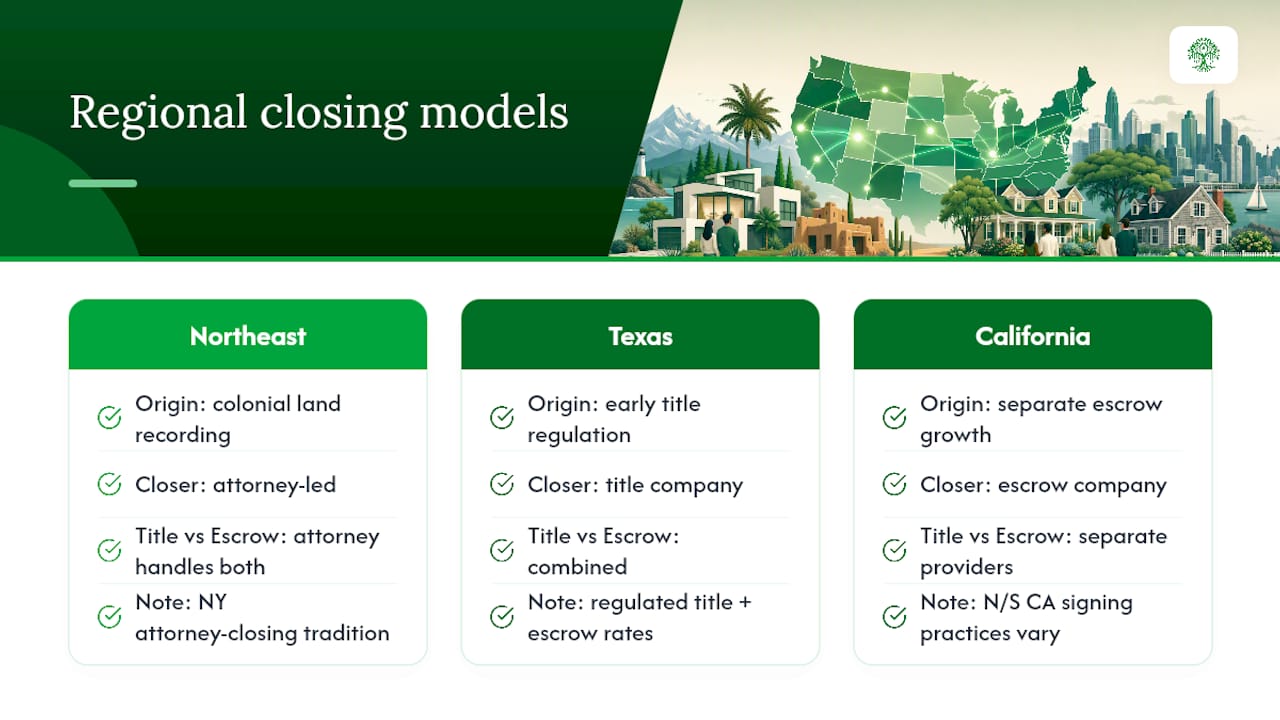
Even within California, Northern and Southern California practices differ slightly, with variations in how joint versus unilateral signing instructions get handled and how much mobile notary services get used for signings.
None of these models is objectively better. They reflect regional legal traditions and how each state’s real estate industry organized itself over the past century. What matters for you is knowing which model governs your purchase, since it determines your timeline, your costs, and who physically handles your paperwork.
When Title and Escrow Roles Blur Together
Confusion tends to show up in a handful of predictable spots, and knowing them in advance saves you a panicked phone call later.
The most common one: your title company and escrow company are the same business, operating under one roof with two different job functions. This happens constantly in Texas and is common elsewhere too. When that’s the case, one point of contact might answer questions about your policy and your wire transfer, which is convenient, but it also means you should specifically confirm which hat they’re wearing when you ask a question.
A second common scenario: your escrow holder is technically a title company’s escrow division, but a separate underwriter is issuing the actual insurance policy. You might get an invoice showing a title fee and a separate escrow fee on the same closing statement, with no explanation of why they’re split. That’s normal. It reflects two distinct services, even if one company delivered both.
A third scenario involves affiliated business arrangements, where your real estate brokerage owns a stake in the title or escrow company handling your file. This isn’t illegal, but federal disclosure rules require you to be told about it in writing, and you retain the right to choose a different provider if you’d rather not use the affiliated one.
Last, first-time buyers sometimes assume the escrow company is holding their loan funds from day one. In reality, loan proceeds typically don’t arrive until very close to closing, often the same day, which is why last-minute funding delays can push a closing date by a day or two even when everything else is ready.
Who’s Liable When Something Goes Wrong
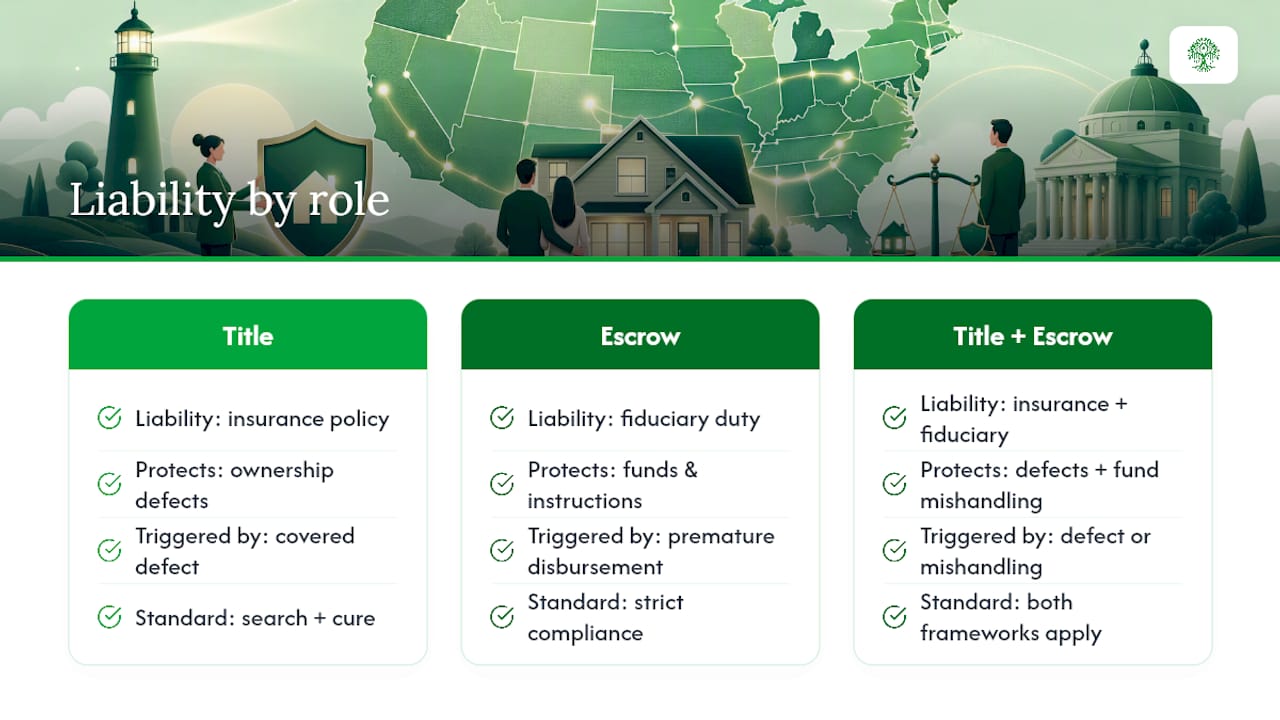
Title companies and escrow companies carry different kinds of legal exposure, and understanding the split helps you know who to contact if a problem surfaces.
Title companies are liable primarily through the title insurance policy itself. If a covered defect surfaces after closing, a lien nobody caught or a forged prior deed, the title insurer is contractually obligated to defend your ownership or cover your loss up to the policy amount. This is why the title search and cure process matters so much before closing: a thorough search reduces the odds of a claim, but the insurance is what actually protects you if the search missed something.
Escrow companies carry a different kind of liability. Because they hold a fiduciary-like duty of neutrality, an escrow agent who disburses funds before conditions are met, or who mishandles instructions, can be held personally and financially responsible for that breach. Courts have generally held escrow agents to a standard of strict compliance with written instructions, meaning they don’t get much benefit of the doubt if they deviate from what the contract says, even with good intentions.
Where things get complicated is in states where one company wears both hats. A combined title and escrow agent can theoretically face liability under both frameworks: as an insurer if a title defect surfaces, and as a fiduciary if funds were mishandled during the transaction. That dual exposure is part of why Texas title agents are required to avoid conflicts of interest and act with good faith even when serving both functions for the same closing.
For you as a buyer, the practical takeaway is simple: your title insurance policy is your protection against ownership problems, and your closing instructions are your protection against fund mishandling. Keep both, and read both, before you sign.
What Title and Escrow Fees Actually Pay For
Closing statements list title and escrow fees separately because they cover genuinely different work, even when one company performs both.
Title-related fees typically include the title search fee, the title examination fee, and the premium for your owner’s and lender’s title insurance policies. Some states also charge a separate settlement or closing fee for preparing the actual closing documents. These costs vary by state and by the price of the home, since title insurance premiums are typically calculated as a percentage of the purchase price or loan amount.
Escrow fees cover the cost of opening and managing the escrow account, tracking contract conditions, coordinating fund transfers between buyer, seller, and lender, and disbursing money at closing. Some escrow companies also charge a small wire fee or a document preparation fee separate from the base escrow charge.
Who pays which fee is negotiable and varies significantly by state and even by county custom. In many California counties, sellers customarily pay for the owner’s title policy, while buyers pay for escrow fees, though this can be negotiated either way in your purchase contract. In Texas, fee splits follow different local customs. California closing costs specifically break down these variations if you want a state-specific look at what you’re likely to see on your own statement.
The one rule that holds everywhere: your Closing Disclosure has to itemize every fee at least three business days before closing, so you have time to question anything that looks off before you’re at the table signing.
What First-Time Buyers Should Actually Focus On
If you take one thing from this article, make it this: confirm who’s holding your funds, verify wiring instructions by phone using a number you found yourself, and secure an owner’s title policy even though nobody’s forcing you to buy one. Everything else, fee splits, state models, company names, is secondary to those three habits. If your closing paperwork ever feels unclear, ask your agent point blank who is handling escrow and who is handling title in your transaction. A good agent answers that in one sentence.
— Anand
Get Hands-On Help With Title and Escrow Decisions
Ficustree gives you a buyer’s advocate for exactly these moments, someone whose only job is protecting your side of the closing, not managing a title company’s own book of business. As direct buyer representation, Ficustree charges a fixed $1,000 fee at closing plus 1% commission, with a rebate of roughly 2% kept where legally permitted, so you know the cost structure before you’re anywhere near a closing table.

Some platforms combine buyer representation with state-aware guidance, on-demand showing agents, and step-by-step closing checklists that clarify where title and escrow responsibilities split. If you want a workflow that keeps your documents and deadlines organized automatically, the home buying workflow tools show how that works in practice. Start by checking your affordability and browsing represented listings at Ficustree to see what hands-on guidance looks like before you’re staring down your own closing date.
Sources
- Consumer Financial Protection Bureau (CFPB)
- U.S. Department of Housing and Urban Development (HUD)
- Bankrate — Title company services
- National Property Services Authority — Title and escrow services
FAQ
Does the Title Company Hold Money in Escrow?
Sometimes. In title states like Texas, the title company often also serves as the escrow holder, but in states like California, a separate escrow company usually holds the funds while the title company only issues insurance.
How Much Do Title Companies Charge for Escrow?
Escrow fees vary by state, county, and home price, and are typically charged separately from title insurance premiums, so check your specific Closing Disclosure rather than assuming a flat rate applies everywhere.
Do Escrow Agents Work at Title Companies?
Yes, in many states escrow agents are employees of title companies, though independent escrow companies also exist, particularly in states like California where the two functions are often kept separate.
What Are the Risks of Not Using a Title Company?
Skipping a title search and owner’s title policy leaves you personally exposed to undiscovered liens, ownership disputes, or forged prior deeds that could surface years after you move in, with no insurance to cover the loss.