
Your annual California property tax bill equals your taxable assessed value multiplied by a base rate of 1%, plus any voter-approved bond rates, parcel taxes, Mello-Roos charges, and special assessments layered on top. Under Proposition 13, that taxable value is set at your purchase price the year you buy and can grow by no more than 2% per year after that, regardless of what the market does.
Three things drive the size of your bill:
- What triggers a big jump: A change in ownership or new construction resets your base-year value to current market levels, which is why a neighbor who bought 20 years ago may pay a fraction of what you owe on an identical home.
- Why long-term owners pay less: Proposition 13’s 2% annual cap means assessed values for longtime owners often sit well below current market value, compressing their tax bill year after year.
- Where to check right now: Go to your county assessor or tax collector website, search by your parcel number (APN), and confirm your current taxable value and what’s on your bill.
Understanding California property taxes fully means knowing not just the formula, but every line item on your bill, when reassessments happen, and what you can do to reduce or challenge your assessment.
Table of Contents
- What actually appears on your California property tax bill
- How your assessed value gets set in the first place
- How your annual tax bill is actually calculated
- Exemptions and relief programs that can lower your bill
- How to appeal your assessed value if it seems too high
- What buyers and sellers need to know about reassessment and Prop 19
- Why Proposition 13 creates a tax gap between neighbors
- Where to look up your bill, rates, and assessment data
- Key Takeaways
- Ficustree helps you budget for property taxes before you close
- FAQ
What actually appears on your California property tax bill
Most homeowners glance at the total and move on. That’s a mistake. Your bill is a layered document, and each line tells you something different about who’s charging you and why.
The LAO’s property tax primer breaks the bill into two broad categories: ad valorem charges (based on your assessed value) and non-ad valorem charges (flat amounts that don’t scale with value).
| Line Item | Type | How It’s Calculated |
|---|---|---|
| 1% General Levy | Ad valorem | 1% × assessed value; goes to county, cities, schools, special districts |
| Voter-approved GO bonds | Ad valorem | Rate set by bond measure; added to your assessed value calculation |
| Parcel tax | Flat (non-ad valorem) | Fixed dollar amount per parcel, regardless of value |
| Mello-Roos / CFD levy | Flat or ad valorem | Varies by district; often a flat annual charge for infrastructure |
| Special assessments | Flat (non-ad valorem) | Street lighting, landscaping, flood control, etc. |
The 1% general levy is the baseline. It’s the line most people recognize, and it funds schools, the county, cities, and special districts. Before Proposition 13, local governments set their own rates independently, and average rates ran much higher. Prop 13 standardized the 1% ceiling and required two-thirds voter approval for any new special local taxes.
Voter-approved general obligation bonds appear as separate line items with their own rates. These fund school construction, parks, or infrastructure projects that voters approved. They’re ad valorem, so they scale with your assessed value.
Parcel taxes are flat charges. Every parcel in the district pays the same amount, whether the home is worth $300,000 or $3 million. They require a two-thirds supermajority to pass.
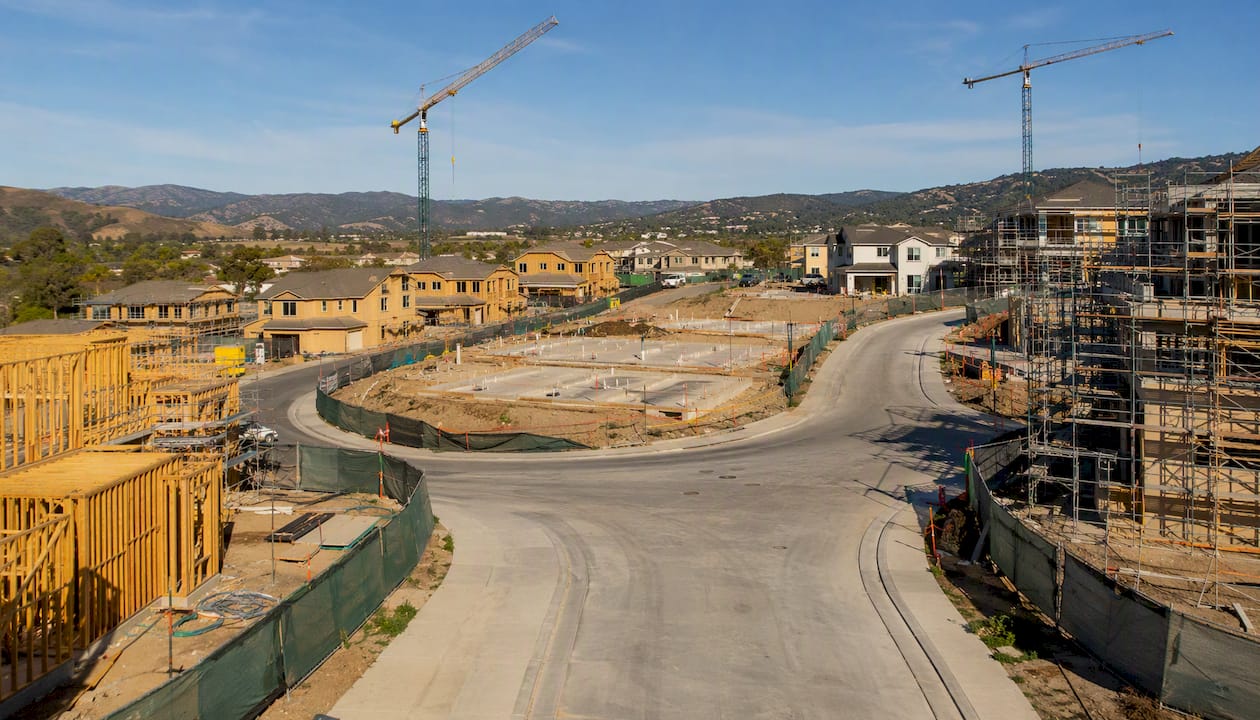
Mello-Roos Community Facilities Districts (CFDs) deserve special attention. Developers in newer subdivisions often form a CFD to finance roads, schools, and utilities. If you buy in a Mello-Roos district, you’ll pay an annual levy that can add hundreds or thousands of dollars to your bill. The charge typically runs for a fixed term (often 25–40 years) and is tied to the parcel, not the value. Always ask whether a property sits in a CFD before making an offer.
Your bill also shows your Assessor’s Parcel Number (APN), the assessed land and improvement values, the total taxable value, and the two payment installment amounts with their due dates.
How your assessed value gets set in the first place
The county assessor is responsible for discovering, inventorying, valuing, and enrolling every taxable property in the county. Here’s how the process works under Proposition 13:
- Base-year value is established at purchase — When you buy a property, the assessor sets your base-year value equal to the purchase price. That becomes the starting point for all future assessments.
- The assessor completes the roll by July 1. The BOE’s overview confirms that assessors must value property as of January 1 and notify owners when assessed values increase. Assessment notices typically go out in the summer.
Pro Tip: When you receive your assessment notice (usually July), you have a limited window to appeal. Mark the date and compare the assessed value to your purchase price and recent comparable sales immediately.
How your annual tax bill is actually calculated
The formula is straightforward once you know the components:
Annual property tax = (Taxable assessed value × 1%) + voter-approved bond rates + parcel taxes + Mello-Roos/CFD charges + other special assessments
The 1% general levy is universal across California. Everything else depends on where the property sits.
| Charge Type | Basis | Typical Range |
|---|---|---|
| 1% general levy | Ad valorem | 1% of assessed value (statewide) |
| GO bond rates | Ad valorem | Varies by district; often 0.01%–0.05% per measure |
| Parcel tax | Flat per parcel | Varies widely; can be $100–$1,000+ per year |
| Mello-Roos levy | Flat or ad valorem | Varies; often $500–$3,000+ per year in newer subdivisions |
| Special assessments | Flat per parcel | Typically $20–$300 per year per district |
Two homes with identical assessed values in different cities can carry meaningfully different total tax rates. A home in a district with multiple active bond measures and a Mello-Roos CFD will pay more than a comparable home in a district with none. This is why understanding California property taxes requires looking beyond the 1% headline rate.
- The 1% levy is set by Proposition 13 and applies statewide.
- Bond rates are set by the bond measure and vary by school district, city, and county.
- Parcel taxes and Mello-Roos charges are set by the specific district and appear as fixed amounts.
- Your county tax collector’s website will show the full rate area breakdown for any APN.
Exemptions and relief programs that can lower your bill
Several programs reduce either your taxable value or the taxes you owe. Most require a one-time application through your county assessor.
- Homeowners’ Exemption: — If the property is your primary residence, you may qualify for an exemption that reduces your assessed value by $7,000. At a 1% rate, that saves $70 per year on the general levy. File a claim with your county assessor after purchase; it typically renews automatically as long as you remain the owner-occupant.
- Property Tax Postponement Program: California’s State Controller administers a program allowing eligible seniors (62+), blind, or disabled homeowners to postpone payment of property taxes on their primary residence. Postponed taxes become a lien on the property, repaid when the home is sold or transferred.
To apply for any exemption, get the claim form from your county assessor’s office. Some exemptions have filing deadlines, so don’t wait.
How to appeal your assessed value if it seems too high
You have the right to challenge your assessed value. The process is formal but manageable if you prepare.
- Review your assessment notice — The assessor mails notices when values increase, typically in July. Check the assessed value against your purchase price and recent comparable sales in your neighborhood.
The window to appeal is short. If you miss the November 30 deadline, you typically must wait until the next assessment cycle.
What buyers and sellers need to know about reassessment and Prop 19
Buying a home in California triggers a reassessment. That’s not a surprise. What catches buyers off guard is the supplemental bill that follows.
Buyer checklist before and during escrow:
- Ask the seller for the most recent property tax bill. Confirm the current assessed value and all line items.
- Ask your escrow officer whether supplemental taxes will be collected through escrow. Per Orange County Assessor guidance, escrow typically does not collect supplemental taxes unless explicitly arranged.
- Confirm with your lender whether your impound account will cover supplemental bills.
- Check whether the property sits in a Mello-Roos CFD. This is disclosed in the Natural Hazard Disclosure report and the preliminary title report.
- Review the offer process to understand what tax-related questions to raise before you sign.
How supplemental assessments work:
When you close escrow, the assessor calculates the difference between the prior assessed value and your new base-year value (the purchase price). That difference is prorated from your close-of-escrow date to the end of the fiscal year (June 30). You’ll receive a Notice of Supplemental Assessment and then a supplemental tax bill, usually several months after closing.
Proposition 19 portability:
If you’re 55 or older, severely disabled, or a wildfire victim, Prop 19 lets you transfer your existing base-year value to a replacement home anywhere in California. The replacement home must be your primary residence, and the transfer must occur within two years of selling the original. If the replacement home costs more than the original, the base-year value is adjusted upward proportionally. Forms and instructions are available through your county assessor. This can be a significant financial benefit for eligible sellers who want to downsize or relocate without losing their low assessed value.
For a full breakdown of what to budget at closing, the California closing costs guide covers supplemental bills alongside other line items.
Why Proposition 13 creates a tax gap between neighbors
This is the part of California property taxes that surprises most buyers, and it’s worth understanding clearly.
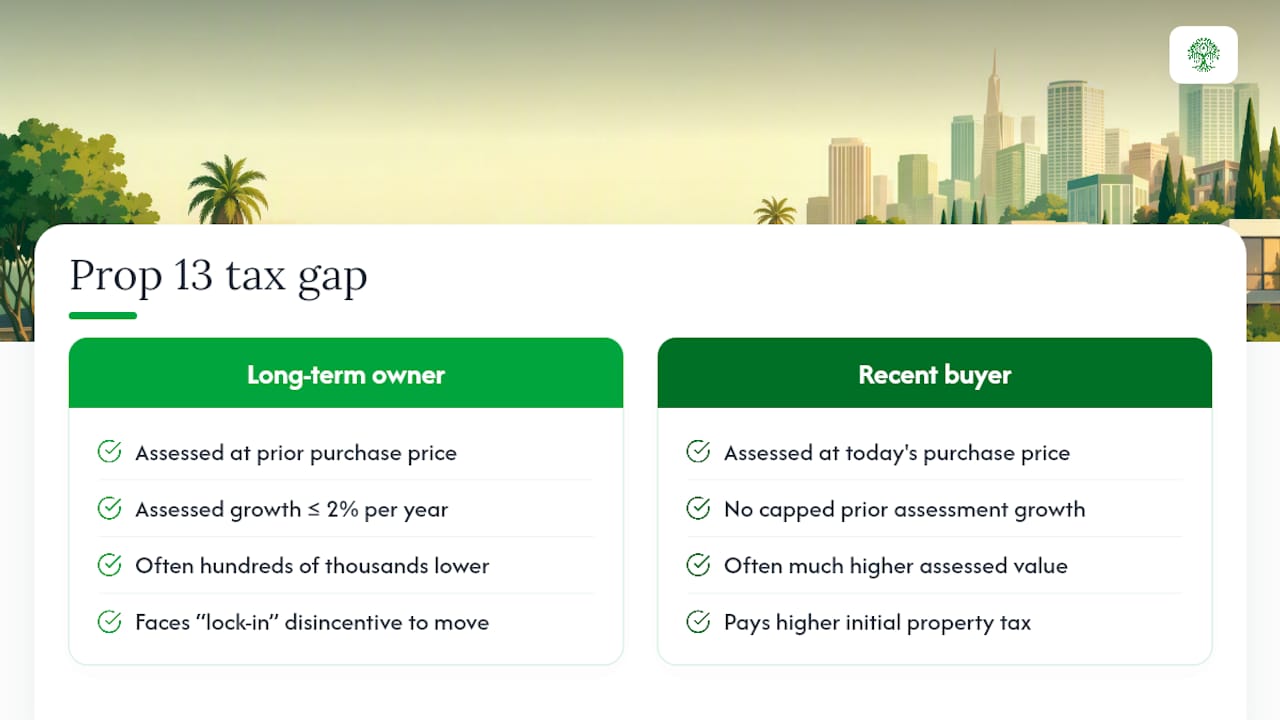
The Lincoln Institute’s research on assessment limits documents how purchase-price-based assessment systems create structural disparities between long-term owners and recent buyers. California’s version is among the most pronounced in the country.
The core dynamic: Under Proposition 13, two identical homes on the same street can carry assessed values that differ by hundreds of thousands of dollars, simply because one owner bought in 1998 and the other bought last year. The long-term owner’s assessed value has grown at most 2% per year, while the recent buyer’s is set at today’s purchase price. The LAO’s analysis of Proposition 13 confirms this produces a “lock-in” effect: long-term owners face a significant tax penalty for selling and buying again, which can discourage them from moving even when their housing needs change.
For buyers, this has two practical consequences. First, your initial tax bill will almost certainly be higher than your neighbor’s if they’ve owned for more than a few years. Second, because Prop 13 made assessed values more stable for long-term owners, local governments shifted toward other revenue sources over time, which is part of why bond measures and parcel taxes have proliferated on California ballots.
The policy trade-off is real. Prop 13 gives homeowners predictability and protection against being taxed out of their homes during price surges. But it also means new buyers absorb a disproportionate share of the local tax base. Factor that into your affordability math before you make an offer. The analysis of why California home prices run high connects this dynamic to broader market pressures worth understanding.
Where to look up your bill, rates, and assessment data
You don’t need to guess at any of these numbers. Official sources give you everything.
- Your county assessor’s website: — Search by APN or owner name to find your current assessed value, base-year value, and any exemptions on file. Every California county has a public parcel search tool.
- Your county tax collector’s website: — Shows your current bill, payment history, due dates, and rate area breakdown. Most counties let you pay online and sign up for e-billing.
- California Board of Equalization (BOE): The BOE’s property tax overview is the authoritative statewide reference for assessment rules, payment schedules, and revenue distribution.
- Legislative Analyst’s Office (LAO): The LAO’s Proposition 13 analysis and property tax primer are the clearest policy-level explanations available.
Pro Tip: When using any online calculator, plug in your county’s actual total rate (not just 1%) for a realistic estimate. The difference between 1% and 1.35% on a $750,000 home is $2,625 per year.
Key Takeaways
California property taxes are set by your purchase price under Proposition 13, capped at 2% annual growth, and billed as the 1% base levy plus local voter-approved charges that vary significantly by district.
| Point | Details |
|---|---|
| Prop 13 sets your base | Your taxable value starts at your purchase price and grows no more than 2% per year. |
| Local charges vary widely | Mello-Roos, bond measures, and parcel taxes can add hundreds or thousands annually beyond the 1% levy. |
| Supplemental bills follow purchase | Expect a prorated supplemental tax bill months after closing; confirm escrow won’t cover it automatically. |
| Appeal window is short | File an assessment appeal by November 30 if your assessed value exceeds your purchase price or comparable sales. |
| Ficustree integrates tax planning | Ficustree’s decision-intelligence platform helps first-time buyers factor property taxes and supplemental bills into affordability before making an offer. |
Ficustree helps you budget for property taxes before you close
Most buyers figure out their true property tax burden after they’ve already signed. Ficustree is built to flip that sequence. The platform’s decision-intelligence tools let you model your actual post-purchase tax bill, including the 1% base levy, local bond rates, and Mello-Roos charges, before you make an offer. You’ll see the full PITI picture, not just the mortgage payment.

When you work with Ficustree, you pay $1,000 at closing plus a 1% commission and keep a rebate of roughly 2% where permitted. The platform is free to use, and you get on-demand showing agents without locking into a traditional agency relationship. For first-time buyers who want to plan their home purchase with clear numbers from the start, that’s a real structural advantage.
Ready to see what your property taxes will actually look like on a specific home? Start your search at ficustree.ai and get the full cost picture before you commit.
This article is general information, not tax or legal advice. Verify current figures and exemption eligibility with your county assessor or a qualified tax professional.
FAQ
Are California property taxes based on purchase price or market value?
Yes, under Proposition 13, your assessed value is set at your purchase price (base-year value) and can increase by no more than 2% per year, regardless of market fluctuations.
How much is property tax on an $800,000 home in California?
At the 1% base rate, your general levy equals 1% of your assessed value. Add local bond measures, parcel taxes, and any Mello-Roos charges for your specific district, and your total annual tax bill varies depending on location.
What is the age-55 property tax rule in California?
Under Proposition 19, homeowners 55 or older can transfer their existing base-year assessed value to a replacement primary residence anywhere in California. If the replacement home costs more than the original, the base-year value is adjusted upward proportionally.
How do you avoid high property taxes in California?
You can’t avoid the reassessment at purchase, but you can reduce your bill by applying for the Homeowners’ Exemption, checking whether you qualify for Prop 19 portability, and appealing your assessed value if it exceeds your purchase price or recent comparable sales.
When is the deadline to appeal a California property tax assessment?
The standard deadline to file an Application for Changed Assessment with your county Assessment Appeals Board is November 30 for the regular assessment roll. Missing this window means waiting until the next assessment cycle.